School of Applied Psychology & Griffith University Centre for Mental Health, Griffith University, Gold Coast Campus, Southport, QLD, 4222, Australia.
School of Applied Psychology & Griffith University Centre for Mental Health, Griffith University, Mount Gravatt Campus, Mount Gravatt, Australia.
Clin Child Fam Psychol Rev. 2023 Sep;26(3):642-664. doi: 10.1007/s10567-023-00439-2. Epub 2023 Jul 5.
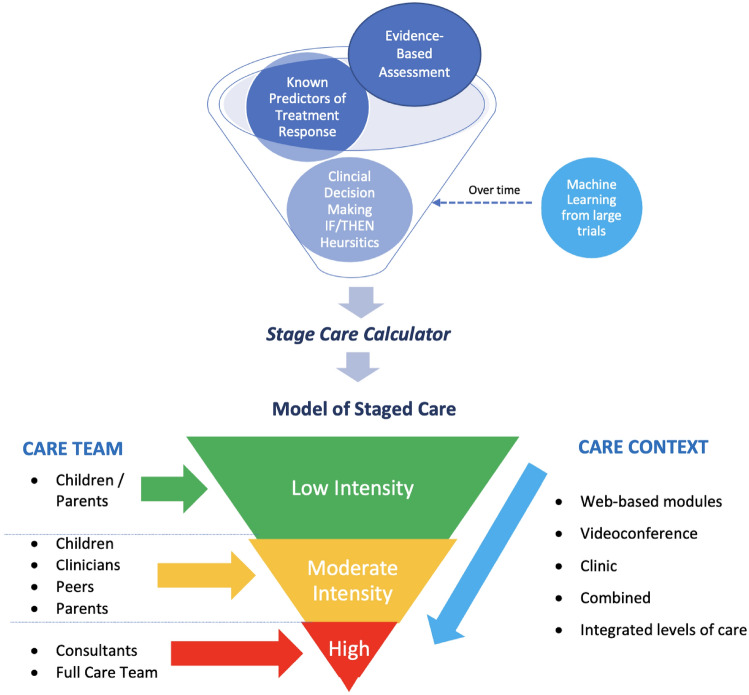
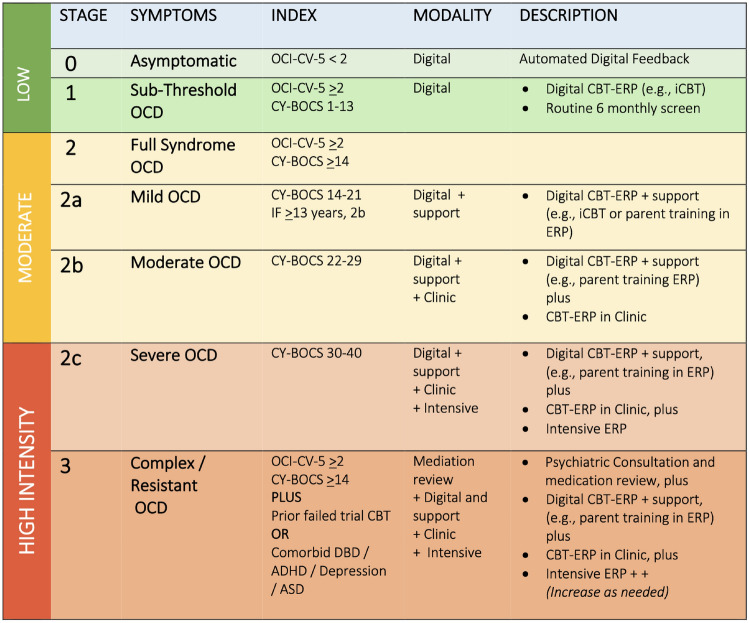
Childhood obsessive-compulsive disorder (OCD) is among the most prevalent and disabling mental health conditions affecting children and adolescents. Although the distress and burden associated with childhood OCD are well documented and empirically supported treatments are available, there remains an unacceptable "treatment gap" and "quality gap" in the provision of services for youth suffering from OCD. The treatment gap represents the large number of children who never receive mental health services for OCD, while the quality gap refers to the children and young people who do access services, but do not receive evidence-based, cognitive behavioural therapy with exposure and response prevention (CBT-ERP). We propose a novel staged-care model of CBT-ERP that aims to improve the treatment access to high-quality CBT-ERP, as well as enhance the treatment outcomes for youth. In staged care, patients receive hierarchically arranged service packages that vary according to the intensity, duration, and mix of treatment options, with provision of care from prevention, early intervention, through to first and second-line treatments. Based on a comprehensive review of the literature on treatment outcomes and predictors of treatments response, we propose a preliminary staging algorithm to determine the level of clinical care, informed by three key determinants: severity of illness, comorbidity, and prior treatment history. The proposed clinical staging model for paediatric OCD prioritises high-quality care for children at all stages and levels of illness, utilising empirically supported CBT-ERP, across multiple modalities, combined with evidence-informed, clinical decision-making heuristics. While informed by evidence, the proposed staging model requires empirical validation before it is ready for prime time.
儿童强迫症(OCD)是儿童和青少年中最常见和最具致残性的心理健康疾病之一。尽管与儿童 OCD 相关的痛苦和负担有充分的记录,并且有经验证的治疗方法可用,但在为患有 OCD 的年轻人提供服务方面,仍然存在不可接受的“治疗差距”和“质量差距”。治疗差距代表了大量从未接受过 OCD 心理健康服务的儿童,而质量差距则是指那些确实获得服务但未接受基于证据的认知行为治疗(CBT-ERP)的儿童和年轻人。我们提出了一种新的 CBT-ERP 分阶段护理模型,旨在改善获得高质量 CBT-ERP 的治疗途径,并提高青年的治疗效果。在分阶段护理中,患者接受按层次排列的服务包,这些服务包根据治疗选择的强度、持续时间和组合而有所不同,从预防、早期干预到一线和二线治疗提供护理。根据对治疗结果和治疗反应预测因素的文献综合回顾,我们提出了一个初步的分期算法,以确定临床护理水平,由三个关键决定因素为依据:疾病严重程度、共病和既往治疗史。拟议的儿童 OCD 临床分期模型优先为所有疾病阶段和严重程度的儿童提供高质量的护理,利用经验证的 CBT-ERP,采用多种模式,结合循证、临床决策启发式。虽然该分期模型是基于证据提出的,但在准备好投入使用之前,需要进行实证验证。