Pharmacovigilance Research Center, Department of Drug Design and Pharmacology, University of Copenhagen, Copenhagen, Denmark.
School of Public Health and Community Medicine, Institute of Medicine, Sahlgrenska Academy, University of Gothenburg, Gothenburg, Sweden.
Front Public Health. 2023 Jun 20;11:1183725. doi: 10.3389/fpubh.2023.1183725. eCollection 2023.
To perform a systematic review on the use of Artificial Intelligence (AI) techniques for predicting COVID-19 hospitalization and mortality using primary and secondary data sources.
Cohort, clinical trials, meta-analyses, and observational studies investigating COVID-19 hospitalization or mortality using artificial intelligence techniques were eligible. Articles without a full text available in the English language were excluded.
Articles recorded in Ovid MEDLINE from 01/01/2019 to 22/08/2022 were screened.
We extracted information on data sources, AI models, and epidemiological aspects of retrieved studies.
A bias assessment of AI models was done using PROBAST.
Patients tested positive for COVID-19.
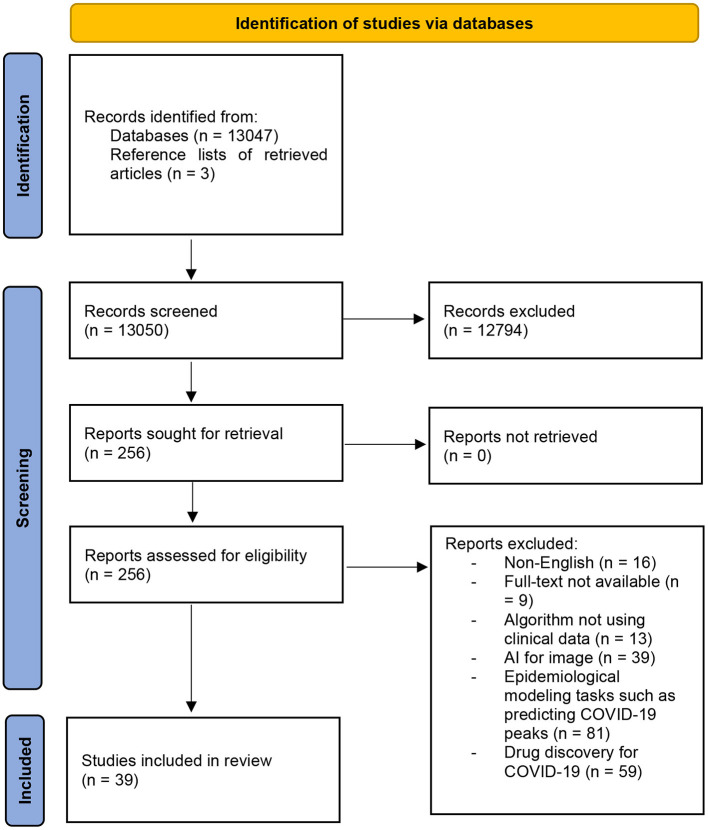
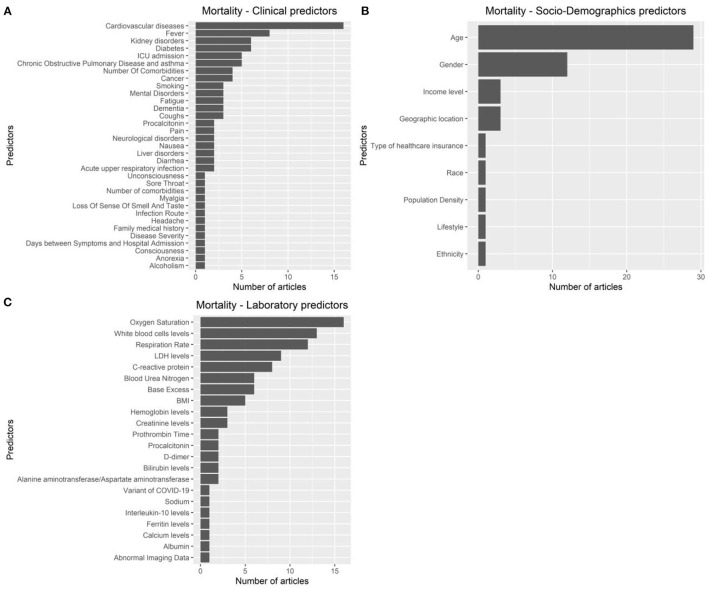
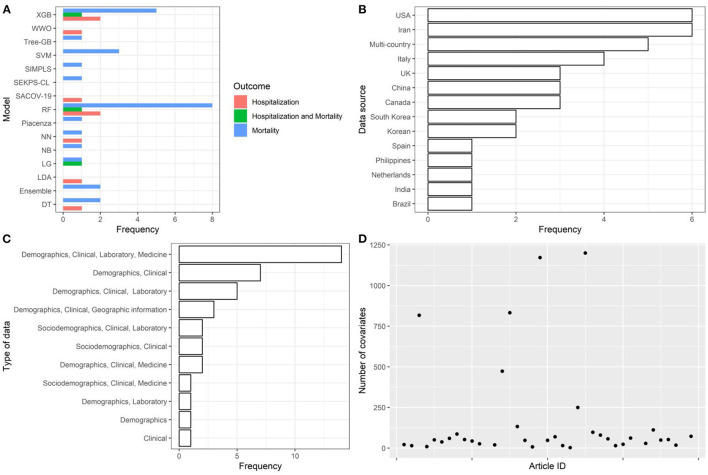
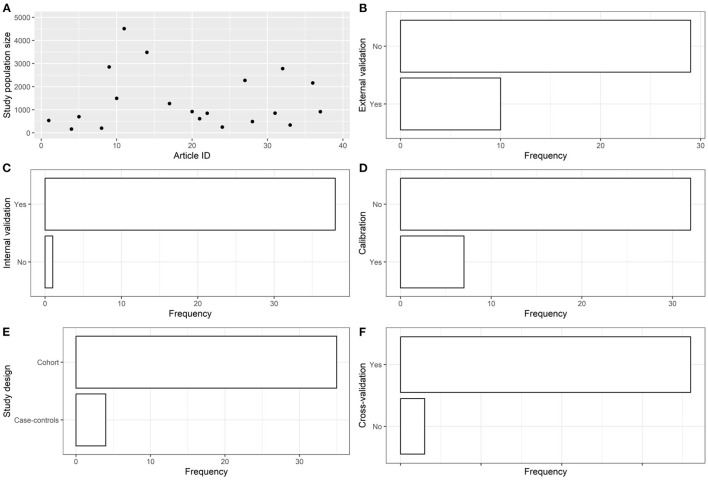
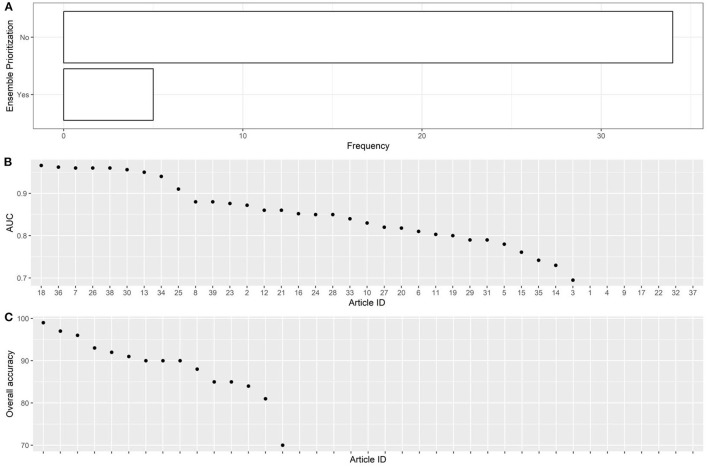
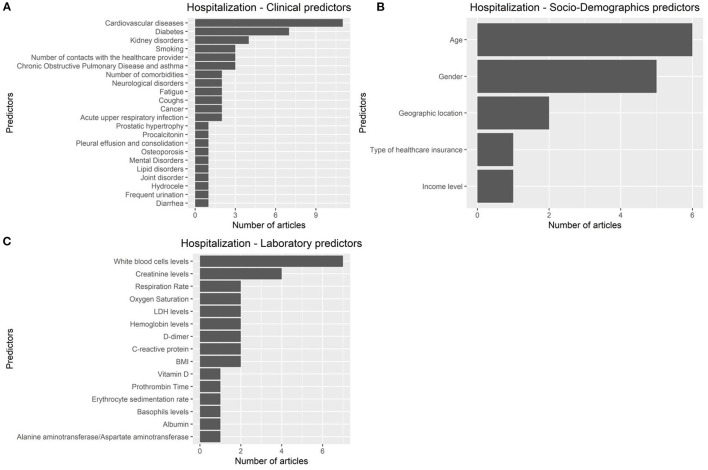
We included 39 studies related to AI-based prediction of hospitalization and death related to COVID-19. The articles were published in the period 2019-2022, and mostly used Random Forest as the model with the best performance. AI models were trained using cohorts of individuals sampled from populations of European and non-European countries, mostly with cohort sample size <5,000. Data collection generally included information on demographics, clinical records, laboratory results, and pharmacological treatments (i.e., high-dimensional datasets). In most studies, the models were internally validated with cross-validation, but the majority of studies lacked external validation and calibration. Covariates were not prioritized using ensemble approaches in most of the studies, however, models still showed moderately good performances with Area under the Receiver operating characteristic Curve (AUC) values >0.7. According to the assessment with PROBAST, all models had a high risk of bias and/or concern regarding applicability.
A broad range of AI techniques have been used to predict COVID-19 hospitalization and mortality. The studies reported good prediction performance of AI models, however, high risk of bias and/or concern regarding applicability were detected.
系统综述使用人工智能 (AI) 技术预测使用初级和二级数据源的 COVID-19 住院和死亡率的情况。
使用人工智能技术对 COVID-19 住院或死亡率进行研究的队列研究、临床试验、荟萃分析和观察性研究。未获得全文且仅提供其他语言版本的文章被排除。
从 2019 年 1 月 1 日至 2022 年 8 月 22 日,在 Ovid MEDLINE 中筛选文章。
我们提取了有关检索研究的数据来源、AI 模型和流行病学方面的信息。
使用 PROBAST 对 AI 模型进行偏倚评估。
COVID-19 检测呈阳性的患者。
我们纳入了 39 项与基于 AI 的 COVID-19 住院和死亡预测相关的研究。这些文章发表于 2019-2022 年期间,主要使用随机森林作为表现最佳的模型。AI 模型使用来自欧洲和非欧洲国家人群的个体样本队列进行训练,样本量大多小于 5000。数据收集通常包括人口统计学信息、临床记录、实验室结果和药物治疗(即高维数据集)。在大多数研究中,模型使用交叉验证进行内部验证,但大多数研究缺乏外部验证和校准。在大多数研究中,协变量未使用集成方法进行优先级排序,但模型仍然表现出中等良好的性能,接收器操作特征曲线下面积(AUC)值>0.7。根据 PROBAST 的评估,所有模型都存在高度偏倚风险和/或适用性问题。
已经使用了广泛的 AI 技术来预测 COVID-19 住院和死亡率。研究报告了 AI 模型的良好预测性能,但发现了高度偏倚风险和/或适用性问题。