Penha Fernando Marcondes, Priotto Bruna Milene, Hennig Francini, Przysiezny Bernardo, Wiethorn Bruno Antunes, Orsi Julia, Nagel Isabelle Beatriz Freccia, Wiggers Brenda, Stuchi Jose Augusto, Lencione Diego, de Souza Prado Paulo Victor, Yamanaka Fernando, Lojudice Fernando, Malerbi Fernando Korn
Fundacao Universidade Regional de Blumenau, Rua Antonio Veiga 140, Blumenau, 89030-903, SC, Brazil.
Botelho Hospital da Visão, Rua 2 de Setembro, 2958, Blumenau, 89052-504, SC, Brazil.
Int J Retina Vitreous. 2023 Jul 10;9(1):41. doi: 10.1186/s40942-023-00477-6.
Diabetic retinopathy (DR) is a leading cause of blindness. Our objective was to evaluate the performance of an artificial intelligence (AI) system integrated into a handheld smartphone-based retinal camera for DR screening using a single retinal image per eye.
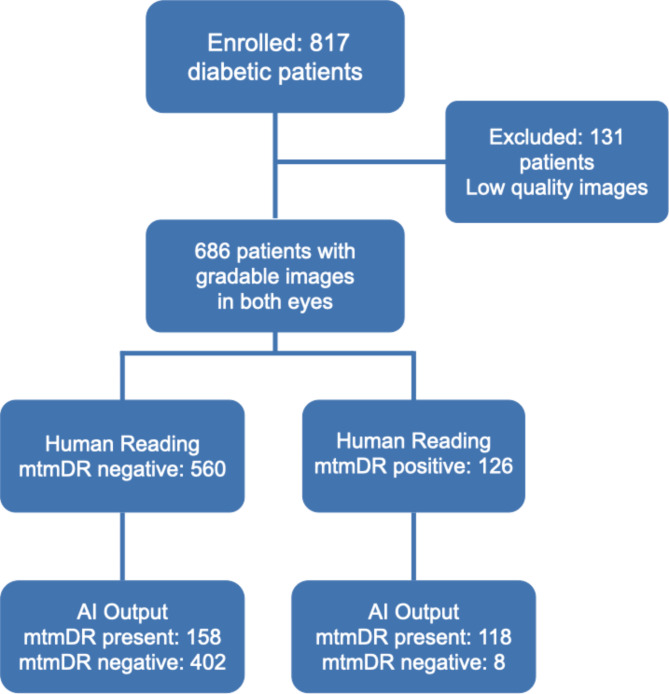
Images were obtained from individuals with diabetes during a mass screening program for DR in Blumenau, Southern Brazil, conducted by trained operators. Automatic analysis was conducted using an AI system (EyerMaps™, Phelcom Technologies LLC, Boston, USA) with one macula-centered, 45-degree field of view retinal image per eye. The results were compared to the assessment by a retinal specialist, considered as the ground truth, using two images per eye. Patients with ungradable images were excluded from the analysis.
A total of 686 individuals (average age 59.2 ± 13.3 years, 56.7% women, diabetes duration 12.1 ± 9.4 years) were included in the analysis. The rates of insulin use, daily glycemic monitoring, and systemic hypertension treatment were 68.4%, 70.2%, and 70.2%, respectively. Although 97.3% of patients were aware of the risk of blindness associated with diabetes, more than half of them underwent their first retinal examination during the event. The majority (82.5%) relied exclusively on the public health system. Approximately 43.4% of individuals were either illiterate or had not completed elementary school. DR classification based on the ground truth was as follows: absent or nonproliferative mild DR 86.9%, more than mild (mtm) DR 13.1%. The AI system achieved sensitivity, specificity, positive predictive value, and negative predictive value percentages (95% CI) for mtmDR as follows: 93.6% (87.8-97.2), 71.7% (67.8-75.4), 42.7% (39.3-46.2), and 98.0% (96.2-98.9), respectively. The area under the ROC curve was 86.4%.
The portable retinal camera combined with AI demonstrated high sensitivity for DR screening using only one image per eye, offering a simpler protocol compared to the traditional approach of two images per eye. Simplifying the DR screening process could enhance adherence rates and overall program coverage.
糖尿病视网膜病变(DR)是导致失明的主要原因。我们的目标是评估集成在基于智能手机的手持式视网膜相机中的人工智能(AI)系统使用每只眼睛的单张视网膜图像进行DR筛查的性能。
图像由经过培训的操作人员在巴西南部布卢梅瑙进行的DR大规模筛查项目中从糖尿病患者处获取。使用人工智能系统(EyerMaps™,美国波士顿的Phelcom Technologies LLC)对每只眼睛一张以黄斑为中心、45度视野的视网膜图像进行自动分析。将结果与视网膜专家的评估进行比较,视网膜专家的评估被视为基本事实,每只眼睛使用两张图像。图像无法分级的患者被排除在分析之外。
共有686人(平均年龄59.2±13.3岁,女性占56.7%,糖尿病病程12.1±9.4年)纳入分析。胰岛素使用、每日血糖监测和系统性高血压治疗的比例分别为68.4%、70.2%和70.2%。尽管97.3%的患者知晓糖尿病相关失明风险,但其中一半以上在此次活动中首次接受视网膜检查。大多数人(82.5%)完全依赖公共卫生系统。约43.4%的人是文盲或未完成小学教育。基于基本事实的DR分类如下:无或非增殖性轻度DR占86.9%,重度(mtm)DR占13.1%。人工智能系统对mtmDR的灵敏度、特异度、阳性预测值和阴性预测值百分比(95%CI)分别为:93.6%(87.8 - 97.2)、71.7%(67.8 - 75.4)、42.7%(39.3 - 46.2)和98.0%(96.2 - 98.9)。ROC曲线下面积为86.4%。
便携式视网膜相机与人工智能相结合,仅使用每只眼睛一张图像进行DR筛查时显示出高灵敏度,与传统的每只眼睛两张图像的方法相比,提供了更简单的方案。简化DR筛查过程可以提高依从率和整体项目覆盖率。