Division of Vector-Borne Diseases, National Center for Emerging and Zoonotic Infectious Diseases, Centers for Disease Control and Prevention, Fort Collins, CO, 80521, USA.
Parasit Vectors. 2023 Jul 10;16(1):228. doi: 10.1186/s13071-023-05845-7.
Numerous bioassay methods have been used to test the efficacy of repellents for ticks, but the comparability of results across different methods has only been evaluated in a single study. Of particular interest are comparisons between bioassays that use artificial containers (in vitro) with those conducted on a human subject (in vivo) for efficacy testing of new potential unregistered active ingredients, which most commonly use in vitro methods.
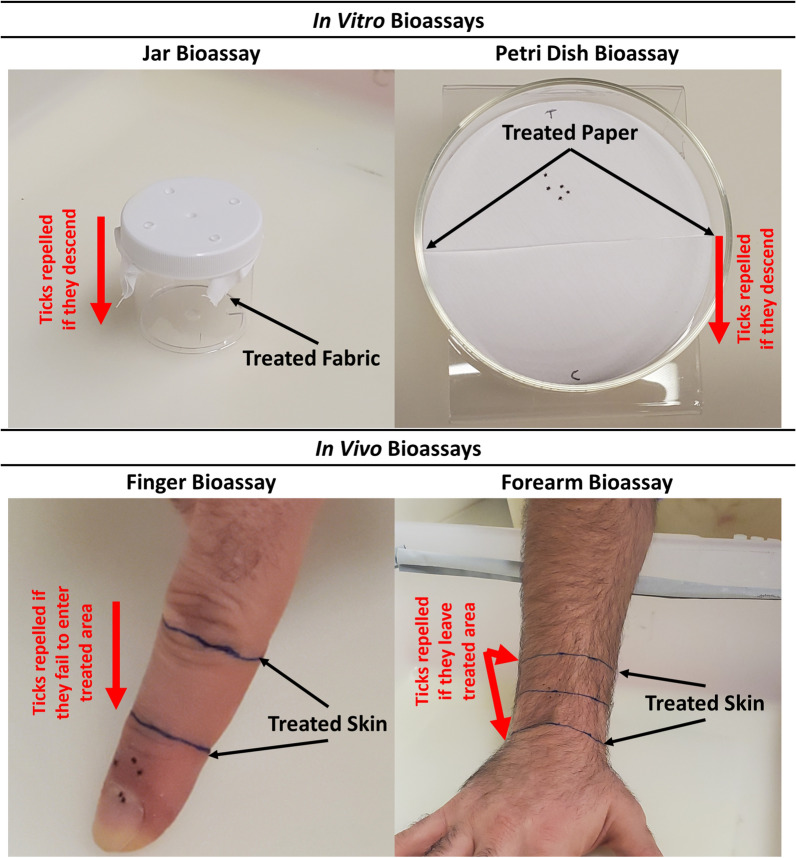
We compared four different bioassay methods and evaluated three ingredients (DEET [N,N-Diethyl-meta-toluamide], peppermint oil and rosemary oil) and a negative control (ethanol) over a 6-h period. Two of the methods tested were in vivo bioassay methods in which the active ingredient was applied to human skin (finger and forearm bioassays), and the other two methods were in vitro methods using artificial containers (jar and petri dish bioassays). All four bioassays were conducted using Ixodes scapularis nymphs. We compared the results using nymphs from two different tick colonies that were derived from I. scapularis collected in the US states of Connecticut and Rhode Island (northern origin) and Oklahoma (southern origin), expecting that ticks of different origin would display differences in host-seeking behavior.
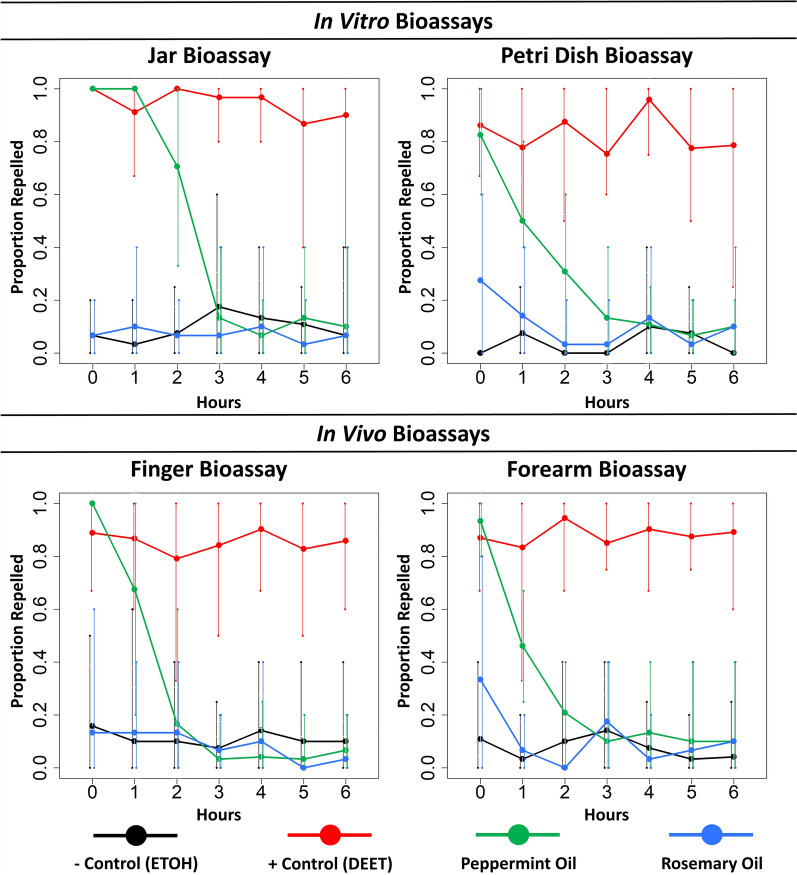
The results between bioassay methods did not differ significantly, even when comparing those that provide the stimulus of human skin with those that do not. We also found that tick colony source can impact the outcome of repellency bioassays due to differences in movement speed; behavioral differences were incorporated into the assay screening. DEET effectively repelled nymphs for the full 6-h duration of the study. Peppermint oil showed a similar repellent efficacy to DEET during the first hour, but it decreased sharply afterwards. Rosemary oil did not effectively repel nymphs across any of the time points.
The repellency results did not differ significantly between the four bioassay methods tested. The results also highlight the need to consider the geographic origin of ticks used in repellency bioassays in addition to species and life stage. Finally, our results indicate a limited repellent efficacy of the two essential oils tested, which highlights the need for further studies on the duration of repellency for similar botanically derived active ingredients and for evaluation of formulated products.
已经有许多生物测定方法被用于测试驱避剂对蜱的效果,但不同方法之间的结果可比性仅在一项研究中进行了评估。特别感兴趣的是,使用人工容器(体外)的生物测定方法与在人体上进行的(体内)生物测定方法之间的比较,用于测试新的潜在未注册的活性成分的功效,这些成分最常用于体外方法。
我们比较了四种不同的生物测定方法,并在 6 小时的时间内评估了三种成分(N,N-二乙基间甲苯酰胺[DEET]、薄荷油和迷迭香油)和一种阴性对照(乙醇)。两种测试方法都是将活性成分应用于人体皮肤的体内生物测定方法(手指和前臂生物测定),另外两种方法是使用人工容器的体外方法(罐和培养皿生物测定)。所有四种生物测定均使用硬蜱若虫进行。我们比较了来自两个不同蜱虫种群的若虫的结果,这些种群是从美国康涅狄格州和罗得岛州(北部起源)以及俄克拉荷马州(南部起源)收集的硬蜱中分离出来的,预计不同起源的蜱虫在寻找宿主的行为上会有所不同。
即使将提供人体皮肤刺激的生物测定方法与不提供刺激的方法进行比较,生物测定方法之间的结果也没有显著差异。我们还发现,由于运动速度的差异,蜱虫种群的来源会影响驱避生物测定的结果;行为差异被纳入了测定筛选中。DEET 在研究的整个 6 小时内有效地驱避了若虫。薄荷油在最初的 1 小时内表现出与 DEET 相似的驱避效果,但随后急剧下降。迷迭香油在任何时间点都不能有效地驱避若虫。
测试的四种生物测定方法之间的驱避效果没有显著差异。结果还强调了在驱避生物测定中,除了物种和生命阶段外,还需要考虑使用的蜱虫的地理起源。最后,我们的结果表明,测试的两种精油的驱避效果有限,这突出表明需要进一步研究类似植物源活性成分的驱避持续时间,并评估配方产品。