Department of Artificial Intelligence Convergence, Chonnam National University, Gwangju, 61186, South Korea.
Department of Nuclear Medicine, Chonnam National University Hospital, Gwangju, 61469, South Korea.
Sci Rep. 2023 Jul 11;13(1):11243. doi: 10.1038/s41598-023-37500-7.
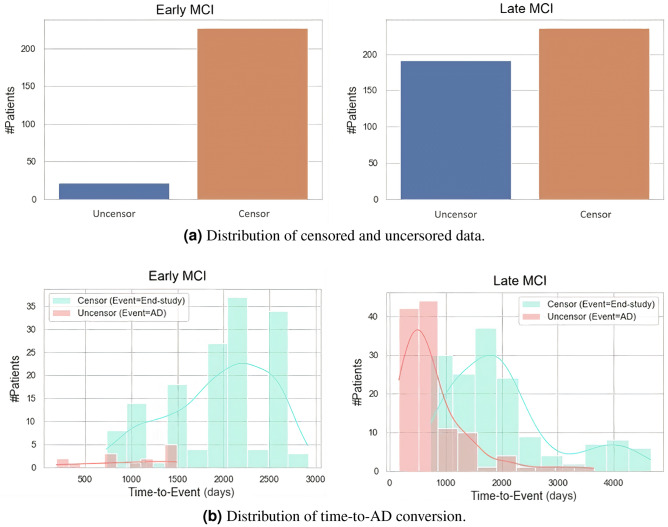
Early identification and treatment of moderate cognitive impairment (MCI) can halt or postpone Alzheimer's disease (AD) and preserve brain function. For prompt diagnosis and AD reversal, precise prediction in the early and late phases of MCI is essential. This research investigates multimodal framework-based multitask learning in the following situations: (1) Differentiating early mild cognitive impairment (eMCI) from late MCI and (2) predicting when an MCI patient would acquire AD. Clinical data and two radiomics features on three brain areas deduced from magnetic resonance imaging were investigated (MRI). We proposed an attention-based module, Stack Polynomial Attention Network (SPAN), to firmly encode clinical and radiomics data input characteristics for successful representation from a small dataset. To improve multimodal data learning, we computed a potent factor using adaptive exponential decay (AED). We used experiments from the Alzheimer's Disease Neuroimaging Initiative (ADNI) cohort study, which included 249 eMCI and 427 lMCI participants at baseline visits. The proposed multimodal strategy yielded the best c-index score in time prediction of MCI to AD conversion (0.85) and the best accuracy in MCI-stage categorization ([Formula: see text]). Moreover, our performance was equivalent to that of contemporary research.
早期识别和治疗中度认知障碍 (MCI) 可以阻止或延缓阿尔茨海默病 (AD) 的发生并保护大脑功能。为了进行及时诊断和 AD 逆转,在 MCI 的早期和晚期进行精确预测至关重要。本研究调查了基于多模态框架的多任务学习在以下情况下的应用:(1) 将早期轻度认知障碍 (eMCI) 与晚期 MCI 区分开来,(2) 预测 MCI 患者何时会患上 AD。我们使用临床数据和从磁共振成像 (MRI) 推导出的三个脑区的两个放射组学特征进行了研究。我们提出了一种基于注意力的模块,Stack Polynomial Attention Network (SPAN),以从较小的数据集成功地表示临床和放射组学数据输入特征。为了提高多模态数据学习的效果,我们使用自适应指数衰减 (AED) 计算了一个有效因子。我们使用了来自阿尔茨海默病神经影像学倡议 (ADNI) 队列研究的实验数据,其中包括 249 名 eMCI 和 427 名 lMCI 参与者在基线访问时的数据。所提出的多模态策略在 MCI 向 AD 转化的时间预测中获得了最佳的 c-index 评分 (0.85),在 MCI 阶段分类方面的准确率最高 ([公式:见文本])。此外,我们的表现与当代研究相当。