Wen Lulu, Yan Chuming, Zheng Wancheng, Li Yi, Wang Yuhui, Qu Miao
Neurology Department, Xuan Wu Hospital Capital Medical University, Beijing, People's Republic of China.
Neurology Department, Third Affiliated Hospital, Beijing University of Chinese Medicine, Beijing, People's Republic of China.
Neuropsychiatr Dis Treat. 2023 Jul 6;19:1555-1564. doi: 10.2147/NDT.S415141. eCollection 2023.
Post-stroke depression (PSD) is one of the most common neuropsychiatric complications after stroke. However, the underlying mechanisms of PSD remain ambiguous, and no objective diagnosis tool is available to diagnose PSD. Previous metabolomic studies on PSD included patients with ischemic and hemorrhagic stroke indiscriminately, which is not conducive to elucidating and predicting the occurrence of PSD. The aim of this study is to elucidate the pathogenesis of PSD and provide potential diagnostic markers for PSD in ischemic stroke patients.
In total, 51 ischemic stroke patients at 2 weeks were included in this study. Those with depressive symptoms were assigned to the PSD group, while the others were assigned to the non-PSD group. Plasma metabolomics based on liquid chromatography-mass spectrometry (LC-MS) was performed to explore the differential plasma metabolites between the PSD and non-PSD groups.
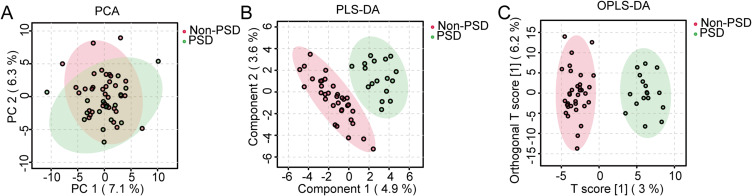
Principal component analysis (PCA), partial least squares discriminant analysis (PLS-DA) and orthogonal partial least-squares discriminant analysis (OPLS-DA) showed significant metabolic alterations between PSD patients and non-PSD patients. In total, 41 differential metabolites were screened out, mainly including phosphatidylcholines (PCs), L-carnitine and acyl carnitines, succinic acid, pyruvic acid and L-lactic acid. Metabolite-related pathway analysis revealed that alanine, aspartate and glutamate metabolism, glycerophospholipid metabolism and the citrate cycle (TCA cycle) may contribute to the pathogenesis of PSD. A panel of three signature metabolites [PC(22:5(7Z,10Z,13Z,16Z,19Z)/15:0), LysoPA(18:1(9Z)/0:0) and 1,5-anhydrosorbitol] was determined as potential biomarkers for PSD in ischemic stroke patients.
These findings are conducive to providing new insights into the pathogenesis of PSD and developing objective diagnostic tools for PSD in ischemic stroke patients.
卒中后抑郁(PSD)是卒中后最常见的神经精神并发症之一。然而,PSD的潜在机制仍不明确,且尚无客观的诊断工具来诊断PSD。既往关于PSD的代谢组学研究不加区分地纳入了缺血性和出血性卒中患者,这不利于阐明和预测PSD的发生。本研究旨在阐明PSD的发病机制,并为缺血性卒中患者的PSD提供潜在的诊断标志物。
本研究共纳入51例发病2周的缺血性卒中患者。有抑郁症状的患者被分配到PSD组,其余患者被分配到非PSD组。采用基于液相色谱-质谱联用(LC-MS)的血浆代谢组学技术,探索PSD组和非PSD组之间的差异血浆代谢物。
主成分分析(PCA)、偏最小二乘判别分析(PLS-DA)和正交偏最小二乘判别分析(OPLS-DA)显示,PSD患者和非PSD患者之间存在显著的代谢改变。共筛选出41种差异代谢物,主要包括磷脂酰胆碱(PCs)、左旋肉碱和酰基肉碱、琥珀酸、丙酮酸和L-乳酸。代谢物相关通路分析显示,丙氨酸、天冬氨酸和谷氨酸代谢、甘油磷脂代谢以及柠檬酸循环(TCA循环)可能与PSD的发病机制有关。确定了一组由三种特征性代谢物[PC(22:5(7Z,10Z,13Z,16Z,19Z)/15:0)、溶血磷脂酸(18:1(9Z)/0:0)和1,5-脱水山梨醇]组成的标志物,作为缺血性卒中患者PSD的潜在生物标志物。
这些发现有助于为PSD的发病机制提供新的见解,并为缺血性卒中患者的PSD开发客观的诊断工具。