Institute of Ecopreneurship, FHNW University of Applied Sciences and Arts Northwestern Switzerland, Muttenz, Switzerland.
Appl Microbiol Biotechnol. 2023 Sep;107(17):5545-5554. doi: 10.1007/s00253-023-12677-z. Epub 2023 Jul 12.
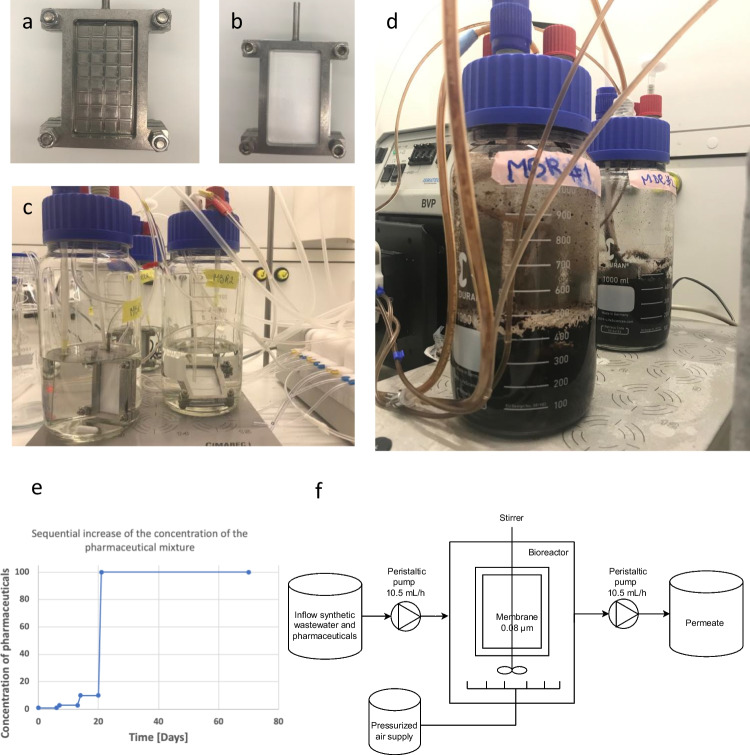
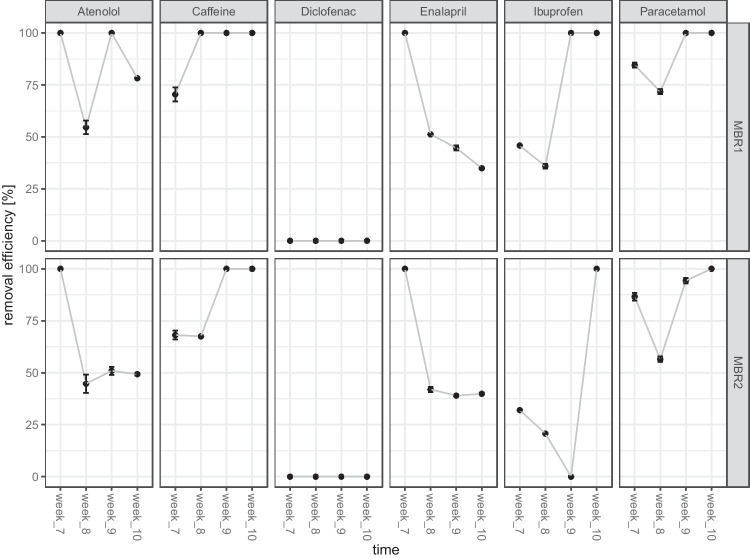
Pharmaceuticals are of concern to our planet and health as they can accumulate in the environment. The impact of these biologically active compounds on ecosystems is hard to predict, and information on their biodegradation is necessary to establish sound risk assessment. Microbial communities are promising candidates for the biodegradation of pharmaceuticals such as ibuprofen, but little is known yet about their degradation capacity of multiple micropollutants at higher concentrations (100 mg/L). In this work, microbial communities were cultivated in lab-scale membrane bioreactors (MBRs) exposed to increasing concentrations of a mixture of six micropollutants (ibuprofen, diclofenac, enalapril, caffeine, atenolol, paracetamol). Key players of biodegradation were identified using a combinatorial approach of 16S rRNA sequencing and analytics. Microbial community structure changed with increasing pharmaceutical intake (from 1 to 100 mg/L) and reached a steady-state during incubation for 7 weeks on 100 mg/L. HPLC analysis revealed a fluctuating but significant degradation (30-100%) of five pollutants (caffeine, paracetamol, ibuprofen, atenolol, enalapril) by an established and stable microbial community mainly composed of Achromobacter, Cupriavidus, Pseudomonas and Leucobacter. By using the microbial community from MBR1 as inoculum for further batch culture experiments on single micropollutants (400 mg/L substrate, respectively), different active microbial consortia were obtained for each single micropollutant. Microbial genera potentially responsible for degradation of the respective micropollutant were identified, i.e. Pseudomonas sp. and Sphingobacterium sp. for ibuprofen, caffeine and paracetamol, Sphingomonas sp. for atenolol and Klebsiella sp. for enalapril. Our study demonstrates the feasibility of cultivating stable microbial communities capable of degrading simultaneously a mixture of highly concentrated pharmaceuticals in lab-scale MBRs and the identification of microbial genera potentially responsible for the degradation of specific pollutants. KEY POINTS: • Multiple pharmaceuticals were removed by stable microbial communities. • Microbial key players of five main pharmaceuticals were identified.
药品对我们的地球和健康构成关注,因为它们会在环境中积累。这些具有生物活性的化合物对生态系统的影响难以预测,因此需要了解它们的生物降解信息,以建立健全的风险评估。微生物群落是生物降解布洛芬等药物的有前途的候选者,但对于它们在较高浓度(100mg/L)下对多种微污染物的降解能力知之甚少。在这项工作中,微生物群落在实验室规模的膜生物反应器(MBR)中进行培养,这些 MBR 中暴露于浓度逐渐增加的六种微污染物(布洛芬、双氯芬酸、依那普利、咖啡因、阿替洛尔、对乙酰氨基酚)混合物中。使用组合的 16S rRNA 测序和分析方法,确定了生物降解的关键参与者。随着药物摄入量的增加(从 1mg/L 增加到 100mg/L),微生物群落结构发生了变化,并且在 100mg/L 下孵育 7 周后达到稳定状态。HPLC 分析显示,在由 Achromobacter、Cupriavidus、Pseudomonas 和 Leucobacter 组成的稳定微生物群落的作用下,五种污染物(咖啡因、对乙酰氨基酚、布洛芬、阿替洛尔、依那普利)的降解呈现波动但显著的趋势(30-100%)。使用 MBR1 中的微生物群落作为接种物,在单微污染物(分别为 400mg/L 底物)的进一步批量培养实验中,获得了针对每种单微污染物的不同活性微生物群落。确定了潜在负责降解各自微污染物的微生物属,即 Pseudomonas sp. 和 Sphingobacterium sp. 负责降解布洛芬、咖啡因和对乙酰氨基酚,Sphingomonas sp. 负责降解阿替洛尔,Klebsiella sp. 负责降解依那普利。我们的研究表明,在实验室规模的 MBR 中培养能够同时降解高浓度药物混合物的稳定微生物群落是可行的,并确定了潜在负责特定污染物降解的微生物属。关键点:
多种药物被稳定的微生物群落去除。
鉴定出五种主要药物的微生物关键参与者。