Guo Jun, Li Kai, Lin Yajun, Liu Yinghua
The Key Laboratory of Geriatrics, Beijing Institute of Geriatrics, Institute of Geriatric Medicine, Chinese Academy of Medical Sciences, Beijing Hospital/National Center of Gerontology of National Health Commission, Beijing, China.
General Surgery Department, The First People's Hospital of Tai'an City, Tai'an, China.
Front Nutr. 2023 Jun 28;10:1202378. doi: 10.3389/fnut.2023.1202378. eCollection 2023.
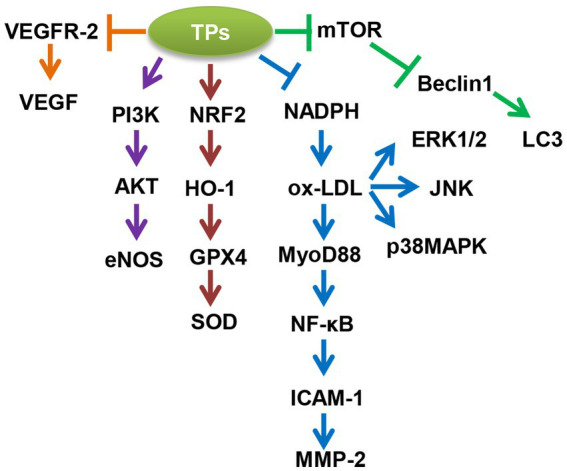
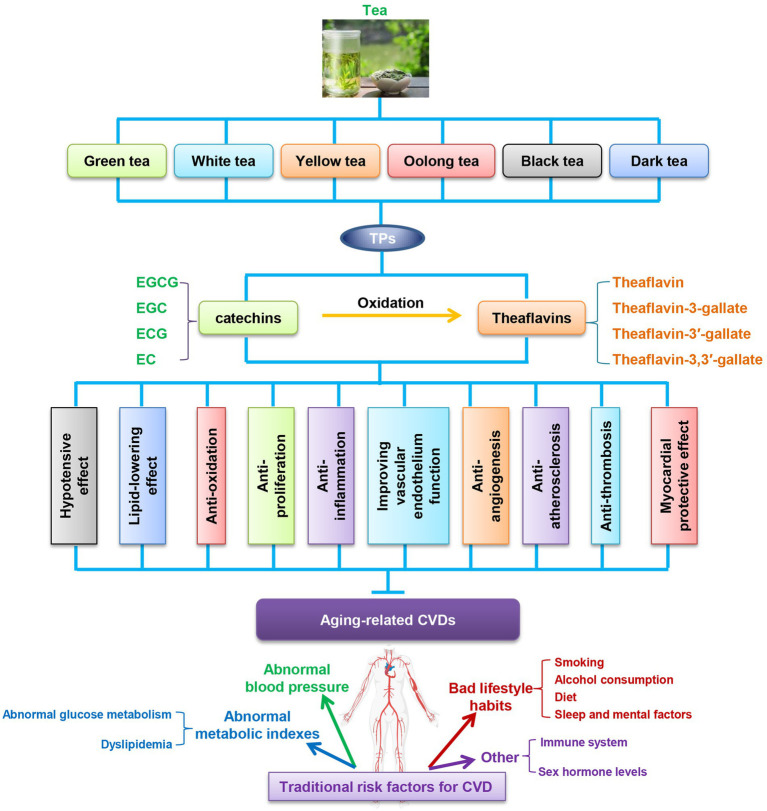
Aging is the most important factor contributing to cardiovascular diseases (CVDs), and the incidence and severity of cardiovascular events tend to increase with age. Currently, CVD is the leading cause of death in the global population. In-depth analysis of the mechanisms and interventions of cardiovascular aging and related diseases is an important basis for achieving healthy aging. Tea polyphenols (TPs) are the general term for the polyhydroxy compounds contained in tea leaves, whose main components are catechins, flavonoids, flavonols, anthocyanins, phenolic acids, condensed phenolic acids and polymeric phenols. Among them, catechins are the main components of TPs. In this article, we provide a detailed review of the classification and composition of teas, as well as an overview of the causes of aging-related CVDs. Then, we focus on ten aspects of the effects of TPs, including anti-hypertension, lipid-lowering effects, anti-oxidation, anti-inflammation, anti-proliferation, anti-angiogenesis, anti-atherosclerosis, recovery of endothelial function, anti-thrombosis, myocardial protective effect, to improve CVDs and the detailed molecular mechanisms.
衰老为心血管疾病(CVDs)的最重要促成因素,心血管事件的发生率和严重程度往往随年龄增长而增加。目前,CVD是全球人口的首要死因。深入分析心血管衰老及相关疾病的机制与干预措施是实现健康衰老的重要基础。茶多酚(TPs)是茶叶中所含多羟基化合物的统称,其主要成分有儿茶素、黄酮类、黄酮醇、花青素、酚酸、缩合酚酸和聚合酚。其中,儿茶素是TPs的主要成分。在本文中,我们详细综述了茶叶的分类和成分,以及与衰老相关的CVDs的病因概述。然后,我们聚焦于茶多酚作用的十个方面,包括抗高血压、降脂作用、抗氧化、抗炎、抗增殖、抗血管生成、抗动脉粥样硬化、内皮功能恢复、抗血栓形成、心肌保护作用,以改善心血管疾病及其详细分子机制。