Ahmed Iftekhar, Roknuzzaman A S M, Islam Md Rabiul
Department of Sociology, Eden Women's College National University Bangladesh Gazipur Bangladesh.
Department of Pharmacy University of Asia Pacific Dhaka Bangladesh.
Health Sci Rep. 2023 Jul 11;6(7):e1423. doi: 10.1002/hsr2.1423. eCollection 2023 Jul.
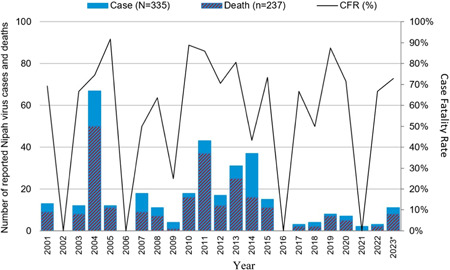
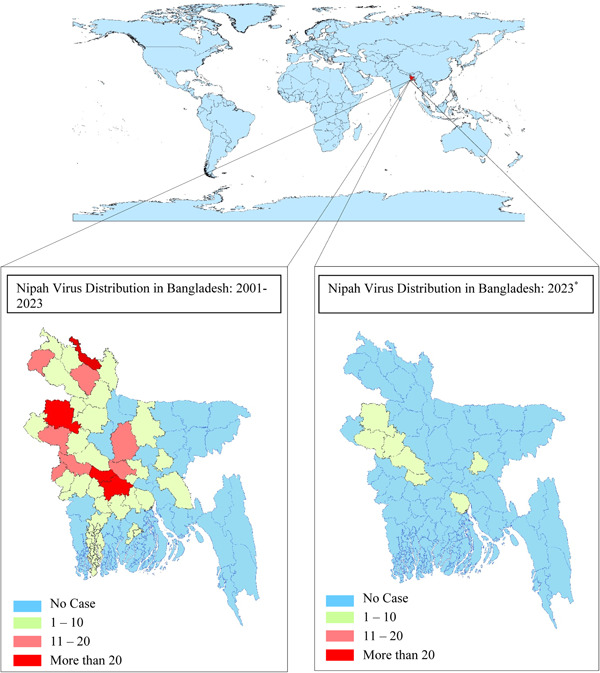
The Nipah virus is a zoonotic infection that can potentially be transmitted from person to person as well as through ingesting contaminated food. It has a high fatality rate, and no treatment or cure at present. Several nations in South Asia have reported Nipah virus outbreaks occurred during a particular season of the year. Since it was first found in Bangladesh in 2001, there have been a total of 335 people infected with it, and 237 of those people have passed away as a result of their infection. With increased public awareness, community engagement, and preventative measures, this potentially fatal virus has been suppressed. Yet, following a pandemic and a considerable increase in the health burden, the transmission rate continuously increased over a few years, indicating that there is a growing possibility to become a global public health concern. Without effective vaccines and reliable treatment options, its capacity for human-to-human transmission and potential to spread throughout the area could result in a disastrous public health emergency worldwide.
尼帕病毒是一种人畜共患感染病,有可能在人与人之间传播,也可通过食用受污染食物传播。它的致死率很高,目前尚无治疗方法或治愈手段。南亚几个国家报告称,在一年中的特定季节发生了尼帕病毒疫情。自2001年在孟加拉国首次发现以来,总共有335人感染了该病毒,其中237人因感染而死亡。随着公众意识的提高、社区参与和预防措施的实施,这种潜在的致命病毒已得到控制。然而,在一场大流行以及健康负担大幅增加之后,几年间传播率持续上升,这表明它越来越有可能成为全球公共卫生问题。如果没有有效的疫苗和可靠的治疗方案,其人际传播能力以及在整个地区传播的可能性可能会导致全球范围内灾难性的公共卫生紧急事件。