Vovk Hanna, Karnpakdee Kwankao, Ludwig Roland, Nosenko Tamara
Educational and Scientific Institute of Food Technology, Department of Fats, Perfumery and Cosmetic Products Technology, National University of Food Technologies, Kyiv, Volodymyrska street 68, 01601 Kyiv, Ukraine.
Institute of Food Technology, Department of Food Science and Technology, University of Natural Resources and Life Sciences (BOKU), Vienna, Muthgasse 18, 1190 Vienna, Austria.
Food Technol Biotechnol. 2023 Jun;61(2):160-178. doi: 10.17113/ftb.61.02.23.7896.
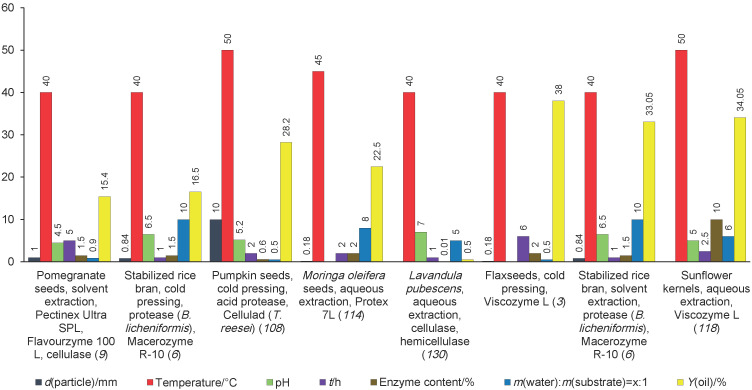
Oil from oilseeds can be extracted by mechanical extraction (pressing), aqueous extraction, or by extraction with organic solvents. Although solvent extraction is the most efficient method, organic solvents are a potential hazard to the life and health for workers as well as to the environment, when solvent vapours are released and act as air pollutant with a high ozone-forming potential. Pressing is safer, environmentally friendly, and it preserves valuable natural components in the resulting oils. The problems associated with pressing are the high energy consumption and the lower yield of oil extraction, because the applied mechanical force does not completely destroy the structural cell components storing the oil. In seed cells, the oil is contained in the form of lipid bodies (oleosomes) that are surrounded by a phospholipid monolayer with a protein layer on the surface. These lipid bodies are further protected by the seed cell walls consisting mainly of polysaccharides such as pectins, hemicelluloses and cellulose, but also of glycoproteins. The use of hydrolases to degrade these barriers is a promising pretreatment strategy to support mechanical extraction and improve the oil yield. It is advisable to use a combination of enzymes with different activities when considering the multicompartment and multicomponent structure of oilseed cells. This article gives an overview of the microstructure and composition of oilseed cells, reviews enzymes capable of destroying oil containing cell compartments, and summarizes the main parameters of enzymatic treatment procedures, such as the composition of the enzyme cocktail, the amount of enzyme and water used, temperature, pH, and the duration of the treatment. Finally, it analyzes the efficiency of proteolytic, cellulolytic and pectolytic enzyme pretreatment to increase the yield of mechanically extracted oil from various types of vegetable raw materials with the main focus on oilseeds.
油籽中的油可以通过机械提取(压榨)、水提取或用有机溶剂提取。虽然溶剂提取是最有效的方法,但当溶剂蒸气释放并作为具有高臭氧形成潜力的空气污染物时,有机溶剂对工人的生命和健康以及环境都是潜在的危害。压榨更安全、环保,并且能保留所得油脂中有价值的天然成分。与压榨相关的问题是高能耗和较低的油提取率,因为施加的机械力不能完全破坏储存油的结构细胞成分。在种子细胞中,油以脂质体(油体)的形式存在,其被表面有蛋白质层的磷脂单分子层包围。这些脂质体进一步受到主要由多糖(如果胶、半纤维素和纤维素)以及糖蛋白组成的种子细胞壁的保护。使用水解酶降解这些屏障是一种有前景的预处理策略,以支持机械提取并提高油产量。考虑到油籽细胞的多隔室和多组分结构,建议使用具有不同活性的酶的组合。本文概述了油籽细胞的微观结构和组成,综述了能够破坏含油细胞隔室的酶,并总结了酶处理程序的主要参数,如酶混合物的组成、酶和水的用量、温度、pH值以及处理持续时间。最后,分析了蛋白水解酶、纤维素分解酶和果胶分解酶预处理对提高从各种类型蔬菜原料(主要是油籽)中机械提取油的产量的效率。