Department of Brain and Cognitive Engineering, Korea University, Seoul, 02841, Republic of Korea.
Department of Artificial Intelligence, Korea University, Seoul, 02841, Republic of Korea.
Sci Rep. 2023 Jul 19;13(1):11664. doi: 10.1038/s41598-023-38240-4.
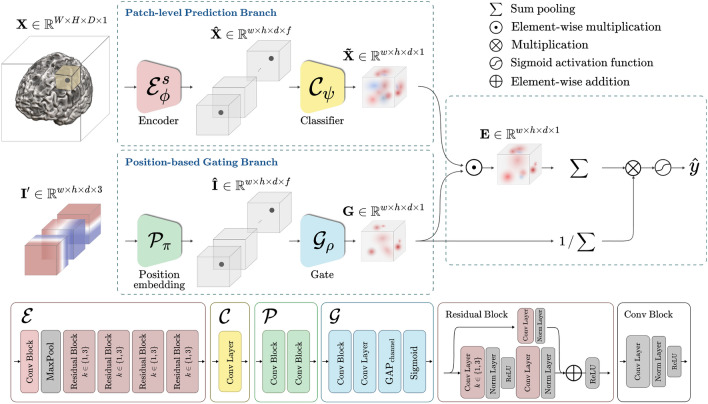
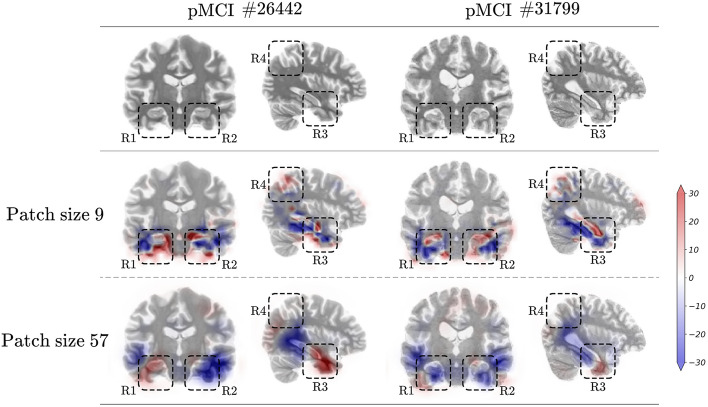
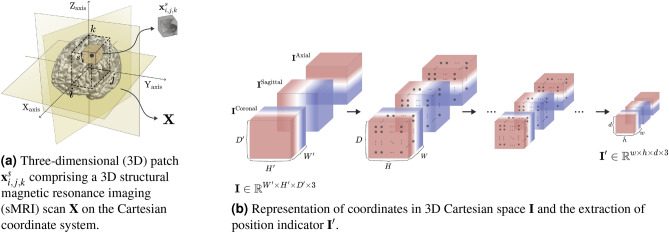
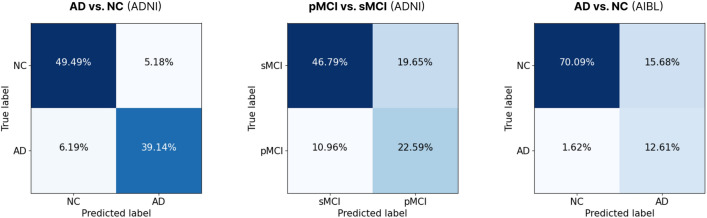
The identification of Alzheimer's disease (AD) using structural magnetic resonance imaging (sMRI) has been studied based on the subtle morphological changes in the brain. One of the typical approaches is a deep learning-based patch-level feature representation. For this approach, however, the predetermined patches before learning the diagnostic model can limit classification performance. To mitigate this problem, we propose the BrainBagNet with a position-based gate (PG), which applies position information of brain images represented through the 3D coordinates. Our proposed method represents the patch-level class evidence based on both MR scan and position information for image-level prediction. To validate the effectiveness of our proposed framework, we conducted comprehensive experiments comparing it with state-of-the-art methods, utilizing two publicly available datasets: the Alzheimer's Disease Neuroimaging Initiative (ADNI) and the Australian Imaging, Biomarkers and Lifestyle (AIBL) dataset. Furthermore, our experimental results demonstrate that our proposed method outperforms the existing competing methods in terms of classification performance for both AD diagnosis and mild cognitive impairment conversion prediction tasks. In addition, we performed various analyses of the results from diverse perspectives to obtain further insights into the underlying mechanisms and strengths of our proposed framework. Based on the results of our experiments, we demonstrate that our proposed framework has the potential to advance deep-learning-based patch-level feature representation studies for AD diagnosis and MCI conversion prediction. In addition, our method provides valuable insights, such as interpretability, and the ability to capture subtle changes, into the underlying pathological processes of AD and MCI, benefiting both researchers and clinicians.
利用结构磁共振成像(sMRI)识别阿尔茨海默病(AD)已基于大脑的细微形态变化进行了研究。一种典型的方法是基于深度学习的补丁级特征表示。然而,对于这种方法,在学习诊断模型之前预先确定的补丁可能会限制分类性能。为了解决这个问题,我们提出了基于位置的门(PG)的 BrainBagNet,它应用了通过 3D 坐标表示的脑图像的位置信息。我们提出的方法基于 MR 扫描和位置信息来表示补丁级别的类别证据,以进行图像级别的预测。为了验证我们提出的框架的有效性,我们使用了两个公开可用的数据集:阿尔茨海默病神经影像学倡议(ADNI)和澳大利亚成像、生物标志物和生活方式(AIBL)数据集,与最先进的方法进行了全面的实验比较。此外,我们的实验结果表明,与现有的竞争方法相比,我们提出的方法在 AD 诊断和轻度认知障碍转换预测任务的分类性能方面表现更好。此外,我们从不同角度对结果进行了各种分析,以进一步深入了解我们提出的框架的潜在机制和优势。基于实验结果,我们证明了我们提出的框架有潜力推进基于深度学习的补丁级特征表示研究,用于 AD 诊断和 MCI 转换预测。此外,我们的方法提供了有价值的见解,例如可解释性和捕捉细微变化的能力,深入了解 AD 和 MCI 的潜在病理过程,使研究人员和临床医生受益。