Division of Infectious Diseases, Department of Medicine, Karolinska Institutet, Solna, Stockholm, Sweden.
Department of Infectious Diseases, Karolinska University Hospital, Stockholm, Sweden.
Sci Rep. 2023 Jul 20;13(1):11760. doi: 10.1038/s41598-023-38858-4.
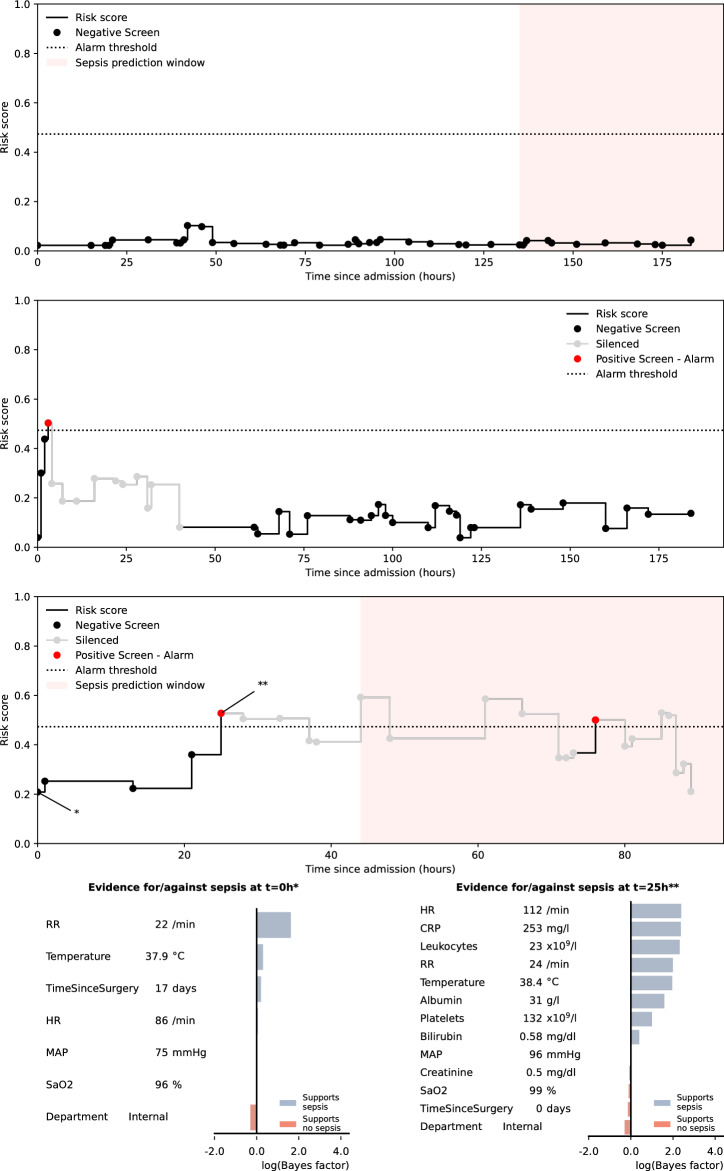
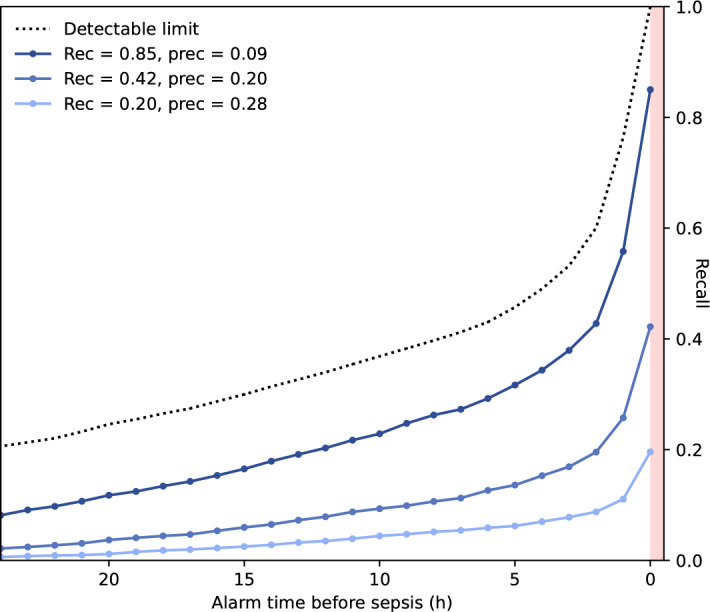
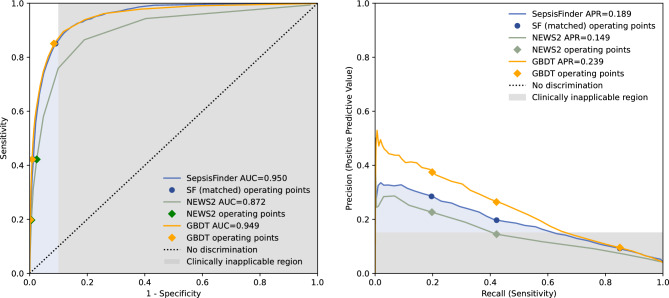
Sepsis is a leading cause of mortality and early identification improves survival. With increasing digitalization of health care data automated sepsis prediction models hold promise to aid in prompt recognition. Most previous studies have focused on the intensive care unit (ICU) setting. Yet only a small proportion of sepsis develops in the ICU and there is an apparent clinical benefit to identify patients earlier in the disease trajectory. In this cohort of 82,852 hospital admissions and 8038 sepsis episodes classified according to the Sepsis-3 criteria, we demonstrate that a machine learned score can predict sepsis onset within 48 h using sparse routine electronic health record data outside the ICU. Our score was based on a causal probabilistic network model-SepsisFinder-which has similarities with clinical reasoning. A prediction was generated hourly on all admissions, providing a new variable was registered. Compared to the National Early Warning Score (NEWS2), which is an established method to identify sepsis, the SepsisFinder triggered earlier and had a higher area under receiver operating characteristic curve (AUROC) (0.950 vs. 0.872), as well as area under precision-recall curve (APR) (0.189 vs. 0.149). A machine learning comparator based on a gradient-boosting decision tree model had similar AUROC (0.949) and higher APR (0.239) than SepsisFinder but triggered later than both NEWS2 and SepsisFinder. The precision of SepsisFinder increased if screening was restricted to the earlier admission period and in episodes with bloodstream infection. Furthermore, the SepsisFinder signaled median 5.5 h prior to antibiotic administration. Identifying a high-risk population with this method could be used to tailor clinical interventions and improve patient care.
脓毒症是导致死亡的主要原因,早期识别可提高生存率。随着医疗保健数据的数字化程度不断提高,自动化脓毒症预测模型有望帮助及时识别。大多数先前的研究都集中在重症监护病房(ICU)环境中。然而,只有一小部分脓毒症发生在 ICU 中,在疾病进程早期识别患者具有明显的临床益处。在这项纳入了 82852 例住院患者和 8038 例根据 Sepsis-3 标准分类的脓毒症病例的队列研究中,我们证明,使用 ICU 外稀疏常规电子健康记录数据,通过机器学习算法构建的评分可以在 48 小时内预测脓毒症的发生。我们的评分基于因果概率网络模型-SepsisFinder-它与临床推理有相似之处。在所有住院患者中每小时生成一次预测,当新变量被记录时。与用于识别脓毒症的既定方法-国家早期预警评分(NEWS2)相比,SepsisFinder 触发更早,且具有更高的受试者工作特征曲线下面积(AUROC)(0.950 比 0.872),以及精度-召回曲线下面积(APR)(0.189 比 0.149)。基于梯度提升决策树模型的机器学习比较器具有类似的 AUROC(0.949)和更高的 APR(0.239),但比 NEWS2 和 SepsisFinder 触发时间更晚。如果将筛选限制在较早的住院期间,并在血流感染的病例中进行筛选,SepsisFinder 的准确率会提高。此外,SepsisFinder 在开始使用抗生素前的中位数 5.5 小时发出信号。使用这种方法识别高危人群可能有助于调整临床干预措施,改善患者护理。