Bedoya Armando D, Futoma Joseph, Clement Meredith E, Corey Kristin, Brajer Nathan, Lin Anthony, Simons Morgan G, Gao Michael, Nichols Marshall, Balu Suresh, Heller Katherine, Sendak Mark, O'Brien Cara
Department of Medicine, Division of Pulmonary, Allergy, and Critical Care Medicine, Duke University, Durham, North Carolina, USA.
Department of Statistics, Duke University, Durham, North Carolina, USA.
JAMIA Open. 2020 Apr 11;3(2):252-260. doi: 10.1093/jamiaopen/ooaa006. eCollection 2020 Jul.
Determine if deep learning detects sepsis earlier and more accurately than other models. To evaluate model performance using implementation-oriented metrics that simulate clinical practice.
We trained internally and temporally validated a deep learning model (multi-output Gaussian process and recurrent neural network [MGP-RNN]) to detect sepsis using encounters from adult hospitalized patients at a large tertiary academic center. Sepsis was defined as the presence of 2 or more systemic inflammatory response syndrome (SIRS) criteria, a blood culture order, and at least one element of end-organ failure. The training dataset included demographics, comorbidities, vital signs, medication administrations, and labs from October 1, 2014 to December 1, 2015, while the temporal validation dataset was from March 1, 2018 to August 31, 2018. Comparisons were made to 3 machine learning methods, random forest (RF), Cox regression (CR), and penalized logistic regression (PLR), and 3 clinical scores used to detect sepsis, SIRS, quick Sequential Organ Failure Assessment (qSOFA), and National Early Warning Score (NEWS). Traditional discrimination statistics such as the C-statistic as well as metrics aligned with operational implementation were assessed.
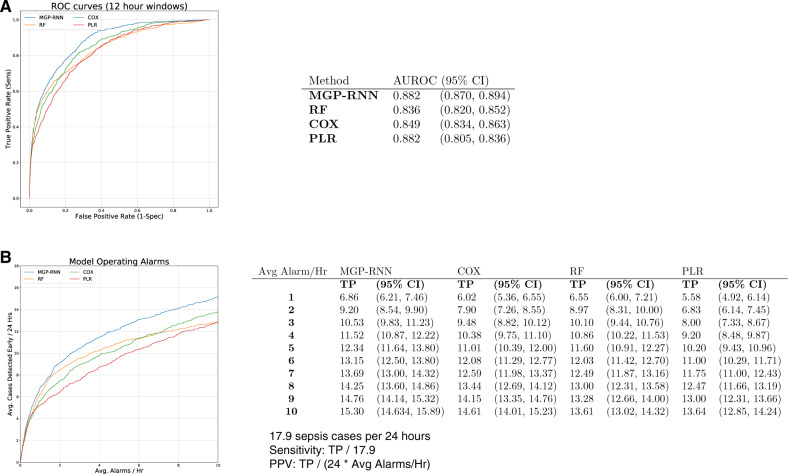
The training set and internal validation included 42 979 encounters, while the temporal validation set included 39 786 encounters. The C-statistic for predicting sepsis within 4 h of onset was 0.88 for the MGP-RNN compared to 0.836 for RF, 0.849 for CR, 0.822 for PLR, 0.756 for SIRS, 0.619 for NEWS, and 0.481 for qSOFA. MGP-RNN detected sepsis a median of 5 h in advance. Temporal validation assessment continued to show the MGP-RNN outperform all 7 clinical risk score and machine learning comparisons.
We developed and validated a novel deep learning model to detect sepsis. Using our data elements and feature set, our modeling approach outperformed other machine learning methods and clinical scores.
确定深度学习在检测脓毒症方面是否比其他模型更早、更准确。使用模拟临床实践的以实施为导向的指标来评估模型性能。
我们在内部进行训练并进行时间验证,使用来自一家大型三级学术中心成年住院患者的病历数据训练了一个深度学习模型(多输出高斯过程和递归神经网络 [MGP-RNN])来检测脓毒症。脓毒症定义为存在2个或更多全身炎症反应综合征(SIRS)标准、血培养医嘱以及至少一项器官功能衰竭要素。训练数据集包括2014年10月1日至2015年12月1日的人口统计学、合并症、生命体征、用药情况和实验室检查结果,而时间验证数据集来自2018年3月1日至2018年8月31日。将其与3种机器学习方法(随机森林 [RF]、Cox回归 [CR] 和惩罚逻辑回归 [PLR])以及用于检测脓毒症的3种临床评分(SIRS、快速序贯器官衰竭评估 [qSOFA] 和国家早期预警评分 [NEWS])进行比较。评估了传统的判别统计量如C统计量以及与实际应用相关的指标。
训练集和内部验证集包含42979份病历,而时间验证集包含39786份病历。对于在发病后4小时内预测脓毒症,MGP-RNN的C统计量为0.88,而RF为0.836,CR为0.849,PLR为0.822,SIRS为0.756,NEWS为0.619,qSOFA为0.481。MGP-RNN提前检测到脓毒症的中位数为5小时。时间验证评估继续表明MGP-RNN优于所有7种临床风险评分和机器学习方法。
我们开发并验证了一种用于检测脓毒症的新型深度学习模型。使用我们的数据元素和特征集,我们的建模方法优于其他机器学习方法和临床评分。