Consejo Nacional de Ciencia y Tecnología-Center for Health and Nutrition Research, National Institute of Public Health, Cuernavaca, Mexico.
Center for Health and Nutrition Research, National Institute of Public Health, Cuernavaca, Mexico.
JAMA Netw Open. 2023 Jul 3;6(7):e2325191. doi: 10.1001/jamanetworkopen.2023.25191.
Tax evaluations have shown effectiveness in reducing purchases of taxed items. However, few studies have looked at changes in overall dietary intake according to national surveys.
To estimate the contribution of taxed and untaxed beverages and foods to dietary intake over time, and the nutritional dietary profile in total beverages and foods consumed.
DESIGN, SETTING, AND PARTICIPANTS: This cross-sectional study used data from 3 National Health and Nutrition Surveys of a nationally representative sample of participants aged older than 1 year in Mexico from 2012 (pretax), 2016, and 2018 (posttax). Data were analyzed from September 2021 to December 2022.
Taxes on sugar-sweetened beverages and nonessential energy-dense foods implemented since 2014.
The outcomes were the contribution of taxed and untaxed beverages to total beverage volume, the contribution of taxed and untaxed foods to total food energy, and the energy density and content of added sugars and saturated fats. Outcomes were assessed with 24-hour recalls (24HR) (2012 and 2016) and Food Frequency Questionnaires (FFQ) (2012, 2016, and 2018), and were adjusted by sociodemographic and macroeconomic variables.
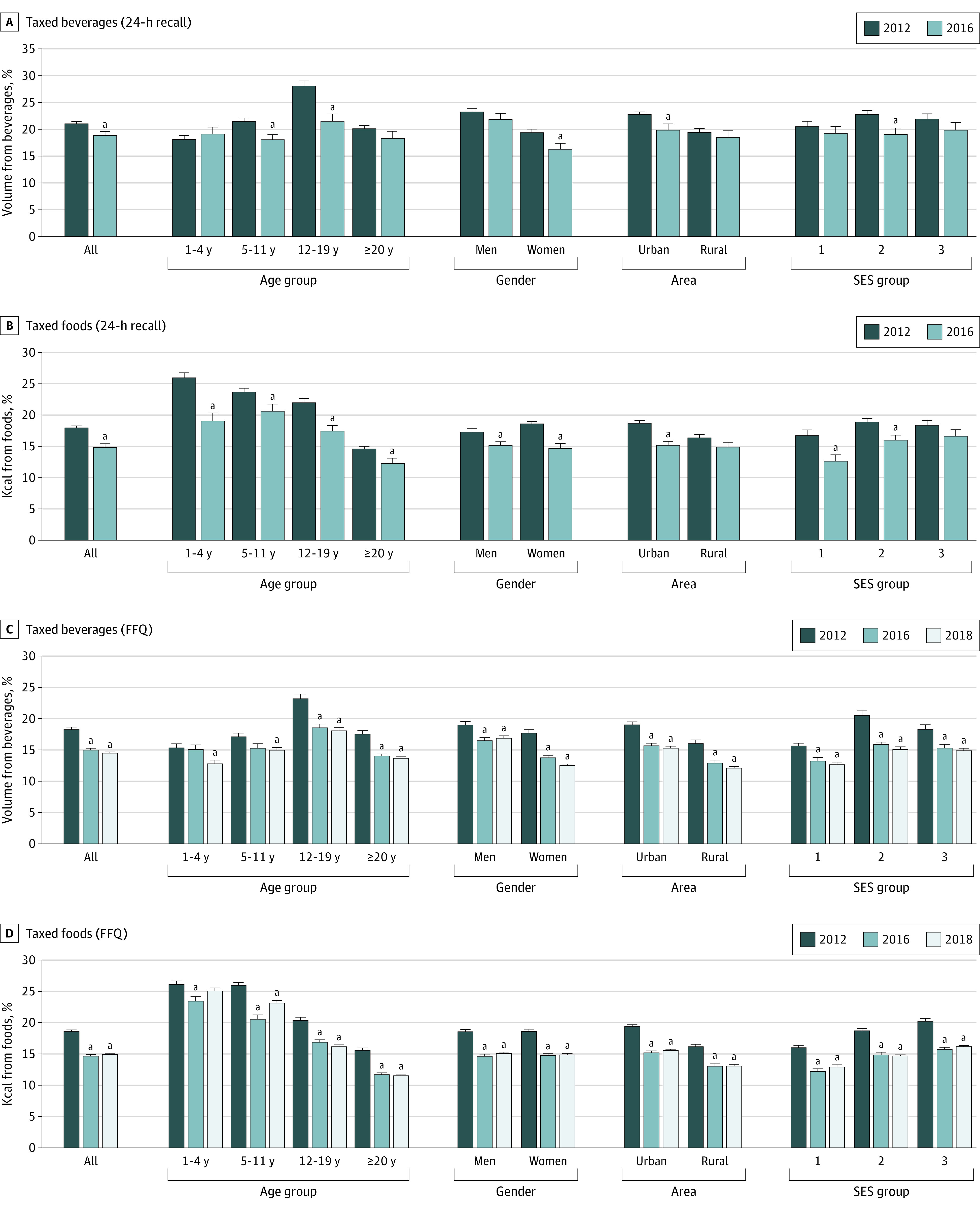
A total of 17 239 participants were analyzed from 2012, 18 974 from 2016, and 30 027 from 2018; approximately 50% were men, and approximately 75% lived in urban areas. According to 24HRs, the contribution of taxed beverages to total beverage volume changed -2.3 (95% CI, -4.4 to -0.2) percentage points from 2012 to 2016, while water increased. The contribution of taxed foods to total food energy changed -3.0 (95% CI, -4.2 to -1.8) percentage points, while untaxed whole grains, processed meats, other animal sources, and sugars and desserts increased. The content in total beverages of added sugars changed -1.1 kcal/100 mL (95% CI, -2.0 to -0.2), and in total foods, the content of added sugar changed -0.6 %kcal (95% CI, -1.0 to -0.2), saturated fat changed -0.8 %kcal (95% CI, -1.1 to -0.4), and energy density changed -9.8 kcal/100 g (95% CI, -13.8 to -5.8). Main results were consistent with the FFQ (up to 2018), with some differences in subgroups and nutritional components.
The findings of this study on 3 cross-sectional national dietary surveys are consistent with previous evaluations; after tax implementation, there was a decrease in the contribution of taxed items. Furthermore, some unhealthy untaxed items increased, but the content of unhealthful nutritional components, particularly added sugar, in overall beverages and foods decreased.
税收评估已被证明在减少应税商品购买方面具有有效性。然而,很少有研究根据国家调查来观察整体饮食摄入的变化。
评估征税和未征税饮料和食品对随时间推移的饮食摄入的贡献,以及总饮料和食品消费的营养饮食状况。
设计、地点和参与者:本横断面研究使用了来自墨西哥全国代表性样本中年龄大于 1 岁的参与者的三个国家健康和营养调查(2012 年(税前)、2016 年和 2018 年(税后))的数据。数据分析于 2021 年 9 月至 2022 年 12 月进行。
自 2014 年以来对含糖饮料和非必需高能量食品征税。
结果是征税和未征税饮料对总饮料量的贡献,征税和未征税食品对总食物能量的贡献,以及添加糖和饱和脂肪的能量密度和含量。通过 24 小时回忆(24HR)(2012 年和 2016 年)和食物频率问卷(FFQ)(2012 年、2016 年和 2018 年)评估了结果,并根据社会人口统计学和宏观经济变量进行了调整。
共分析了 2012 年的 17239 名参与者、2016 年的 18974 名参与者和 2018 年的 30027 名参与者;约 50%为男性,约 75%居住在城市地区。根据 24HR,征税饮料对总饮料量的贡献从 2012 年到 2016 年变化了-2.3(95%CI,-4.4 至-0.2)个百分点,而水的摄入量增加。征税食品对总食物能量的贡献变化了-3.0(95%CI,-4.2 至-1.8)个百分点,而未征税的全谷物、加工肉类、其他动物来源以及糖和甜点的摄入量增加。总饮料中添加糖的含量变化了-1.1 千卡/100 毫升(95%CI,-2.0 至-0.2),总食物中添加糖的含量变化了-0.6%千卡(95%CI,-1.0 至-0.2),饱和脂肪变化了-0.8%千卡(95%CI,-1.1 至-0.4),能量密度变化了-9.8 千卡/100 克(95%CI,-13.8 至-5.8)。主要结果与 FFQ(截至 2018 年)一致,在亚组和营养成分方面存在一些差异。
本研究对 3 项全国横断面饮食调查的发现与之前的评估一致;税收实施后,征税物品的贡献有所减少。此外,一些不健康的未征税物品有所增加,但总体饮料和食品中不健康营养成分(特别是添加糖)的含量有所下降。