Nuffield Department of Primary Care Health Sciences, Radcliffe Observatory Quarter, Woodstock Road, Oxford, OX2 6GG, UK.
MRC Epidemiology Unit, Institute of Metabolic Science, University of Cambridge School of Clinical Medicine, Cambridge Biomedical Campus, Box 285, Cambridge, CB2 0QQ, UK.
BMC Public Health. 2023 Jul 24;23(1):1419. doi: 10.1186/s12889-023-16293-4.
Extensive public health research reports the nature, scope and effects of various marketing activities used by food and drinks companies to support the sale of their products. Such literature informs the regulation of food marketing that encourages unhealthy eating behaviours and poor diet-related health outcomes. However, it is not clear whether this literature consistently conceptualises and applies marketing, which could in turn influence the approach and efficacy of policies to regulate food marketing. We aimed to understand the conceptualisation and operationalisation of marketing in public health research of food marketing, eventually focusing on the conceptualisation of integrated marketing.
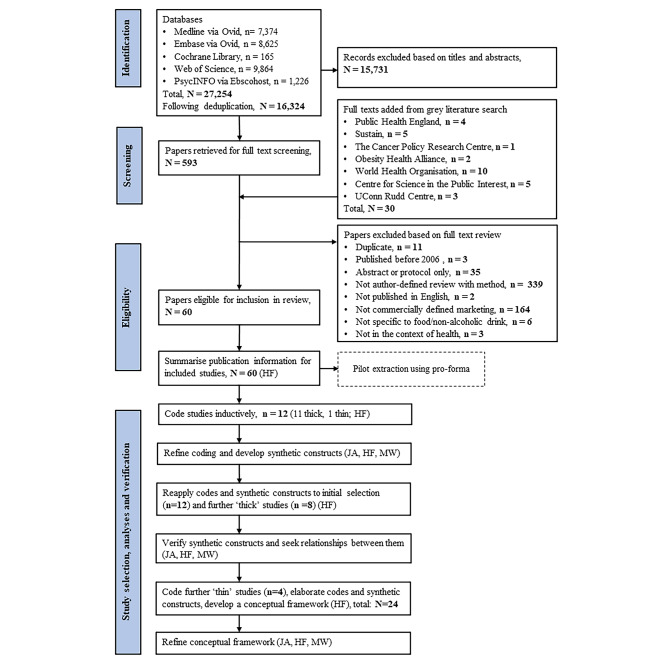
We conducted a review of reviews that drew on scoping review methods and applied principles of critical interpretive synthesis. Five databases of peer-reviewed literature and websites of relevant organisations were searched in June - August 2020. Articles were screened against inclusion criteria to identify reviews examining food marketing in a health context. Informative text segments from included articles were coded using NVivo. Codes were grouped into synthetic constructs and a synthesising argument.
After screening against inclusion criteria, 60 publications were eligible for inclusion. Informative text segments from 24 publications were coded, after which no new codes were identified. Our synthesising argument was that the understanding of integrated marketing appeared inconsistent across publications, such as by differences in use of underlying conceptual frameworks and in the application of terms such as marketing strategy and tactics.
Using our synthesising argument, we suggest ways to improve the future study of food marketing in public health research, for example by using in-depth case studies to understand the integrated operation and effect of multi-component marketing strategies. Improving conceptual clarity in the study of food marketing in public health research has the potential to inform policy that is more reflective of the true nature of marketing, and thus more effective in combating food marketing effects and protecting public health.
The review protocol was made publicly available on Open Science Framework prior to the start of the study (DOI: https://doi.org/10.17605/OSF.IO/VSJCW ).
大量公共卫生研究报告了食品和饮料公司用于支持其产品销售的各种营销活动的性质、范围和影响。这些文献为鼓励不健康的饮食行为和不良的与饮食相关的健康结果的食品营销法规提供了信息。然而,目前尚不清楚这些文献是否一致地对营销进行概念化和应用,这反过来又可能影响监管食品营销的政策的方法和效果。我们旨在了解公共卫生中食品营销研究中营销的概念化和操作化,最终重点关注整合营销的概念化。
我们进行了一项综述研究,该研究借鉴了范围综述方法,并应用了批判解释性综合的原则。我们于 2020 年 6 月至 8 月在五个同行评议文献数据库和相关组织的网站上进行了搜索。根据纳入标准筛选文章,以确定审查食品营销在健康背景下的文章。从纳入文章中提取有意义的文本片段,使用 NVivo 进行编码。将代码分组为综合构建和综合论证。
根据纳入标准筛选后,有 60 篇出版物符合纳入标准。对 24 篇出版物的有意义的文本片段进行了编码,之后没有发现新的代码。我们的综合论证是,综合营销的理解在出版物中似乎不一致,例如在使用基础概念框架的差异以及在营销战略和策略等术语的应用方面存在差异。
使用我们的综合论证,我们提出了改进公共卫生研究中食品营销未来研究的方法,例如使用深入的案例研究来了解多组分营销策略的综合运作和效果。在公共卫生研究中提高食品营销研究的概念清晰度有可能为更能反映营销本质的政策提供信息,从而更有效地打击食品营销的影响并保护公共健康。
在研究开始之前,审查方案在开放科学框架上公开可用(DOI:https://doi.org/10.17605/OSF.IO/VSJCW)。