Han Hyeon, Jacquet Quentin, Jiang Zhen, Sayed Farheen N, Jeon Jae-Chun, Sharma Arpit, Schankler Aaron M, Kakekhani Arvin, Meyerheim Holger L, Park Jucheol, Nam Sang Yeol, Griffith Kent J, Simonelli Laura, Rappe Andrew M, Grey Clare P, Parkin Stuart S P
Max Planck Institute of Microstructure Physics, Halle (Saale), Germany.
Yusuf Hamied Department of Chemistry, University of Cambridge, Cambridge, UK.
Nat Mater. 2023 Sep;22(9):1128-1135. doi: 10.1038/s41563-023-01612-2. Epub 2023 Jul 27.
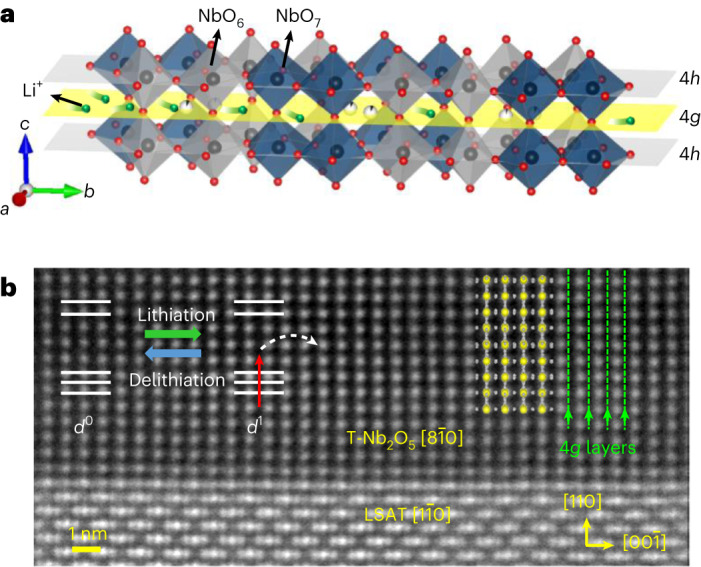
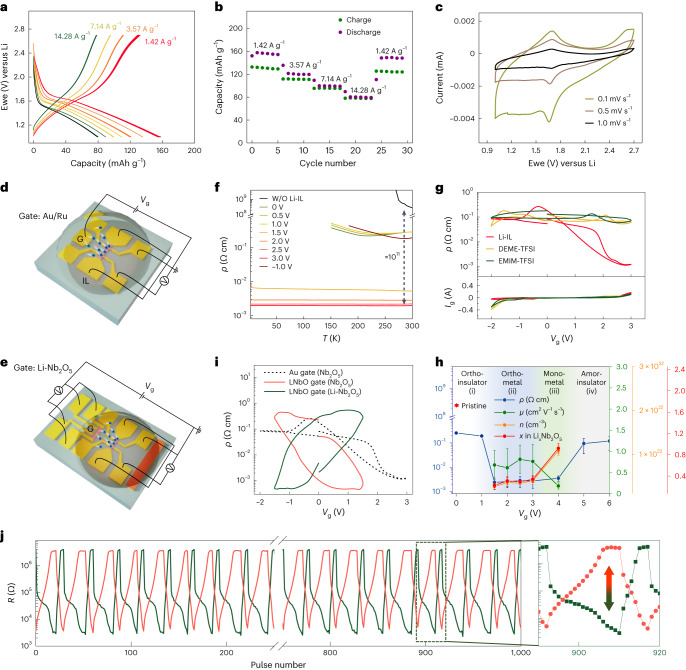
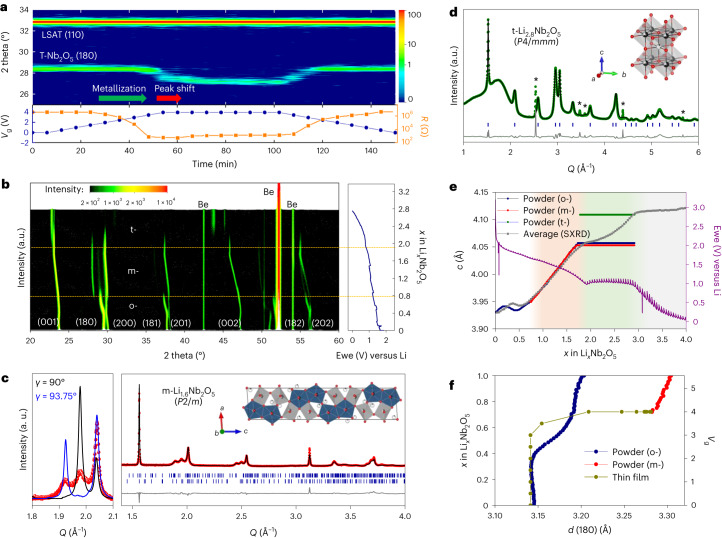
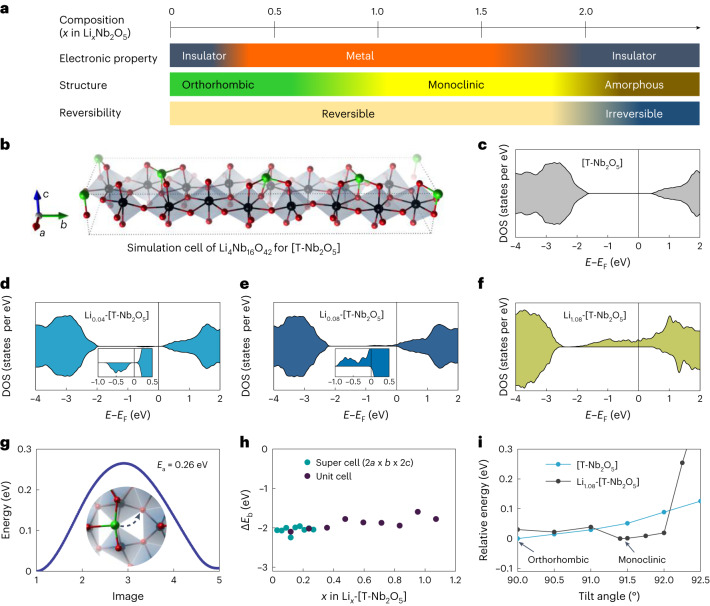
The niobium oxide polymorph T-NbO has been extensively investigated in its bulk form especially for applications in fast-charging batteries and electrochemical (pseudo)capacitors. Its crystal structure, which has two-dimensional (2D) layers with very low steric hindrance, allows for fast Li-ion migration. However, since its discovery in 1941, the growth of single-crystalline thin films and its electronic applications have not yet been realized, probably due to its large orthorhombic unit cell along with the existence of many polymorphs. Here we demonstrate the epitaxial growth of single-crystalline T-NbO thin films, critically with the ionic transport channels oriented perpendicular to the film's surface. These vertical 2D channels enable fast Li-ion migration, which we show gives rise to a colossal insulator-metal transition, where the resistivity drops by 11 orders of magnitude due to the population of the initially empty Nb 4d states by electrons. Moreover, we reveal multiple unexplored phase transitions with distinct crystal and electronic structures over a wide range of Li-ion concentrations by comprehensive in situ experiments and theoretical calculations, which allow for the reversible and repeatable manipulation of these phases and their distinct electronic properties. This work paves the way for the exploration of novel thin films with ionic channels and their potential applications.
氧化铌多晶型物T-NbO已被广泛研究其块状形式,特别是在快速充电电池和电化学(伪)电容器中的应用。其晶体结构具有二维(2D)层,空间位阻非常低,允许锂离子快速迁移。然而,自1941年发现以来,单晶薄膜的生长及其电子应用尚未实现,这可能是由于其较大的正交晶胞以及存在许多多晶型物。在这里,我们展示了单晶T-NbO薄膜的外延生长,关键是离子传输通道垂直于薄膜表面取向。这些垂直的二维通道实现了锂离子的快速迁移,我们表明这会导致巨大的绝缘体-金属转变,由于电子填充了最初空的Nb 4d态,电阻率下降了11个数量级。此外,通过全面的原位实验和理论计算,我们揭示了在广泛的锂离子浓度范围内具有不同晶体和电子结构的多个未探索的相变,这允许对这些相及其独特的电子性质进行可逆和可重复的操纵。这项工作为探索具有离子通道的新型薄膜及其潜在应用铺平了道路。