HIV/STI Surveillance Research Center, and WHO Collaborative Center for HIV Surveillance, Institute for Futures Studies in Health, Kerman University of Medical Sciences, Kerman, Iran (the Islamic Republic of).
Deputy of Health, Department of Communicable Diseases, Kerman University of Medical Sciences, Kerman, Iran (the Islamic Republic of).
BMJ Open. 2023 Jul 30;13(7):e072326. doi: 10.1136/bmjopen-2023-072326.
The COVID-19 pandemic exposed significant gaps in Iran's and other health systems' risk communication. The accompanying infodemic undermined policy responses, amplified distrust in government and reduced adherence to public health recommendations among the Iranian population. This study aimed to develop a conceptual framework for health risk communication and infodemic management (RCIM) during epidemics and health emergencies in Iran that could have potential applications in other contexts.
This study was designed in two phases. Phase 1 involved semistructured qualitative interviews with key informants to explore effective RCIM strategies across public health settings in Iran and to develop a conceptual framework. Phase 2 involved revising the framework based on feedback from an online expert panel regarding its comprehensiveness and validity.
Provincial/national public health settings in Iran.
Twenty key informants from provincial and national public health authorities who contributed to COVID-19 response programmes participated in interviews. Nine experts from diverse academic disciplines, provincial and national settings, and geographical locations participated in an online expert panel.
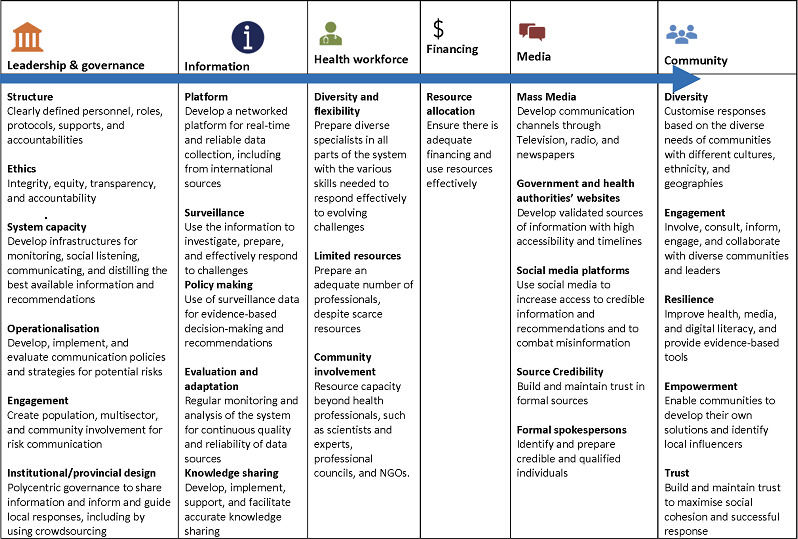
The conceptual model was created based on qualitative interviews and expert panel discussions and was structured according to six pillars of the WHO health system framework: leadership and governance, information, health workforce and financial resources, along with media and community. Leadership and governance, including trustworthy leaders, were recommended as the foundation for developing RCIM in Iran. Developing an official strategy with information infrastructures, including high-quality surveillance systems, identified personnel and training for specialists among the health workforce, financial resources, communication channels and community engagement were recognised as other dimensions for developing health risk communication in Iran.
The proposed framework represents a step toward establishing a national RCIM strategy in Iran. Further validation of the conceptual framework and experiments on how it could potentially influence policy and practice is recommended. This model has the potential to be applied in other contexts in its current form or as the foundation for customised local versions.
新冠疫情暴露了伊朗和其他卫生系统在风险沟通方面的重大差距。随之而来的信息疫情破坏了政策应对,加剧了民众对政府的不信任,降低了伊朗民众对公共卫生建议的遵从度。本研究旨在为伊朗在流行病和卫生紧急情况下制定卫生风险沟通和信息疫情管理(RCIM)的概念框架,该框架在其他背景下也可能具有潜在应用价值。
本研究分两个阶段进行。第一阶段采用半结构式定性访谈,对伊朗公共卫生领域的有效 RCIM 策略进行探讨,并制定概念框架。第二阶段根据在线专家小组对框架全面性和有效性的反馈意见对框架进行修订。
伊朗省级/国家级公共卫生设置。
参与新冠疫情应对计划的 20 名来自省级和国家级公共卫生机构的关键信息提供者参加了访谈。9 名来自不同学术学科、省级和国家级背景以及地理位置的专家参加了在线专家小组。
该概念模型是根据定性访谈和专家小组讨论构建的,根据世卫组织卫生系统框架的六个支柱进行组织:领导力和治理、信息、卫生人力和财政资源,以及媒体和社区。领导力和治理,包括值得信赖的领导人,被建议作为在伊朗制定 RCIM 的基础。制定一项官方战略,建立信息基础设施,包括高质量的监测系统,确定卫生人力中的专业人员以及培训、财政资源、沟通渠道和社区参与被认为是伊朗发展卫生风险沟通的其他方面。
所提出的框架代表了在伊朗建立国家 RCIM 战略的一步。建议进一步验证概念框架,并对其如何潜在影响政策和实践进行试验。该模型具有以现有形式应用于其他背景或作为定制化本地版本基础的潜力。