Department of Nutrition and Movement Sciences, NUTRIM School of Nutrition and Translational Research in Metabolism, Maastricht University, Maastricht, The Netherlands.
Department of Internal Medicine, Maastricht University Medical Centre, Maastricht, The Netherlands.
Physiol Rep. 2022 Aug;10(16):e15395. doi: 10.14814/phy2.15395.
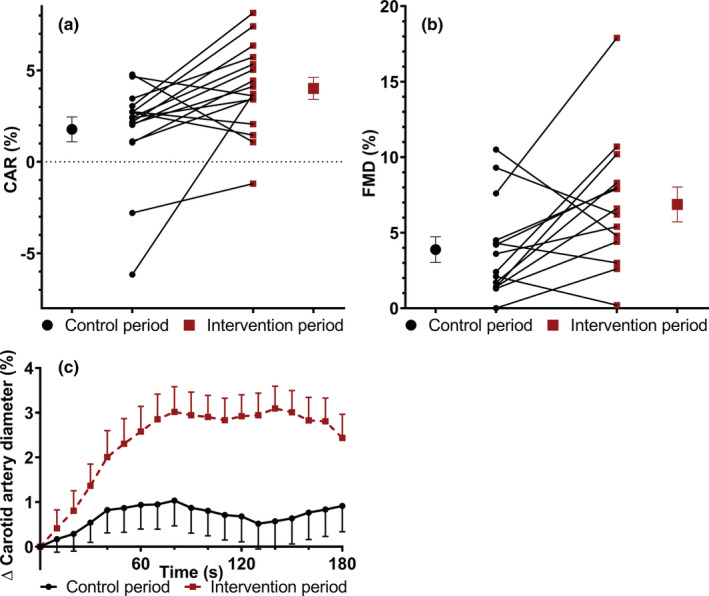
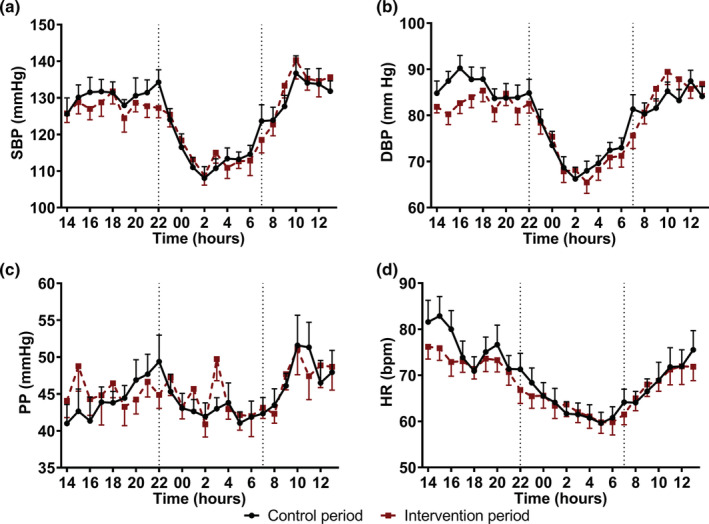
It is well-known that aerobic exercise training beneficially affects endothelial function as measured by brachial artery flow-mediated vasodilation (FMD). This trial with older sedentary overweight and obese men, therefore, examined the effects of aerobic training on other non-invasive markers of the vasculature, which have been studied in less detail. Seventeen men (67 ± 2 years, BMI: 30.3 ± 2.8 kg/m ) participated in this controlled cross-over study. Study participants followed in random order a fully supervised, progressive, aerobic exercise training (three 50-min sessions each week at 70% maximal power) and a no-exercise control period for 8 weeks, separated by a 12-week wash-out period. At the end of each period, endothelial function was assessed by the carotid artery reactivity (CAR) response to a cold pressor test and FMD, and local carotid and regional aortic stiffness by the carotid-to-femoral pulse wave velocity (PWV ). The retinal microvasculature, the serum lipid profile, 24-h ambulatory blood pressure, and 96-h continuous glucose concentrations were also determined. Aerobic training increased CAR from 1.78% to 4.01% (Δ2.23 percentage point [pp]; 95% CI: 0.58, 3.89 pp; p = 0.012) and FMD from 3.88% to 6.87% (Δ2.99 pp; 95% CI: 0.58, 5.41 pp; p = 0.019). The stiffness index β increased by 1.1 (95% CI: 0.3, 1.9; p = 0.012), while PWV did not change. Retinal arteriolar width increased by 4 μm (95% CI: 0, 7 μm; p = 0.041). Office blood pressure decreased, but ambulatory blood pressure, and serum lipid and continuous glucose concentrations did not change. Aerobic exercise training improved endothelial function and retinal arteriolar width in older sedentary overweight and obese men, which may reduce cardiovascular risk.
众所周知,有氧运动训练有益于通过肱动脉血流介导的舒张(FMD)来改善内皮功能。因此,这项针对年龄较大、久坐不动、超重和肥胖男性的试验研究了有氧运动训练对血管的其他非侵入性标志物的影响,这些标志物的研究较少。17 名男性(67±2 岁,BMI:30.3±2.8kg/m²)参与了这项对照交叉研究。研究参与者随机按顺序接受了为期 8 周的完全监督、渐进式有氧运动训练(每周 3 次,每次 50 分钟,达到最大功率的 70%)和无运动对照组,中间间隔 12 周洗脱期。在每个周期结束时,通过颈动脉对冷加压试验的反应评估内皮功能(CAR)和 FMD,通过颈动脉-股动脉脉搏波速度(PWV)评估局部颈动脉和区域性主动脉僵硬度。还确定了视网膜微血管、血清脂质谱、24 小时动态血压和 96 小时连续血糖浓度。有氧运动训练使 CAR 从 1.78%增加到 4.01%(增加 2.23 个百分点[pp];95%CI:0.58,3.89 pp;p=0.012),FMD 从 3.88%增加到 6.87%(增加 2.99 pp;95%CI:0.58,5.41 pp;p=0.019)。僵硬度指数β增加了 1.1(95%CI:0.3,1.9;p=0.012),而 PWV 没有变化。视网膜小动脉宽度增加了 4μm(95%CI:0,7μm;p=0.041)。诊室血压降低,但动态血压、血清脂质和连续血糖浓度没有变化。有氧运动训练改善了年龄较大、久坐不动、超重和肥胖男性的内皮功能和视网膜小动脉宽度,这可能降低心血管风险。