Graduate School, Heilongjiang University of Chinese Medicine, Harbin, Heilongjiang, China.
Department of Oncology, Second Ward, The First People's Hospital of Bei'an City, Harbin, Heilongjiang, China.
Front Endocrinol (Lausanne). 2023 Jul 17;14:1224967. doi: 10.3389/fendo.2023.1224967. eCollection 2023.
Cardiovascular disease (CVD) is a global health concern, with a significant impact on morbidity and mortality rates. Using fasting glucose, fasting triglycerides, body mass index (BMI), and high-density lipoprotein cholesterol (HDL-C), the metabolic score of insulin resistance (Mets-IR), a novel index created by Mexican researchers to assess insulin sensitivity, is a more precise way to measure insulin sensitivity. This study aimes to explore the association between Mets-IR and CVD, as well as investigate the potential mediating role of of low-density lipoprotein cholesterol (LDL-C).
The study's data came from the 2011 and 2018 China Health and Retirement Longitudinal Studies (CHARLS). We used three logistic regression models to account for the potential effects of ten factors on cardiovascular disease/stroke/heart disease. Moreover, We performed mediation analyses to evaluate the role of LDL-C in the association between Mets-IR and incident CVD.
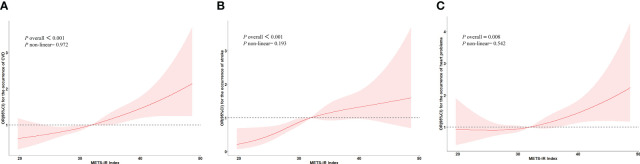
This study comprised 4,540 participants, of whom 494 (10.88%) were found to develop disease (CVD). Each interquartile range (IQR) increased in Mets-IR raised the risk of developing CVD by 38% (OR=1.38; 95% CI, 1.21-1.56) and there was a linear dose-response relationship between Mets-IR and the risk of new-onset cardiovascular disease, stroke, and heart disease ( <0.05, >0.05). Approximately 5% (indirect effect/total effect) of the significant association of Mets-IR with stroke was mediated by LDL-C, respectively. With the addition of Mets-IR to the base model, the continuous net reclassification improvement and integrated discrimination improvement for predicting cardiovascular disease increased by 0.175 (P <0.001) and 0.006 (0.001), respectively.
ets-IR is associated with an increased risk of cardiovascular disease/stroke/cardiac issues, with LDL-C mediating these relationships. Improving insulin sensitivity and lipid regulation may be essential and effective preventive measures for cardiovascular events.
心血管疾病(CVD)是一个全球性的健康问题,对发病率和死亡率有重大影响。墨西哥研究人员创造了一种新的胰岛素敏感性评估指标——代谢性胰岛素抵抗评分(Mets-IR),该评分结合了空腹血糖、空腹甘油三酯、体重指数(BMI)和高密度脂蛋白胆固醇(HDL-C)。Mets-IR 是一种更精确的测量胰岛素敏感性的方法。本研究旨在探讨 Mets-IR 与 CVD 的关系,并研究 LDL-C 在其中的潜在中介作用。
本研究的数据来自 2011 年和 2018 年中国健康与退休纵向研究(CHARLS)。我们使用三个逻辑回归模型来考虑十个因素对心血管疾病/中风/心脏病的潜在影响。此外,我们进行了中介分析,以评估 LDL-C 在 Mets-IR 与新发 CVD 之间的关联中的作用。
该研究共纳入 4540 名参与者,其中 494 人(10.88%)患有疾病(CVD)。Mets-IR 每增加一个四分位间距(IQR),患 CVD 的风险增加 38%(OR=1.38;95%CI,1.21-1.56),并且 Mets-IR 与新发心血管疾病、中风和心脏病的风险之间存在线性剂量反应关系(<0.05,>0.05)。Mets-IR 与中风的显著关联中,约有 5%(间接效应/总效应)通过 LDL-C 介导。在基础模型中加入 Mets-IR 后,预测心血管疾病的连续净重新分类改善和综合判别改善分别增加了 0.175(P<0.001)和 0.006(0.001)。
Mets-IR 与心血管疾病/中风/心脏问题的风险增加相关,LDL-C 介导了这些关系。改善胰岛素敏感性和脂质调节可能是预防心血管事件的重要和有效措施。