Farrell Alex, Phan Tin, Brooke Christopher B, Koelle Katia, Ke Ruian
Department of Mathematics, University of Arizona, Tucson, AZ 85721, USA.
T-6, Theoretical Biology and Biophysics, Los Alamos, NM 87545, USA.
Virus Evol. 2023 Mar 21;9(1):vead020. doi: 10.1093/ve/vead020. eCollection 2023.
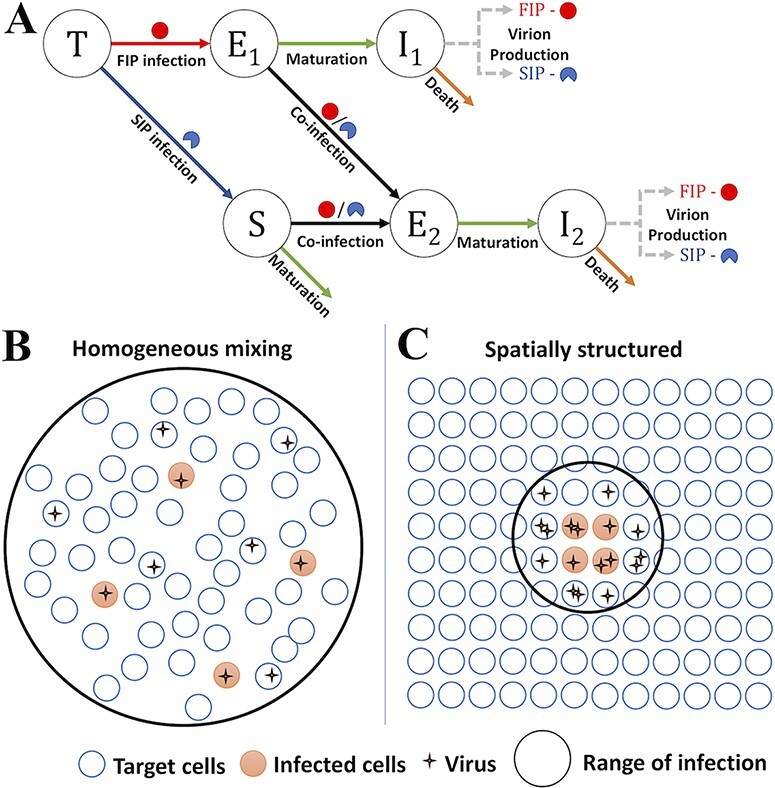
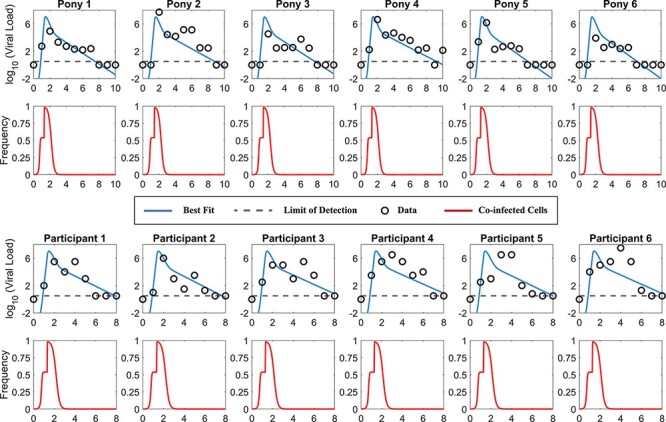
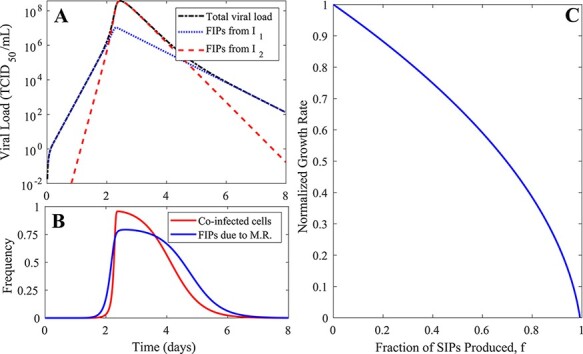
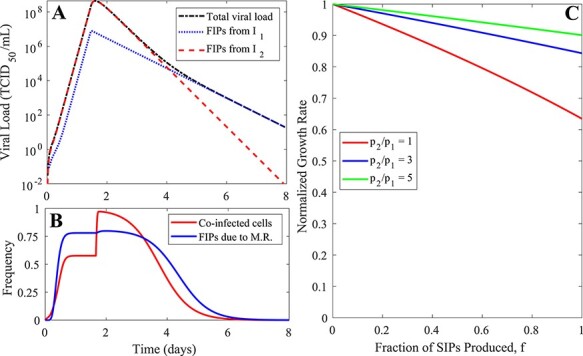
Influenza is an ribonucleic acid virus with a genome that comprises eight segments. Experiments show that the vast majority of virions fail to express one or more gene segments and thus cannot cause a productive infection on their own. These particles, called semi-infectious particles (SIPs), can induce virion production through complementation when multiple SIPs are present in an infected cell. Previous within-host influenza models did not explicitly consider SIPs and largely ignore the potential effects of coinfection during virus infection. Here, we constructed and analyzed two distinct models explicitly keeping track of SIPs and coinfection: one without spatial structure and the other implicitly considering spatial structure. While the model without spatial structure fails to reproduce key aspects of within-host influenza virus dynamics, we found that the model implicitly considering the spatial structure of the infection process makes predictions that are consistent with biological observations, highlighting the crucial role that spatial structure plays during an influenza infection. This model predicts two phases of viral growth prior to the viral peak: a first phase driven by fully infectious particles at the initiation of infection followed by a second phase largely driven by coinfections of fully infectious particles and SIPs. Fitting this model to two sets of data, we show that SIPs can contribute substantially to viral load during infection. Overall, the model provides a new interpretation of the exponential viral growth observed in experiments and a mechanistic explanation for why the production of large numbers of SIPs does not strongly impede viral growth. Being simple and predictive, our model framework serves as a useful tool to understand coinfection dynamics in spatially structured acute viral infections.
流感是一种核糖核酸病毒,其基因组由八个片段组成。实验表明,绝大多数病毒粒子无法表达一个或多个基因片段,因此自身无法引发有效的感染。这些粒子被称为半感染性粒子(SIPs),当感染细胞中存在多个SIPs时,它们可以通过互补作用诱导病毒粒子的产生。先前的宿主体内流感模型没有明确考虑SIPs,并且在很大程度上忽略了病毒感染期间合并感染的潜在影响。在这里,我们构建并分析了两个不同的模型,明确跟踪SIPs和合并感染:一个没有空间结构,另一个隐含地考虑了空间结构。虽然没有空间结构的模型无法重现宿主体内流感病毒动态的关键方面,但我们发现隐含考虑感染过程空间结构的模型所做的预测与生物学观察结果一致,突出了空间结构在流感感染过程中所起的关键作用。该模型预测在病毒峰值之前病毒生长的两个阶段:第一阶段由感染开始时的完全感染性粒子驱动,随后是第二阶段,主要由完全感染性粒子和SIPs的合并感染驱动。将该模型与两组数据拟合,我们表明SIPs在感染期间可对病毒载量有显著贡献。总体而言,该模型为实验中观察到的病毒指数增长提供了新的解释,并对大量SIPs的产生为何不会强烈阻碍病毒生长提供了一个机理解释。我们的模型框架简单且具有预测性,是理解空间结构急性病毒感染中合并感染动态的有用工具。