Carpenter Catherine M, Dennis Nancy A
The Pennsylvania State University.
bioRxiv. 2024 Jan 26:2023.07.26.550683. doi: 10.1101/2023.07.26.550683.
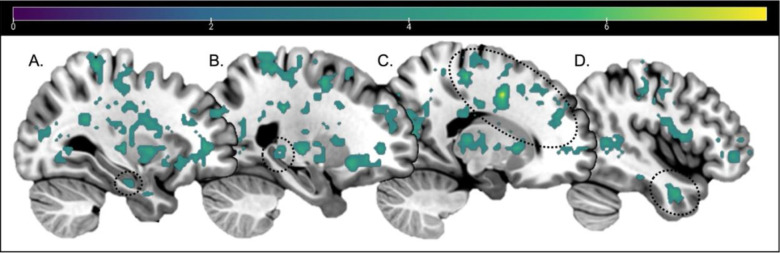
Schemas allow us to make assumptions about the world based upon previous experiences and aid in memory organization and retrieval. However, a reliance on schemas may also result in increased false memories to schematically related lures. Prior neuroimaging work has linked schematic processing in memory tasks to activity in prefrontal, visual, and temporal regions. Yet, it is unclear what type of processing in these regions underlies memory errors. The current study examined where schematic lures exhibit greater neural similarity to schematic targets, leading to this memory error, as compared to neural overlap with non-schematic lures, which, like schematic lures, are novel items at retrieval. Results showed that patterns of neural activity in ventromedial prefrontal cortex, medial frontal gyrus, middle temporal gyrus, hippocampus, and occipital cortices exhibited greater neural pattern similarity for schematic targets and schematic lures than between schematic lures and non-schematic lures. As such, results suggest that schematic membership, and not object history, may be more critical to the neural processes underlying memory retrieval in the context of a strong schema.
图式使我们能够基于以往的经验对世界做出假设,并有助于记忆的组织和提取。然而,对图式的依赖也可能导致对与图式相关的诱饵产生更多的错误记忆。先前的神经成像研究已经将记忆任务中的图式处理与前额叶、视觉和颞叶区域的活动联系起来。然而,尚不清楚这些区域中的哪种处理方式是记忆错误的基础。当前的研究考察了与非图式诱饵(在提取时与图式诱饵一样都是新出现的项目)的神经重叠相比,图式诱饵在哪些方面与图式目标表现出更大的神经相似性,从而导致这种记忆错误。结果表明,腹内侧前额叶皮层、额内侧回、颞中回、海马体和枕叶皮层的神经活动模式,对于图式目标和图式诱饵而言,其神经模式相似性大于图式诱饵和非图式诱饵之间的相似性。因此,结果表明,在存在强烈图式的情况下,图式成员关系而非客体历史,可能对记忆提取背后的神经过程更为关键。