• 文献检索
  • 文档翻译
  • 深度研究
  • 学术资讯
  • Suppr Zotero 插件Zotero 插件
  • 邀请有礼
  • 套餐&价格
  • 历史记录
应用&插件
Suppr Zotero 插件Zotero 插件浏览器插件Mac 客户端Windows 客户端微信小程序
定价
高级版会员购买积分包购买API积分包
服务
文献检索文档翻译深度研究API 文档MCP 服务
关于我们
关于 Suppr公司介绍联系我们用户协议隐私条款
关注我们

Suppr 超能文献

核心技术专利:CN118964589B侵权必究
粤ICP备2023148730 号-1Suppr @ 2026

文献检索

告别复杂PubMed语法,用中文像聊天一样搜索,搜遍4000万医学文献。AI智能推荐,让科研检索更轻松。

立即免费搜索

文件翻译

保留排版,准确专业,支持PDF/Word/PPT等文件格式,支持 12+语言互译。

免费翻译文档

深度研究

AI帮你快速写综述,25分钟生成高质量综述,智能提取关键信息,辅助科研写作。

立即免费体验

CAM-YOLO:基于改进的YOLOv5并结合注意力机制的番茄检测与分类

CAM-YOLO: tomato detection and classification based on improved YOLOv5 using combining attention mechanism.

作者信息

Appe Seetharam Nagesh, G Arulselvi, Gn Balaji

机构信息

Department of Computer Science and Engineering, Annamalai University, Chidambaram, Tamilnadu, India.

Department of Information Technology, CVR College of Engineering, Hyderabad, India.

出版信息

PeerJ Comput Sci. 2023 Jul 20;9:e1463. doi: 10.7717/peerj-cs.1463. eCollection 2023.

DOI:10.7717/peerj-cs.1463
PMID:37547387
原文链接:https://pmc.ncbi.nlm.nih.gov/articles/PMC10403160/
Abstract

BACKGROUND

One of the key elements in maintaining the consistent marketing of tomato fruit is tomato quality. Since ripeness is the most important factor for tomato quality in the viewpoint of consumers, determining the stages of tomato ripeness is a fundamental industrial concern with regard to tomato production to obtain a high quality product. Since tomatoes are one of the most important crops in the world, automatic ripeness evaluation of tomatoes is a significant study topic as it may prove beneficial in ensuring an optimal production of high-quality product, increasing profitability. This article explores and categorises the various maturity/ripeness phases to propose an automated multi-class classification approach for tomato ripeness testing and evaluation.

METHODS

Object detection is the critical component in a wide variety of computer vision problems and applications such as manufacturing, agriculture, medicine, and autonomous driving. Due to the tomato fruits' complex identification background, texture disruption, and partial occlusion, the classic deep learning object detection approach (YOLO) has a poor rate of success in detecting tomato fruits. To figure out these issues, this article proposes an improved YOLOv5 tomato detection algorithm. The proposed algorithm CAM-YOLO uses YOLOv5 for feature extraction, target identification and Convolutional Block Attention Module (CBAM). The CBAM is added to the CAM-YOLO to focus the model on improving accuracy. Finally, non-maximum suppression and distance intersection over union (DIoU) are applied to enhance the identification of overlapping objects in the image.

RESULTS

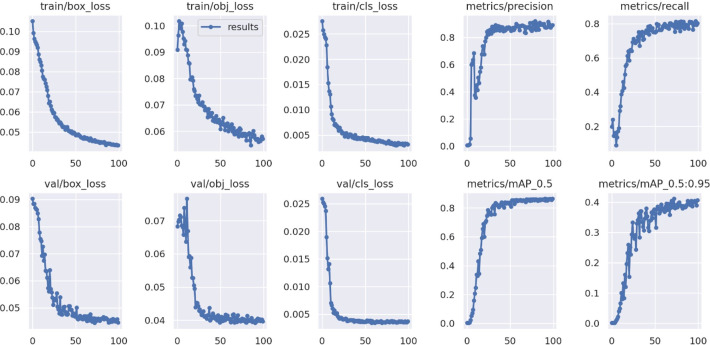
Several images from the dataset were chosen for testing to assess the model's performance, and the detection performance of the CAM-YOLO and standard YOLOv5 models under various conditions was compared. The experimental results affirms that CAM-YOLO algorithm is efficient in detecting the overlapped and small tomatoes with an average precision of 88.1%.

摘要

背景

维持番茄果实持续稳定销售的关键因素之一是番茄品质。从消费者的角度来看,成熟度是影响番茄品质的最重要因素,因此确定番茄的成熟阶段是番茄生产中关乎获得高质量产品的一项基本产业关注点。由于番茄是世界上最重要的作物之一,番茄成熟度的自动评估是一个重要的研究课题,因为它可能有助于确保优质产品的最佳产量,提高盈利能力。本文探索并分类了不同的成熟阶段,以提出一种用于番茄成熟度测试和评估的自动化多类分类方法。

方法

目标检测是众多计算机视觉问题和应用(如制造业、农业、医学和自动驾驶)中的关键组成部分。由于番茄果实的识别背景复杂、纹理干扰和部分遮挡,经典的深度学习目标检测方法(YOLO)在检测番茄果实方面成功率较低。为了解决这些问题,本文提出了一种改进的YOLOv5番茄检测算法。所提出的算法CAM-YOLO使用YOLOv5进行特征提取、目标识别,并引入了卷积块注意力模块(CBAM)。将CBAM添加到CAM-YOLO中,以使模型专注于提高准确性。最后,应用非极大值抑制和距离交并比(DIoU)来增强图像中重叠物体的识别。

结果

从数据集中选择了几张图像进行测试,以评估模型的性能,并比较了CAM-YOLO和标准YOLOv5模型在各种条件下的检测性能。实验结果证实,CAM-YOLO算法在检测重叠和小番茄方面效率较高,平均精度为88.1%。

https://cdn.ncbi.nlm.nih.gov/pmc/blobs/6e84/10403160/f549ae401759/peerj-cs-09-1463-g014.jpg
https://cdn.ncbi.nlm.nih.gov/pmc/blobs/6e84/10403160/63568b79f0a5/peerj-cs-09-1463-g001.jpg
https://cdn.ncbi.nlm.nih.gov/pmc/blobs/6e84/10403160/b1c70c317fc7/peerj-cs-09-1463-g002.jpg
https://cdn.ncbi.nlm.nih.gov/pmc/blobs/6e84/10403160/113c5a33c94f/peerj-cs-09-1463-g003.jpg
https://cdn.ncbi.nlm.nih.gov/pmc/blobs/6e84/10403160/a323650adc39/peerj-cs-09-1463-g004.jpg
https://cdn.ncbi.nlm.nih.gov/pmc/blobs/6e84/10403160/e059daa1a26c/peerj-cs-09-1463-g005.jpg
https://cdn.ncbi.nlm.nih.gov/pmc/blobs/6e84/10403160/6e4960b532c8/peerj-cs-09-1463-g006.jpg
https://cdn.ncbi.nlm.nih.gov/pmc/blobs/6e84/10403160/645ab2214ac2/peerj-cs-09-1463-g007.jpg
https://cdn.ncbi.nlm.nih.gov/pmc/blobs/6e84/10403160/e0ccd9578b7c/peerj-cs-09-1463-g008.jpg
https://cdn.ncbi.nlm.nih.gov/pmc/blobs/6e84/10403160/c8be31c6baab/peerj-cs-09-1463-g009.jpg
https://cdn.ncbi.nlm.nih.gov/pmc/blobs/6e84/10403160/4d44eaf25e31/peerj-cs-09-1463-g010.jpg
https://cdn.ncbi.nlm.nih.gov/pmc/blobs/6e84/10403160/bfff5c9adac9/peerj-cs-09-1463-g011.jpg
https://cdn.ncbi.nlm.nih.gov/pmc/blobs/6e84/10403160/2e8b42a66265/peerj-cs-09-1463-g012.jpg
https://cdn.ncbi.nlm.nih.gov/pmc/blobs/6e84/10403160/a726651559c2/peerj-cs-09-1463-g013.jpg
https://cdn.ncbi.nlm.nih.gov/pmc/blobs/6e84/10403160/f549ae401759/peerj-cs-09-1463-g014.jpg
https://cdn.ncbi.nlm.nih.gov/pmc/blobs/6e84/10403160/63568b79f0a5/peerj-cs-09-1463-g001.jpg
https://cdn.ncbi.nlm.nih.gov/pmc/blobs/6e84/10403160/b1c70c317fc7/peerj-cs-09-1463-g002.jpg
https://cdn.ncbi.nlm.nih.gov/pmc/blobs/6e84/10403160/113c5a33c94f/peerj-cs-09-1463-g003.jpg
https://cdn.ncbi.nlm.nih.gov/pmc/blobs/6e84/10403160/a323650adc39/peerj-cs-09-1463-g004.jpg
https://cdn.ncbi.nlm.nih.gov/pmc/blobs/6e84/10403160/e059daa1a26c/peerj-cs-09-1463-g005.jpg
https://cdn.ncbi.nlm.nih.gov/pmc/blobs/6e84/10403160/6e4960b532c8/peerj-cs-09-1463-g006.jpg
https://cdn.ncbi.nlm.nih.gov/pmc/blobs/6e84/10403160/645ab2214ac2/peerj-cs-09-1463-g007.jpg
https://cdn.ncbi.nlm.nih.gov/pmc/blobs/6e84/10403160/e0ccd9578b7c/peerj-cs-09-1463-g008.jpg
https://cdn.ncbi.nlm.nih.gov/pmc/blobs/6e84/10403160/c8be31c6baab/peerj-cs-09-1463-g009.jpg
https://cdn.ncbi.nlm.nih.gov/pmc/blobs/6e84/10403160/4d44eaf25e31/peerj-cs-09-1463-g010.jpg
https://cdn.ncbi.nlm.nih.gov/pmc/blobs/6e84/10403160/bfff5c9adac9/peerj-cs-09-1463-g011.jpg
https://cdn.ncbi.nlm.nih.gov/pmc/blobs/6e84/10403160/2e8b42a66265/peerj-cs-09-1463-g012.jpg
https://cdn.ncbi.nlm.nih.gov/pmc/blobs/6e84/10403160/a726651559c2/peerj-cs-09-1463-g013.jpg
https://cdn.ncbi.nlm.nih.gov/pmc/blobs/6e84/10403160/f549ae401759/peerj-cs-09-1463-g014.jpg

相似文献

1
CAM-YOLO: tomato detection and classification based on improved YOLOv5 using combining attention mechanism.CAM-YOLO:基于改进的YOLOv5并结合注意力机制的番茄检测与分类
PeerJ Comput Sci. 2023 Jul 20;9:e1463. doi: 10.7717/peerj-cs.1463. eCollection 2023.
2
Fusion of fruit image processing and deep learning: a study on identification of citrus ripeness based on R-LBP algorithm and YOLO-CIT model.水果图像处理与深度学习的融合:基于R-LBP算法和YOLO-CIT模型的柑橘成熟度识别研究
Front Plant Sci. 2024 Jun 5;15:1397816. doi: 10.3389/fpls.2024.1397816. eCollection 2024.
3
Enhanced object detection in pediatric bronchoscopy images using YOLO-based algorithms with CBAM attention mechanism.基于带有CBAM注意力机制的YOLO算法增强儿科支气管镜图像中的目标检测
Heliyon. 2024 Jun 17;10(12):e32678. doi: 10.1016/j.heliyon.2024.e32678. eCollection 2024 Jun 30.
4
Enhanced YOLOv5: An Efficient Road Object Detection Method.增强型YOLOv5:一种高效的道路目标检测方法。
Sensors (Basel). 2023 Oct 10;23(20):8355. doi: 10.3390/s23208355.
5
Lightweight tomato ripeness detection algorithm based on the improved RT-DETR.基于改进的RT-DETR的轻量级番茄成熟度检测算法。
Front Plant Sci. 2024 Jul 5;15:1415297. doi: 10.3389/fpls.2024.1415297. eCollection 2024.
6
Recognition of terminal buds of densely-planted Chinese fir seedlings using improved YOLOv5 by integrating attention mechanism.基于注意力机制改进YOLOv5对密植杉木幼苗顶芽的识别
Front Plant Sci. 2022 Oct 10;13:991929. doi: 10.3389/fpls.2022.991929. eCollection 2022.
7
YOLO-P: An efficient method for pear fast detection in complex orchard picking environment.YOLO-P:一种在复杂果园采摘环境中快速检测梨的有效方法。
Front Plant Sci. 2023 Jan 4;13:1089454. doi: 10.3389/fpls.2022.1089454. eCollection 2022.
8
Stochastic Decision Fusion of Convolutional Neural Networks for Tomato Ripeness Detection in Agricultural Sorting Systems.基于卷积神经网络的随机决策融合在农业分拣系统中的番茄成熟度检测。
Sensors (Basel). 2021 Jan 29;21(3):917. doi: 10.3390/s21030917.
9
Accurate and fast detection of tomatoes based on improved YOLOv5s in natural environments.基于改进的YOLOv5s在自然环境中对番茄进行准确快速检测
Front Plant Sci. 2024 Jan 11;14:1292766. doi: 10.3389/fpls.2023.1292766. eCollection 2023.
10
Enhanced tomato detection in greenhouse environments: a lightweight model based on S-YOLO with high accuracy.温室环境中番茄检测的增强:一种基于S-YOLO的高精度轻量级模型。
Front Plant Sci. 2024 Aug 22;15:1451018. doi: 10.3389/fpls.2024.1451018. eCollection 2024.

引用本文的文献

1
Research on enhancing road apparent crack detection based on the improved YOLOv8n model.基于改进的YOLOv8n模型增强道路表观裂缝检测的研究
PLoS One. 2025 Sep 4;20(9):e0330218. doi: 10.1371/journal.pone.0330218. eCollection 2025.
2
YOLO-RGDD: A Novel Method for the Online Detection of Tomato Surface Defects.YOLO-RGDD:一种在线检测番茄表面缺陷的新方法。
Foods. 2025 Jul 17;14(14):2513. doi: 10.3390/foods14142513.
3
AITP-YOLO: improved tomato ripeness detection model based on multiple strategies.AITP-YOLO:基于多种策略的改进型番茄成熟度检测模型。

本文引用的文献

1
An Industrial-Grade Solution for Crop Disease Image Detection Tasks.一种用于作物病害图像检测任务的工业级解决方案。
Front Plant Sci. 2022 Jun 27;13:921057. doi: 10.3389/fpls.2022.921057. eCollection 2022.
2
Weed Identification by Single-Stage and Two-Stage Neural Networks: A Study on the Impact of Image Resizers and Weights Optimization Algorithms.基于单阶段和两阶段神经网络的杂草识别:图像缩放器和权重优化算法的影响研究
Front Plant Sci. 2022 Apr 25;13:850666. doi: 10.3389/fpls.2022.850666. eCollection 2022.
3
Enhanced Field-Based Detection of Potato Blight in Complex Backgrounds Using Deep Learning.
Front Plant Sci. 2025 May 26;16:1596739. doi: 10.3389/fpls.2025.1596739. eCollection 2025.
4
YOLO-ODD: an improved YOLOv8s model for onion foliar disease detection.YOLO-ODD:一种用于洋葱叶部病害检测的改进型YOLOv8s模型。
Front Plant Sci. 2025 May 22;16:1551794. doi: 10.3389/fpls.2025.1551794. eCollection 2025.
5
Tomato ripeness detection and fruit segmentation based on instance segmentation.基于实例分割的番茄成熟度检测与果实分割
Front Plant Sci. 2025 May 2;16:1503256. doi: 10.3389/fpls.2025.1503256. eCollection 2025.
6
Research on mechanical automatic food packaging defect detection model based on improved YOLOv5 algorithm.基于改进YOLOv5算法的机械自动食品包装缺陷检测模型研究
PLoS One. 2025 Apr 24;20(4):e0321971. doi: 10.1371/journal.pone.0321971. eCollection 2025.
7
Hyperparameter Optimization for Tomato Leaf Disease Recognition Based on YOLOv11m.基于YOLOv11m的番茄叶部病害识别超参数优化
Plants (Basel). 2025 Feb 21;14(5):653. doi: 10.3390/plants14050653.
8
Detection of mare parturition through balanced multi-scale feature fusion based on improved Libra RCNN.基于改进的天秤座区域卷积神经网络的平衡多尺度特征融合实现母马分娩检测。
PLoS One. 2025 Mar 4;20(3):e0318498. doi: 10.1371/journal.pone.0318498. eCollection 2025.
9
Multi-stage tomato fruit recognition method based on improved YOLOv8.基于改进YOLOv8的多阶段番茄果实识别方法
Front Plant Sci. 2024 Sep 5;15:1447263. doi: 10.3389/fpls.2024.1447263. eCollection 2024.
10
Enhanced tomato detection in greenhouse environments: a lightweight model based on S-YOLO with high accuracy.温室环境中番茄检测的增强:一种基于S-YOLO的高精度轻量级模型。
Front Plant Sci. 2024 Aug 22;15:1451018. doi: 10.3389/fpls.2024.1451018. eCollection 2024.
基于深度学习的复杂背景下马铃薯晚疫病增强田间检测
Plant Phenomics. 2021 May 16;2021:9835724. doi: 10.34133/2021/9835724. eCollection 2021.
4
Tomato Diseases and Pests Detection Based on Improved Yolo V3 Convolutional Neural Network.基于改进的Yolo V3卷积神经网络的番茄病虫害检测
Front Plant Sci. 2020 Jun 16;11:898. doi: 10.3389/fpls.2020.00898. eCollection 2020.
5
Focal Loss for Dense Object Detection.用于密集目标检测的焦散损失
IEEE Trans Pattern Anal Mach Intell. 2020 Feb;42(2):318-327. doi: 10.1109/TPAMI.2018.2858826. Epub 2018 Jul 23.
6
Deep Count: Fruit Counting Based on Deep Simulated Learning.深度计数:基于深度模拟学习的水果计数。
Sensors (Basel). 2017 Apr 20;17(4):905. doi: 10.3390/s17040905.
7
Faster R-CNN: Towards Real-Time Object Detection with Region Proposal Networks.更快的 R-CNN:基于区域建议网络的实时目标检测。
IEEE Trans Pattern Anal Mach Intell. 2017 Jun;39(6):1137-1149. doi: 10.1109/TPAMI.2016.2577031. Epub 2016 Jun 6.