Campbell Family Mental Health Research Institute, Centre for Addiction and Mental Health, 80 Workman Way, Toronto, ON, M6J 1H4, Canada.
Adult Neurodevelopment and Geriatric Psychiatry Division, Centre for Addiction and Mental Health, Toronto, ON, Canada.
Alzheimers Res Ther. 2023 Aug 7;15(1):133. doi: 10.1186/s13195-023-01280-z.
Alzheimer's dementia (AD) is associated with electroencephalography (EEG) abnormalities including in the power ratio of beta to theta frequencies. EEG studies in mild cognitive impairment (MCI) have been less consistent in identifying such abnormalities. One potential reason is not excluding the EEG aperiodic components, which are less associated with cognition than the periodic components. Here, we investigate whether aperiodic and periodic EEG components are disrupted differently in AD or MCI vs. healthy control (HC) individuals and whether a periodic based beta/theta ratio differentiates better MCI from AD and HC groups than a ratio based on the full spectrum.
Data were collected from 44 HC (mean age (SD) = 69.1 (5.3)), 114 MCI (mean age (SD) = 72.2 (7.5)), and 41 AD (mean age (SD) = 75.7 (6.5)) participants. Aperiodic and periodic components and full spectrum EEG were compared among the three groups. Receiver operating characteristic curves obtained via logistic regression classifications were used to distinguish the groups. Last, we explored the relationships between cognitive performance and the beta/theta ratios based on the full or periodic spectrum.
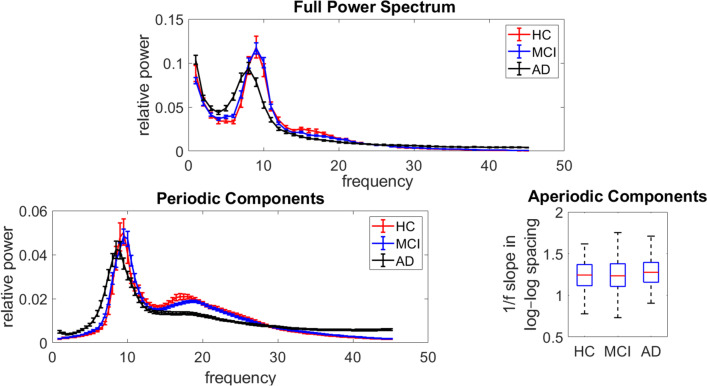
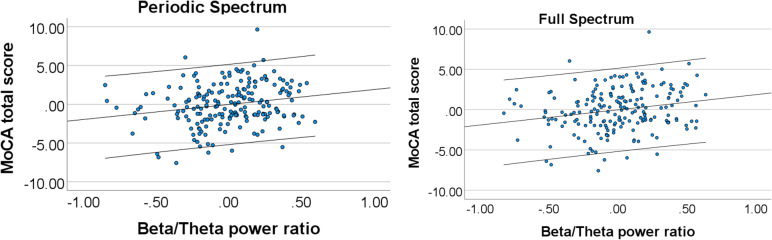
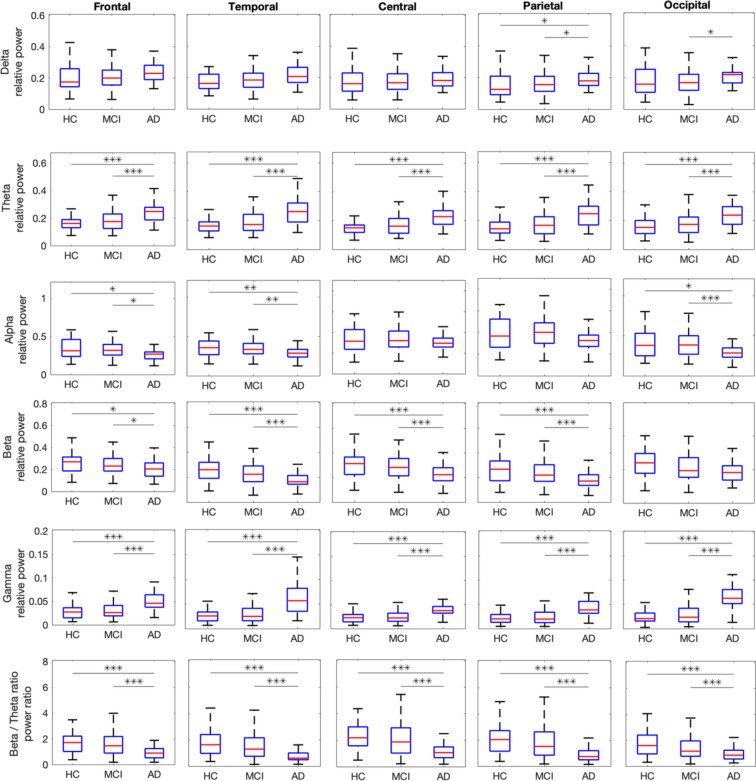
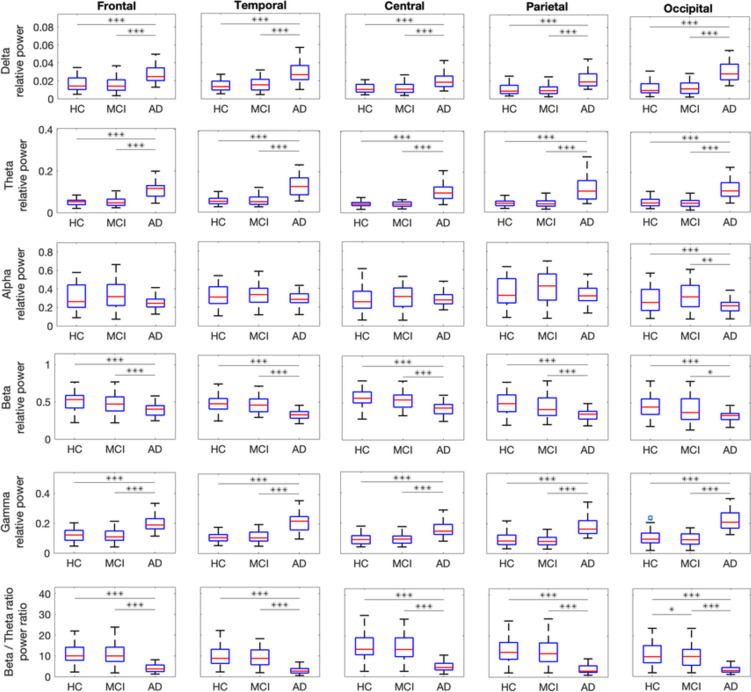
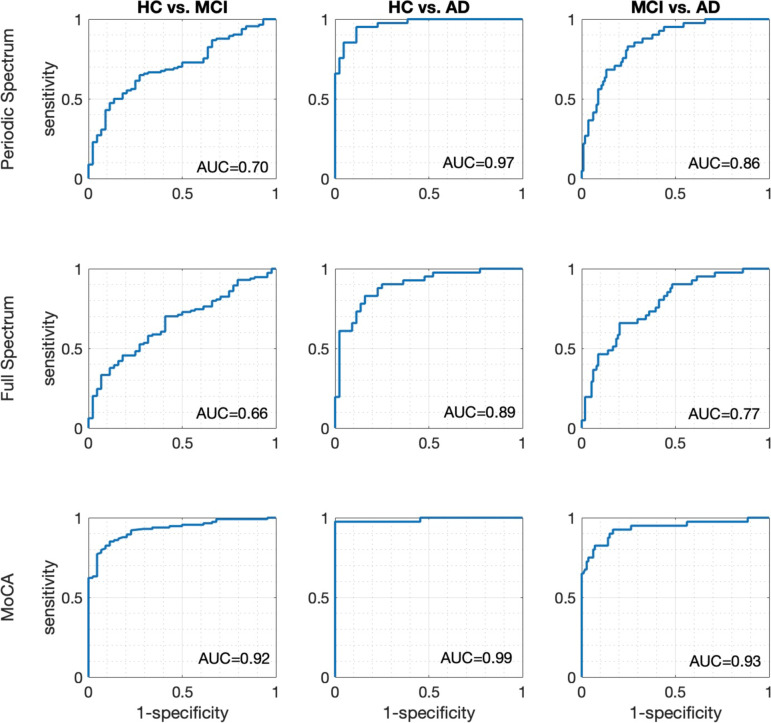
Aperiodic EEG components did not differ among the three groups. In contrast, AD participants showed an increase in full spectrum and periodic relative powers for delta, theta, and gamma and a decrease for beta when compared to HC or MCI participants. As predicted, MCI group differed from HC participants on the periodic based beta/theta ratio (Bonferroni corrected p-value = 0.036) measured over the occipital region. Classifiers based on beta/theta power ratio in EEG periodic components distinguished AD from HC and MCI participants, and outperformed classifiers based on beta/theta power ratio in full spectrum EEG. Beta/theta ratios were comparable in their association with cognition.
In contrast to a full spectrum EEG analysis, a periodic-based analysis shows that MCI individuals are different on beta/theta ratio when compared to healthy individuals. Focusing on periodic components in EEG studies with or without other biological markers of neurodegenerative diseases could result in more reliable findings to separate MCI from healthy aging, which would be valuable for designing preventative interventions.
阿尔茨海默病(AD)与脑电图(EEG)异常相关,包括β波与θ波频率的功率比。轻度认知障碍(MCI)的 EEG 研究在识别此类异常方面一直不太一致。一个潜在的原因是没有排除与认知的关联不如周期性成分强的 EEG 非周期性成分。在这里,我们研究了 AD 或 MCI 与健康对照组(HC)个体相比,非周期性和周期性 EEG 成分是否受到不同的破坏,以及基于周期性的β/θ 比值是否比基于全谱的比值更好地区分 MCI 与 AD 和 HC 组。
从 44 名 HC(平均年龄(标准差)= 69.1(5.3))、114 名 MCI(平均年龄(标准差)= 72.2(7.5))和 41 名 AD(平均年龄(标准差)= 75.7(6.5))参与者中收集数据。比较三组之间的非周期性和周期性成分和全谱 EEG。通过逻辑回归分类获得的接收者操作特征曲线用于区分组。最后,我们探索了认知表现与基于全谱或周期性谱的β/θ 比值之间的关系。
三组之间的非周期性 EEG 成分没有差异。相比之下,与 HC 或 MCI 参与者相比,AD 参与者的 delta、theta 和 gamma 全谱和周期性相对功率增加,而 beta 减少。正如预期的那样,MCI 组与 HC 组相比,在枕区测量的基于周期性的β/θ 比值(经 Bonferroni 校正的 p 值 = 0.036)上存在差异。基于 EEG 周期性成分的β/θ 功率比的分类器区分了 AD 与 HC 和 MCI 参与者,并且优于基于全谱 EEG 的β/θ 功率比的分类器。β/θ 比值在与认知的关联上是可比的。
与全谱 EEG 分析相比,基于周期性的分析表明,与健康个体相比,MCI 个体在β/θ 比值上存在差异。在 EEG 研究中关注周期性成分,无论是否存在神经退行性疾病的其他生物标志物,都可能会产生更可靠的发现,从而将 MCI 与健康衰老区分开来,这对于设计预防干预措施将是有价值的。