Department of Psychiatry, Leiden University Medical Center (LUMC), Leiden, the Netherlands.
Division of Behavioral Science, National Defense Medical College Research Institute, Saitama, Japan.
Eur J Psychotraumatol. 2023;14(2):2241732. doi: 10.1080/20008066.2023.2241732.
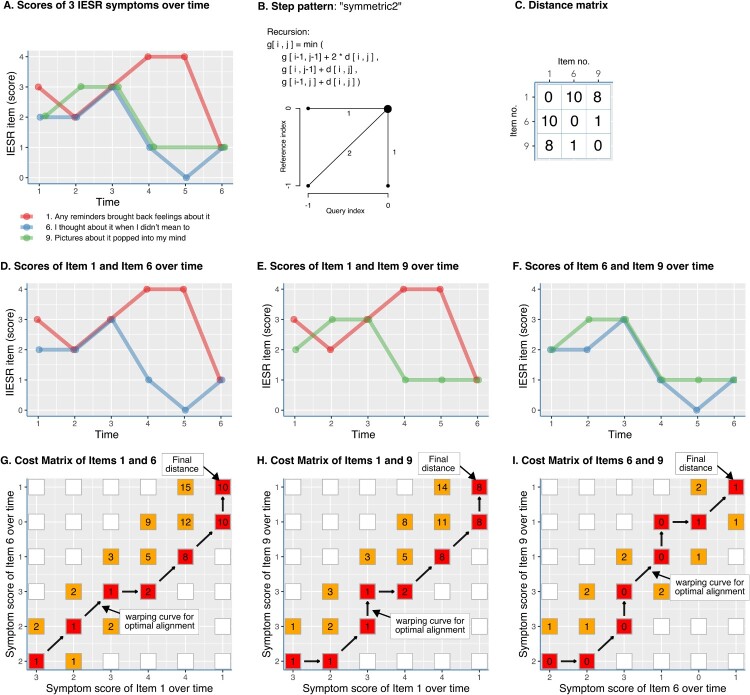
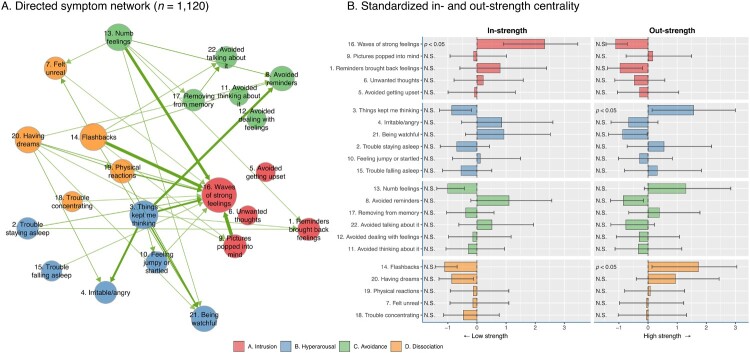
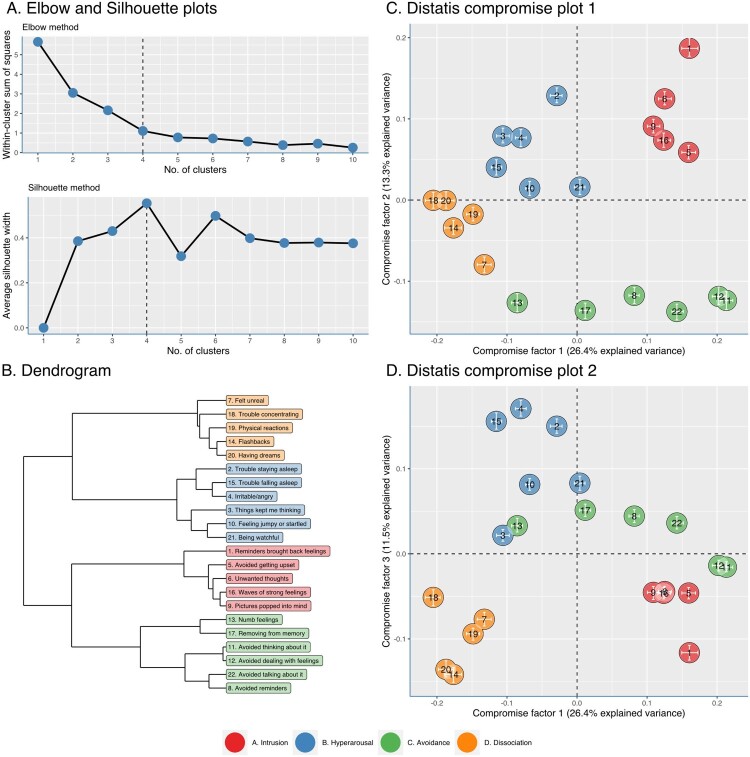
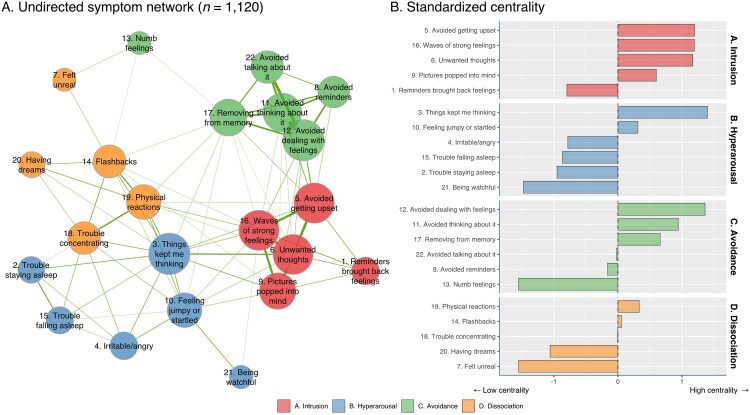
After the Great East Japan Earthquake [GEJE], approximately 70,000 Japan Ground Self Defense Force [JGSDF] personnel were deployed, risking Post-Traumatic Stress Disorder [PTSD]. The network approach to psychopathology suggests that symptoms may cause and exacerbate each other, resulting in the emergence and maintenance of disorders, including PTSD. It is therefore important to further explore the temporal interplay between symptoms. Most studies assessing the factor structure of the Impact of Event Scale-Revised [IES-R] have used cross-sectional designs. In this study, the structure of the IES-R was re-evaluated while incorporating the temporal interplay between symptoms. Using Dynamic Time Warping [DTW] the distances between PTSD symptoms on the IES-R were modelled in 1120 JGSDF personnel. Highly correlated symptoms were clustered at the group level using Distatis three-way principal component analyses of the distance matrices. The resulting clusters were compared to the original three subscales of the IES-R using a Confirmatory Factor Analysis (CFA). The DTW analysis yielded four symptom clusters: Intrusion (five items), Hyperarousal (six items), Avoidance (six items), and Dissociation (five items). CFA yielded better fit estimates for this four-factor solution (RMSEA = 0.084, CFI = 0.918, TLI = 0.906), compared to the original three subscales of the IES-R (RMSEA = 0.103, CFI = 0.873, TLI = 0.858). DTW offers a new method of modelling the temporal relationships between symptoms. It yielded four IES-R symptom clusters, which may facilitate understanding of PTSD as a complex dynamic system.
在东日本大地震[GEJE]之后,大约有 70000 名日本自卫队[JGSDF]人员冒着创伤后应激障碍[PTSD]的风险被部署。网络方法对精神病理学的研究表明,症状可能会相互导致和加剧,从而导致疾病的出现和维持,包括 PTSD。因此,进一步探讨症状之间的时间相互作用非常重要。大多数评估修订后的事件影响量表[IES-R]因子结构的研究都使用了横断面设计。在这项研究中,在纳入症状之间的时间相互作用的同时,重新评估了 IES-R 的结构。使用动态时间 warping[DTW],在 1120 名自卫队人员中对 IES-R 上的 PTSD 症状之间的距离进行建模。使用 Distatis 三向主成分分析距离矩阵,将高度相关的症状在群体水平上聚类。使用验证性因素分析(CFA)将得到的聚类与 IES-R 的原始三个子量表进行比较。DTW 分析得出了四个症状群:侵入(五个项目)、高度警觉(六个项目)、回避(六个项目)和分离(五个项目)。与 IES-R 的原始三个子量表相比,CFA 对这个四因子解决方案的拟合度估计更好(RMSEA=0.084,CFI=0.918,TLI=0.906),而不是 IES-R 的原始三个子量表(RMSEA=0.103,CFI=0.873,TLI=0.858)。DTW 提供了一种新的方法来模拟症状之间的时间关系。它产生了四个 IES-R 症状群,这可能有助于理解 PTSD 作为一个复杂的动态系统。