Mahardika T Nurul Qashri, Fuadah Yunendah Nur, Jeong Da Un, Lim Ki Moo
Computational Medicine Lab, Department of IT Convergence Engineering, Kumoh National Institute of Technology, Gumi 39177, Gyeongbuk, Republic of Korea.
School of Electrical Engineering, Telkom University, Bandung 40257, Indonesia.
Diagnostics (Basel). 2023 Aug 1;13(15):2566. doi: 10.3390/diagnostics13152566.
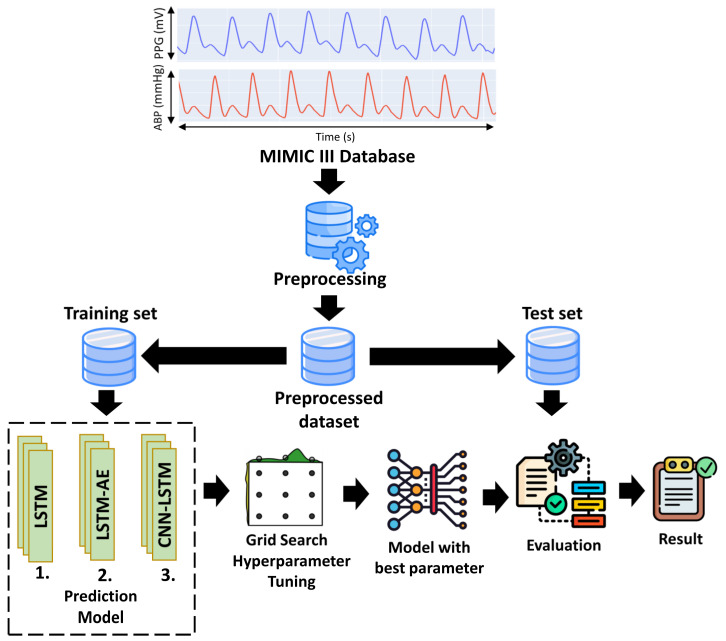
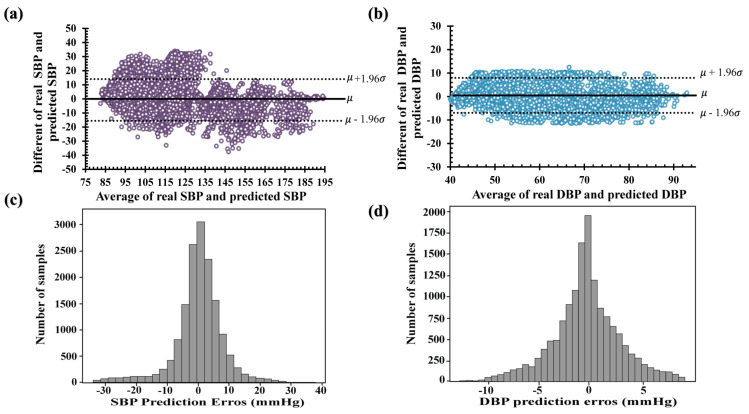
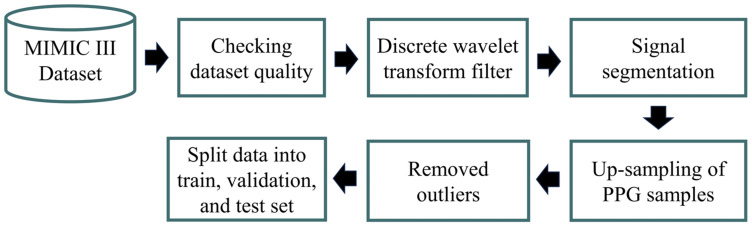
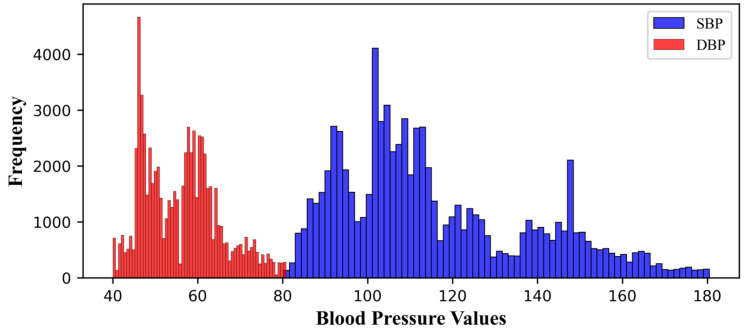
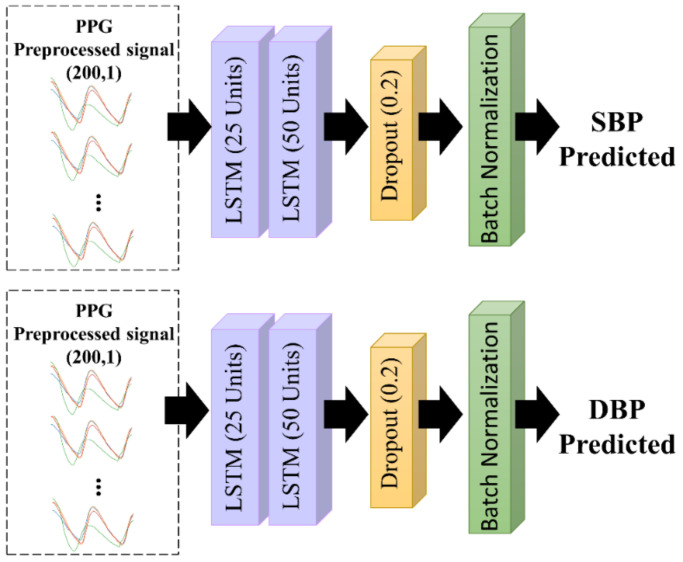
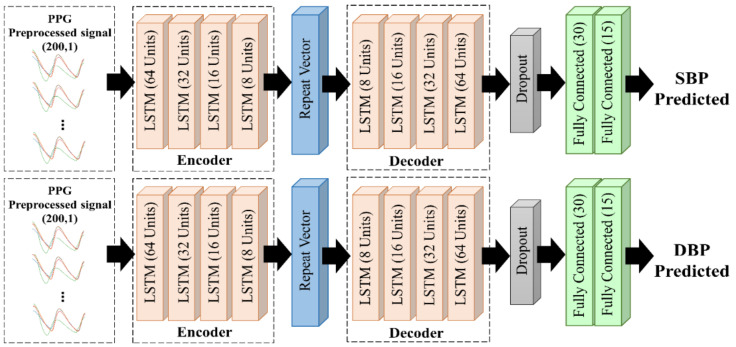
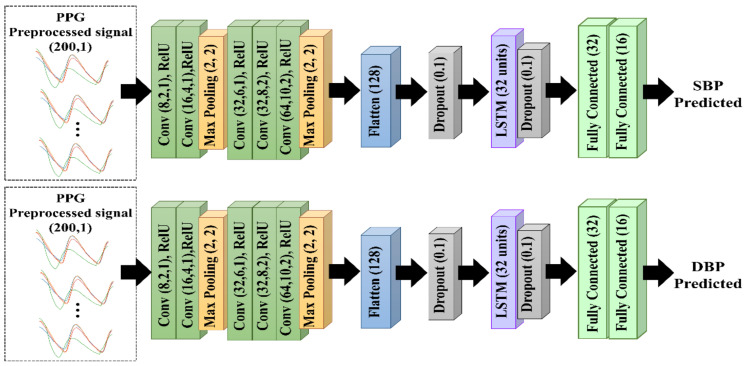
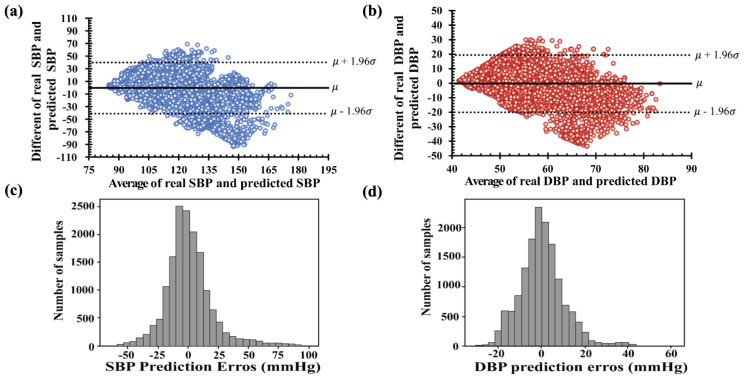
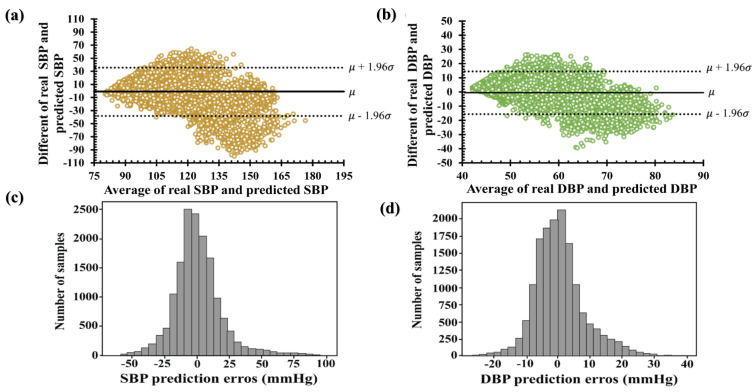
Researchers commonly use continuous noninvasive blood-pressure measurement (cNIBP) based on photoplethysmography (PPG) signals to monitor blood pressure conveniently. However, the performance of the system still needs to be improved. Accuracy and precision in blood-pressure measurements are critical factors in diagnosing and managing patients' health conditions. Therefore, we propose a convolutional long short-term memory neural network (CNN-LSTM) with grid search ability, which provides a robust blood-pressure estimation system by extracting meaningful information from PPG signals and reducing the complexity of hyperparameter optimization in the proposed model. The multiparameter intelligent monitoring for intensive care III (MIMIC III) dataset obtained PPG and arterial-blood-pressure (ABP) signals. We obtained 75,226 signal segments, with 60,180 signals allocated for training data, 12,030 signals allocated for the validation set, and 15,045 signals allocated for the test data. During training, we applied five-fold cross-validation with a grid-search method to select the best model and determine the optimal hyperparameter settings. The optimized configuration of the CNN-LSTM layers consisted of five convolutional layers, one long short-term memory (LSTM) layer, and two fully connected layers for blood-pressure estimation. This study successfully achieved good accuracy in assessing both systolic blood pressure (SBP) and diastolic blood pressure (DBP) by calculating the standard deviation (SD) and the mean absolute error (MAE), resulting in values of 7.89 ± 3.79 and 5.34 ± 2.89 mmHg, respectively. The optimal configuration of the CNN-LSTM provided satisfactory performance according to the standards set by the British Hypertension Society (BHS), the Association for the Advancement of Medical Instrumentation (AAMI), and the Institute of Electrical and Electronics Engineers (IEEE) for blood-pressure monitoring devices.
研究人员通常使用基于光电容积脉搏波描记法(PPG)信号的连续无创血压测量(cNIBP)来方便地监测血压。然而,该系统的性能仍有待提高。血压测量的准确性和精确性是诊断和管理患者健康状况的关键因素。因此,我们提出了一种具有网格搜索能力的卷积长短期记忆神经网络(CNN-LSTM),它通过从PPG信号中提取有意义的信息并降低所提出模型中超参数优化的复杂性,提供了一个强大的血压估计系统。重症监护III(MIMIC III)数据集获取了PPG和动脉血压(ABP)信号。我们获得了75226个信号段,其中60180个信号分配给训练数据,12030个信号分配给验证集,15045个信号分配给测试数据。在训练过程中,我们应用五折交叉验证和网格搜索方法来选择最佳模型并确定最优超参数设置。用于血压估计的CNN-LSTM层的优化配置由五个卷积层、一个长短期记忆(LSTM)层和两个全连接层组成。本研究通过计算标准差(SD)和平均绝对误差(MAE),在评估收缩压(SBP)和舒张压(DBP)方面均成功取得了良好的准确性,收缩压和舒张压的结果分别为7.89±3.79和5.34±2.89 mmHg。根据英国高血压协会(BHS)、医疗仪器促进协会(AAMI)和电气与电子工程师协会(IEEE)为血压监测设备设定的标准,CNN-LSTM的最优配置提供了令人满意的性能。