Kang Weixi
Department of Brain Sciences, Imperial College London, London W12 0BZ, UK.
Healthcare (Basel). 2023 Aug 5;11(15):2209. doi: 10.3390/healthcare11152209.
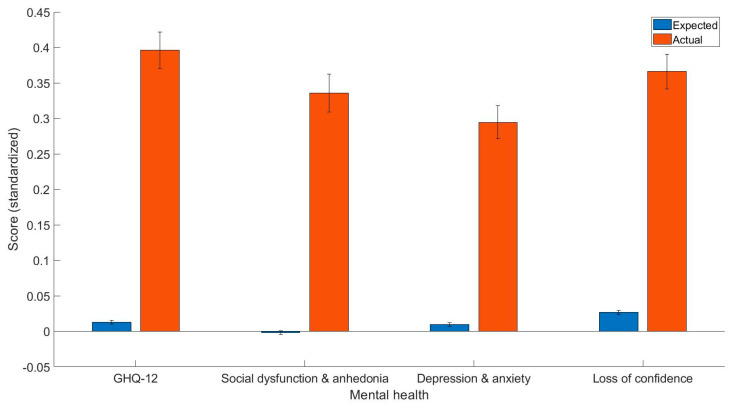
Epilepsy, a severe neurological disorder impacting approximately 50 million individuals worldwide, is associated with a high prevalence of mental health issues. However, existing research has predominantly examined the relationship between epilepsy and depression or anxiety, neglecting other dimensions of mental health as assessed by factor scores from the general health survey (GHQ), such as the GHQ-12. This study aimed to explore how epilepsy affects both general mental health and specific dimensions of mental health. By employing a factor analysis and a predictive normative modeling approach, the study examined 426 epilepsy patients and 39,171 individuals without epilepsy. The findings revealed that epilepsy patients experienced poorer general mental health and specific aspects of mental health. Consequently, this study highlights the validity of GHQ-12 as a measure of mental health problems in epilepsy patients and emphasizes the importance of considering the impact of epilepsy on various dimensions of mental health, rather than focusing solely on depression or anxiety. Clinicians should incorporate these study results into the development of interventions aimed at enhancing mental well-being in epilepsy patients, ultimately leading to improved outcomes.
癫痫是一种严重的神经系统疾病,全球约有5000万人受其影响,且常伴有高发性心理健康问题。然而,现有研究主要关注癫痫与抑郁或焦虑之间的关系,而忽略了通过一般健康调查(GHQ)因子得分评估的心理健康的其他维度,如GHQ - 12。本研究旨在探讨癫痫如何影响总体心理健康和心理健康的特定维度。通过采用因子分析和预测性规范建模方法,该研究对426名癫痫患者和39171名非癫痫患者进行了检查。研究结果显示,癫痫患者的总体心理健康状况和心理健康的特定方面较差。因此,本研究强调了GHQ - 12作为衡量癫痫患者心理健康问题指标的有效性,并强调了考虑癫痫对心理健康各个维度的影响的重要性,而不是仅仅关注抑郁或焦虑。临床医生应将这些研究结果纳入旨在提高癫痫患者心理健康水平的干预措施的制定中,最终改善治疗效果。