de Courson Benoît, Thouzeau Valentin, Baumard Nicolas
Max Planck Institute for the Study of Crime, Security and Law, Günterstalstraße 73, 79100 Freiburg, Germany.
Ecole Normale Superieure, Departement d'Etudes Cognitives, Departement d'Etudes Cognitives, Paris, France.
Evol Hum Sci. 2023 Apr 13;5:e19. doi: 10.1017/ehs.2023.6. eCollection 2023.
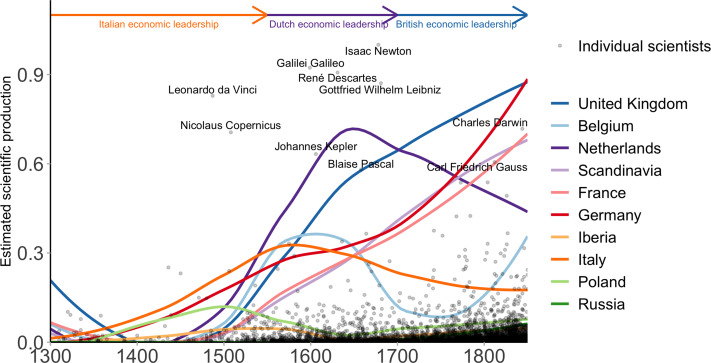
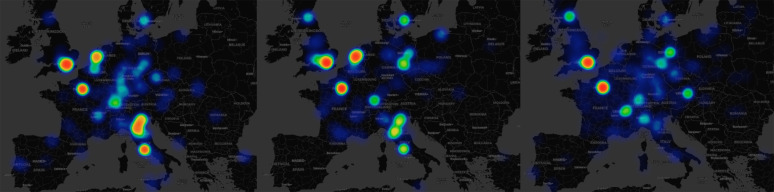
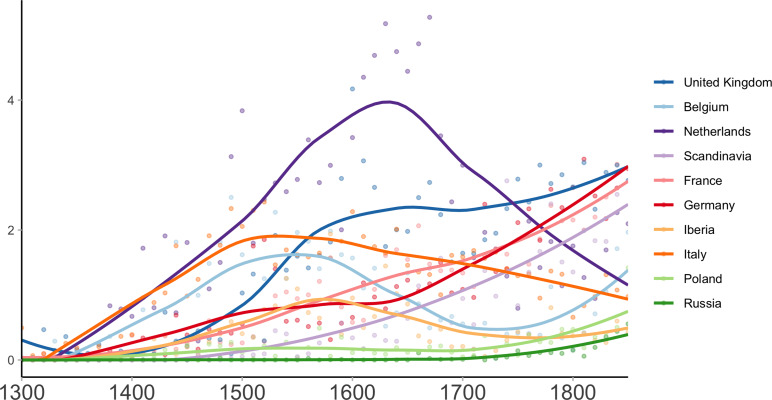
The Scientific Revolution represents a turning point in the history of humanity. Yet it remains ill-understood, partly because of a lack of quantification. Here, we leverage large datasets of individual biographies ( = 22,943) and present the first estimates of scientific production during the late medieval and early modern period (1300-1850). Our data reveal striking differences across countries, with England and the United Provinces being much more creative than other countries, suggesting that economic development has been key in generating the Scientific Revolution. In line with recent results in behavioural sciences, we show that scientific creativity and economic development are associated with other kinds of creative activities in philosophy, literature, music and the arts, as well as with inclusive institutions and ascetic religiosity, suggesting a common underlying mindset associated with long-term orientation and exploration. Finally, we investigate the interplay between economic development and cultural transmission (the so-called 'Republic of Letters') using partially observed Markov models imported from population biology. Surprisingly, the role of horizontal transmission (from one country to another) seems to have been marginal. Beyond the case of science, our results suggest that economic development is an important factor in the evolution of aspects of human culture.
科学革命代表了人类历史上的一个转折点。然而,它仍然没有得到很好的理解,部分原因是缺乏量化研究。在这里,我们利用了大量个人传记数据集(=22943个),并给出了中世纪晚期和近代早期(1300 - 1850年)科学产出的首次估算。我们的数据揭示了各国之间的显著差异,英国和联合省比其他国家更具创造力,这表明经济发展是引发科学革命的关键因素。与行为科学的近期研究结果一致,我们表明科学创造力和经济发展与哲学、文学、音乐和艺术等其他类型的创造性活动,以及与包容性机构和苦行宗教信仰相关联,这表明存在一种与长期导向和探索相关的共同潜在思维模式。最后,我们使用从群体生物学引入的部分观测马尔可夫模型,研究了经济发展与文化传播(即所谓的“文人共和国”)之间的相互作用。令人惊讶的是,横向传播(从一个国家到另一个国家)的作用似乎微不足道。除了科学领域,我们的研究结果表明经济发展是人类文化某些方面演变的一个重要因素。