Vanderbilt Microbiome Innovation Center, Vanderbilt University, Nashville, Tennessee, United States of America.
Department of Biological Sciences, Vanderbilt University, Nashville, Tennessee, United States of America.
PLoS Biol. 2023 Aug 17;21(8):e3002230. doi: 10.1371/journal.pbio.3002230. eCollection 2023 Aug.
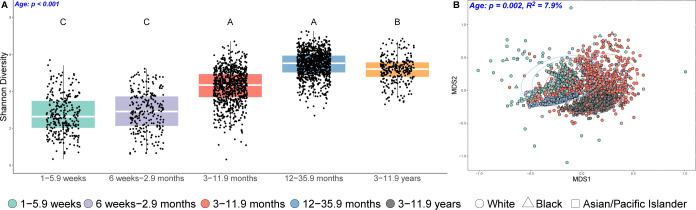
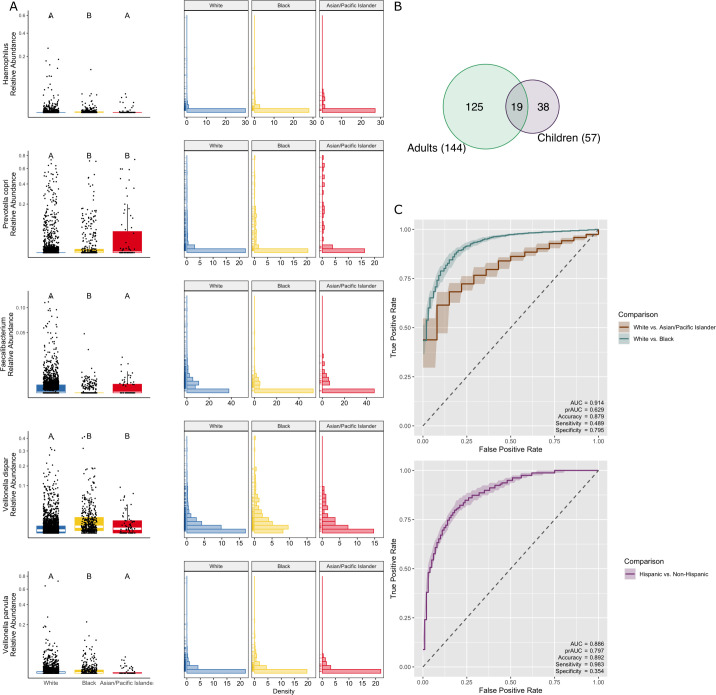
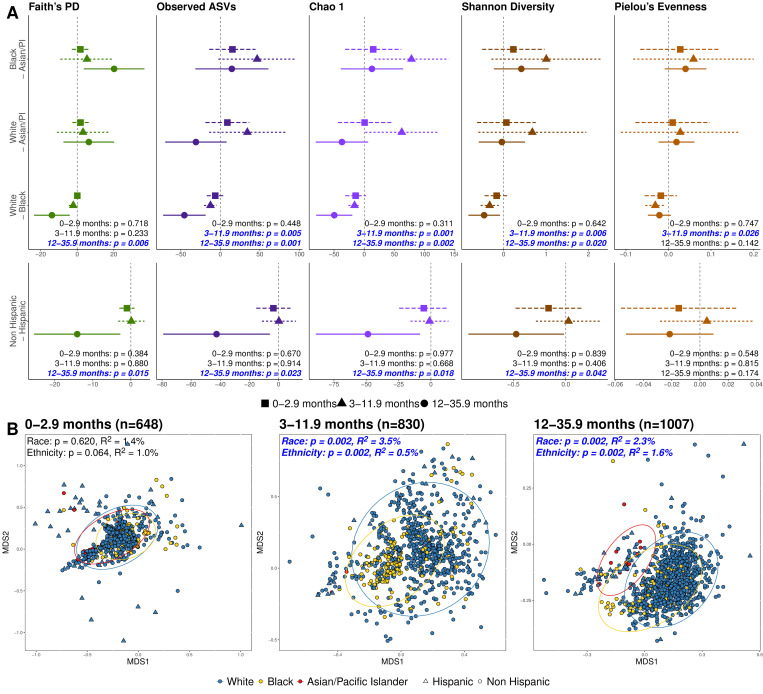
Human microbiome variation is linked to the incidence, prevalence, and mortality of many diseases and associates with race and ethnicity in the United States. However, the age at which microbiome variability emerges between these groups remains a central gap in knowledge. Here, we identify that gut microbiome variation associated with race and ethnicity arises after 3 months of age and persists through childhood. One-third of the bacterial taxa that vary across caregiver-identified racial categories in children are taxa reported to also vary between adults. Machine learning modeling of childhood microbiomes from 8 cohort studies (2,756 samples from 729 children) distinguishes racial and ethnic categories with 87% accuracy. Importantly, predictive genera are also among the top 30 most important taxa when childhood microbiomes are used to predict adult self-identified race and ethnicity. Our results highlight a critical developmental window at or shortly after 3 months of age when social and environmental factors drive race and ethnicity-associated microbiome variation and may contribute to adult health and health disparities.
人类微生物组的变化与许多疾病的发病率、患病率和死亡率有关,并且与美国的种族和民族有关。然而,这些群体之间微生物组可变性出现的年龄仍然是知识的一个主要空白。在这里,我们发现与种族和民族相关的肠道微生物组的变化发生在 3 个月大之后,并持续到儿童期。在儿童中,与看护者确定的种族类别相关的细菌分类群中有三分之一是报告在成人之间也存在差异的分类群。来自 8 项队列研究(2756 个样本来自 729 个儿童)的儿童微生物组的机器学习模型以 87%的准确率区分种族和民族类别。重要的是,当使用儿童微生物组预测成人自我确定的种族和民族时,预测属也是最重要的前 30 个分类群之一。我们的研究结果强调了一个关键的发育窗口期,即在 3 个月左右或之后,社会和环境因素会导致与种族和民族相关的微生物组变化,并可能影响成年人的健康和健康差异。