Grau-Del Valle Carmen, Fernández Javier, Solá Eva, Montoya-Castilla Inmaculada, Morillas Carlos, Bañuls Celia
Department of Endocrinology and Nutrition, University Hospital Doctor Peset, Foundation for the Promotion of Health and Biomedical Research in the Valencian Region (FISABIO), Valencia, Spain.
Department of Medicine, University of Valencia, Valencia, Spain.
Front Psychol. 2023 Aug 3;14:1215674. doi: 10.3389/fpsyg.2023.1215674. eCollection 2023.
In recent years, it has been described that the dysbiosis of the intestinal microbiota plays a transcendental role in several pathologies. In this sense, the importance of the gut microbiota in the gut-brain axis, with a bidirectional communication, has been demonstrated. Furthermore, the gut microbiota has been linked with mood disorders and neuropsychiatric disorders.
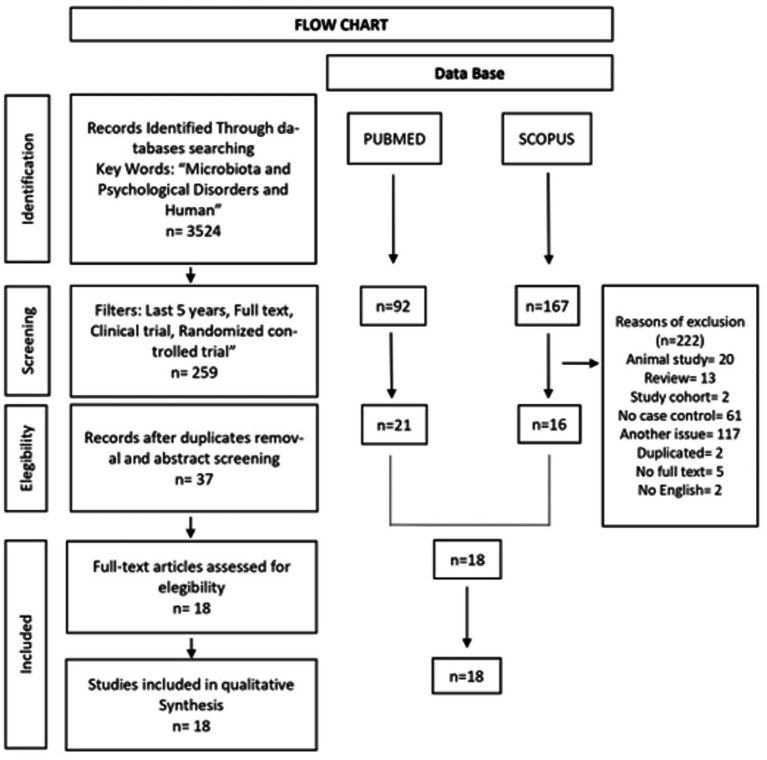
A systematic review of two databases - PubMed and Scopus - was carried out following PRISMA guidelines. We included original studies in humans with a control group published in the last 11 years, which were assessed by the Critical Appraisal Skills Program (CASP) to confirm their quality. Eighteen articles met all the selection criteria.
A review of the articles revealed an association between psychiatric disorders and different bacterial phyla. The studies we have reviewed have demonstrated differences between subjects with psychiatric disorders and controls and highlight a clear relationship between depression, stress, autism spectrum disorder (ASD), psychotic episodes, eating disorders, anxiety and brain function and the gut microbiota composition.
A reduction of fermentative taxa has been observed in different psychiatric disorders, resulting in a decrease in the production of short-chain fatty acids (SCFAs) and an increase in pro-inflammatory taxa, both of which may be consequences of the exacerbation of these pathologies.
近年来,已有研究表明肠道微生物群失调在多种疾病中发挥着至关重要的作用。从这个意义上说,肠道微生物群在肠-脑轴中的重要性已得到证实,其具有双向通信功能。此外,肠道微生物群还与情绪障碍和神经精神疾病有关。
按照PRISMA指南对两个数据库——PubMed和Scopus进行了系统综述。我们纳入了过去11年发表的、设有对照组的人体原始研究,并通过批判性评估技能计划(CASP)对其质量进行评估。18篇文章符合所有入选标准。
对这些文章的综述揭示了精神疾病与不同细菌门类之间的关联。我们所综述的研究表明,患有精神疾病的受试者与对照组之间存在差异,并突出了抑郁症、压力、自闭症谱系障碍(ASD)、精神病发作、饮食失调、焦虑与脑功能和肠道微生物群组成之间的明确关系。
在不同的精神疾病中均观察到发酵类群减少,导致短链脂肪酸(SCFAs)生成减少,促炎类群增加,而这两者可能都是这些疾病恶化的后果。