Kuang Grace, Halimitabrizi Mina, Edziah Amy-Ann, Salowe Rebecca, O'Brien Joan M
Perelman School of Medicine, Scheie Eye Institute, University of Pennsylvania, Philadelphia, PA, United States.
Penn Medicine Center for Genetics in Complex Diseases, University of Pennsylvania, Philadelphia, PA, United States.
Front Physiol. 2023 Aug 2;14:1184060. doi: 10.3389/fphys.2023.1184060. eCollection 2023.
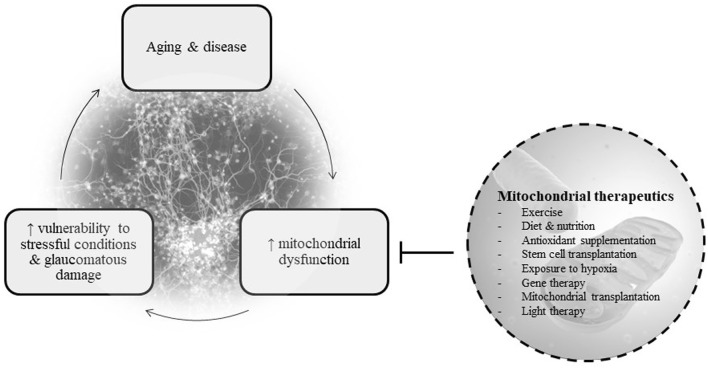
Glaucoma, an age-related neurodegenerative disease, is characterized by the death of retinal ganglion cells (RGCs) and the corresponding loss of visual fields. This disease is the leading cause of irreversible blindness worldwide, making early diagnosis and effective treatment paramount. The pathophysiology of primary open-angle glaucoma (POAG), the most common form of the disease, remains poorly understood. Current available treatments, which target elevated intraocular pressure (IOP), are not effective at slowing disease progression in approximately 30% of patients. There is a great need to identify and study treatment options that target other disease mechanisms and aid in neuroprotection for POAG. Increasingly, the role of mitochondrial injury in the development of POAG has become an emphasized area of research interest. Disruption in the function of mitochondria has been linked to problems with neurodevelopment and systemic diseases. Recent studies have shown an association between RGC death and damage to the cells' mitochondria. In particular, oxidative stress and disrupted oxidative phosphorylation dynamics have been linked to increased susceptibility of RGC mitochondria to secondary mechanical injury. Several mitochondria-targeted treatments for POAG have been suggested, including physical exercise, diet and nutrition, antioxidant supplementation, stem cell therapy, hypoxia exposure, gene therapy, mitochondrial transplantation, and light therapy. Studies have shown that mitochondrial therapeutics may have the potential to slow the progression of POAG by protecting against mitochondrial decline associated with age, genetic susceptibility, and other pathology. Further, these therapeutics may potentially target already present neuronal damage and symptom manifestations. In this review, the authors outline potential mitochondria-targeted treatment strategies and discuss their utility for use in POAG.
青光眼是一种与年龄相关的神经退行性疾病,其特征是视网膜神经节细胞(RGCs)死亡以及相应的视野缺损。这种疾病是全球不可逆失明的主要原因,因此早期诊断和有效治疗至关重要。原发性开角型青光眼(POAG)是该疾病最常见的形式,其病理生理学仍知之甚少。目前针对眼压升高的现有治疗方法,在大约30%的患者中并不能有效减缓疾病进展。迫切需要确定和研究针对其他疾病机制并有助于POAG神经保护的治疗方案。线粒体损伤在POAG发生发展中的作用日益成为研究热点。线粒体功能紊乱与神经发育问题和全身性疾病有关。最近的研究表明,RGC死亡与细胞线粒体损伤之间存在关联。特别是,氧化应激和氧化磷酸化动力学紊乱与RGC线粒体对继发性机械损伤的易感性增加有关。已经提出了几种针对POAG的线粒体靶向治疗方法,包括体育锻炼、饮食与营养、抗氧化剂补充、干细胞治疗、低氧暴露、基因治疗、线粒体移植和光疗。研究表明,线粒体治疗可能有潜力通过防止与年龄、遗传易感性和其他病理相关的线粒体衰退来减缓POAG的进展。此外,这些治疗方法可能潜在地针对已经存在的神经元损伤和症状表现。在这篇综述中,作者概述了潜在的线粒体靶向治疗策略,并讨论了它们在POAG中的应用价值。