Institute of Movement and Neurosciences, German Sport University Cologne, Cologne, Germany.
Institute of Exercise Training and Sport Informatics, German Sport University Cologne, Cologne, Germany.
Sports Med. 2023 Dec;53(12):2463-2475. doi: 10.1007/s40279-023-01903-3. Epub 2023 Aug 21.
Gas exchange data from maximum oxygen uptake ([Formula: see text]) testing typically require post-processing. Different processing strategies may lead to varying [Formula: see text] values affecting their interpretation. However, the exact processing strategies used in the literature have yet to be systematically investigated. Previous research investigated differences across methods at the group level only.
Out of a random sample, we investigated 242 recently published articles that measured [Formula: see text] during ramp tests. Reported data processing methods and their rationale were extracted. We compared the most common processing strategies on a data set of 72 standardized exercise tests in trained athletes.
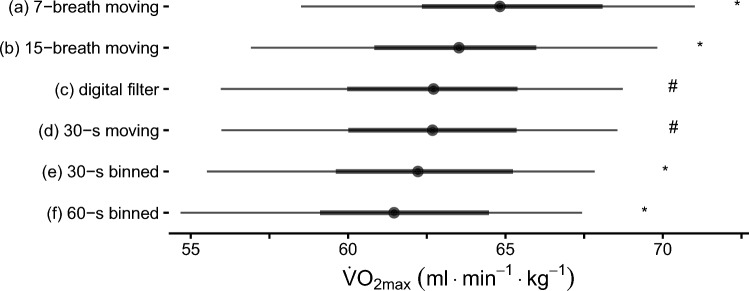
Half of the included studies did not report their data processing strategy and almost all articles failed to provide a rationale for the particular strategy chosen. Most studies use binned time averages to determine [Formula: see text], with a minority using moving time or moving breath averages. The processing strategies found in the literature can lead to mean differences in [Formula: see text] of more than 5% (range 0-7%) with considerable variation at the individual level.
We advise researchers to change their processing strategy and use moving averages or digital filters instead of binned averages. Researchers should report their data processing strategy used to determine [Formula: see text]. We provide a reporting checklist of seven items that can function as a template for reporting.
最大摄氧量([Formula: see text])测试中的气体交换数据通常需要进行后处理。不同的处理策略可能会导致不同的[Formula: see text]值,从而影响其解释。然而,文献中使用的确切处理策略尚未系统地研究过。以前的研究仅在组水平上调查了不同方法之间的差异。
我们从随机样本中调查了 242 篇最近发表的测量递增负荷试验中[Formula: see text]的文章。提取了报告的数据处理方法及其原理。我们比较了 72 名训练有素的运动员标准化运动测试数据集中最常见的处理策略。
纳入研究的一半未报告其数据处理策略,几乎所有文章都未能为所选择的特定策略提供理由。大多数研究使用分组时间平均值来确定[Formula: see text],少数研究使用移动时间或移动呼吸平均值。文献中发现的处理策略可能导致[Formula: see text]的平均差异超过 5%(范围 0-7%),个体水平差异较大。
我们建议研究人员改变他们的处理策略,使用移动平均值或数字滤波器代替分组平均值。研究人员应报告用于确定[Formula: see text]的数据分析处理策略。我们提供了一个包含七个项目的报告清单,可以作为报告模板。