Porto-Álvarez Jacobo, Cernadas Eva, Aldaz Martínez Rebeca, Fernández-Delgado Manuel, Huelga Zapico Emilio, González-Castro Víctor, Baleato-González Sandra, García-Figueiras Roberto, Antúnez-López J Ramon, Souto-Bayarri Miguel
Department of Radiology, Complexo Hospitalario Universitario de Santiago de Compostela, 15706 Santiago de Compostela, Spain.
Centro Singular de Investigación en Tecnoloxías Intelixentes da USC (CiTIUS), Universidade de Santiago de Compostela, 15705 Santiago de Compostela, Spain.
Biomedicines. 2023 Jul 29;11(8):2144. doi: 10.3390/biomedicines11082144.
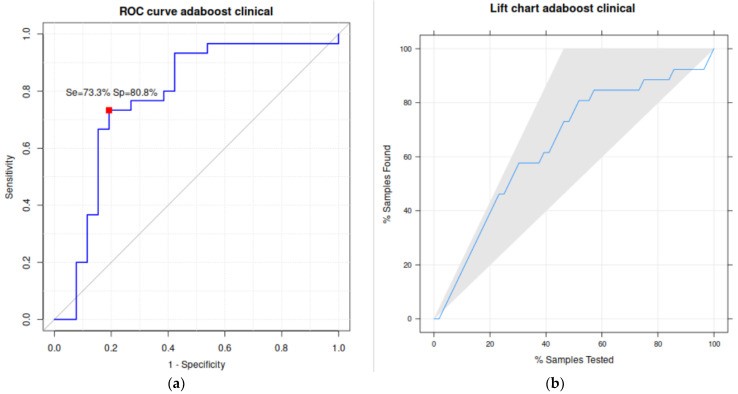
Colorectal cancer (CRC) is one of the most common types of cancer worldwide. The mutation is present in 30-50% of CRC patients. This mutation confers resistance to treatment with anti-EGFR therapy. This article aims at proving that computer tomography (CT)-based radiomics can predict the mutation in CRC patients. The piece is a retrospective study with 56 CRC patients from the Hospital of Santiago de Compostela, Spain. All patients had a confirmatory pathological analysis of the status. Radiomics features were obtained using an abdominal contrast enhancement CT (CECT) before applying any treatments. We used several classifiers, including AdaBoost, neural network, decision tree, support vector machine, and random forest, to predict the presence or absence of mutation. The most reliable prediction was achieved using the AdaBoost ensemble on clinical patient data, with a kappa and accuracy of 53.7% and 76.8%, respectively. The sensitivity and specificity were 73.3% and 80.8%. Using texture descriptors, the best accuracy and kappa were 73.2% and 46%, respectively, with sensitivity and specificity of 76.7% and 69.2%, also showing a correlation between texture patterns on CT images and mutation. Radiomics could help manage CRC patients, and in the future, it could have a crucial role in diagnosing CRC patients ahead of invasive methods.
结直肠癌(CRC)是全球最常见的癌症类型之一。30%-50%的CRC患者存在该突变。这种突变赋予了对表皮生长因子受体(EGFR)靶向治疗的耐药性。本文旨在证明基于计算机断层扫描(CT)的放射组学能够预测CRC患者的该突变情况。该研究是一项回顾性研究,纳入了来自西班牙圣地亚哥德孔波斯特拉医院的56例CRC患者。所有患者均对该状态进行了确诊性病理分析。在进行任何治疗前,通过腹部增强CT(CECT)获取放射组学特征。我们使用了多种分类器,包括AdaBoost、神经网络、决策树、支持向量机和随机森林,来预测该突变的有无。使用AdaBoost集成模型对临床患者数据进行预测时获得了最可靠的结果,kappa值和准确率分别为53.7%和76.8%。敏感性和特异性分别为73.3%和80.8%。使用纹理描述符时,最佳准确率和kappa值分别为73.2%和46%,敏感性和特异性分别为76.7%和69.2%,这也显示了CT图像上的纹理模式与该突变之间的相关性。放射组学有助于CRC患者的管理,并且在未来,它可能在侵入性方法之前对CRC患者的诊断中发挥关键作用。