Department of Epidemiology, School of Public Health and Tropical Medicine, Tulane University, New Orleans, LA 70118, USA.
Department of Nutrition, Harvard T.H. Chan School of Public Health, Boston, MA 02115, USA.
Nutrients. 2023 Aug 21;15(16):3665. doi: 10.3390/nu15163665.
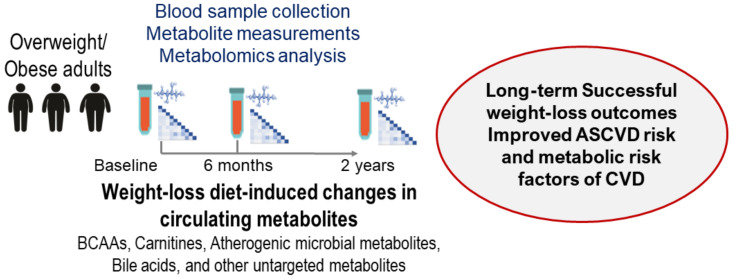
The POUNDS Lost trial is a 2-year clinical trial testing the effects of dietary interventions on weight loss. This study included 811 adults with overweight or obesity who were randomized to one of four diets that contained either 15% or 25% protein and 20% or 40% fat in a 2 × 2 factorial design. By 2 years, participants on average lost from 2.9 to 3.6 kg in body weight in the four intervention arms, while no significant difference was observed across the intervention arms. In POUNDS Lost, we performed a series of ancillary studies to detect intrinsic factors particular to genomic, epigenomic, and metabolomic markers that may modulate changes in weight and other cardiometabolic traits in response to the weight-loss dietary interventions. Genomic variants identified from genome-wide association studies (GWASs) on obesity, type 2 diabetes, glucose and lipid metabolisms, gut microbiome, and dietary intakes have been found to interact with dietary macronutrients (fat, protein, and carbohydrates) in relation to weight loss and changes of body composition and cardiometabolic traits. In addition, we recently investigated epigenomic modifications, particularly blood DNA methylation and circulating microRNAs (miRNAs). We reported DNA methylation levels at , , , and were related to weight loss or changes of glucose, lipids, and blood pressure; we also reported thrifty miRNA expression as a significant epigenomic marker related to changes in insulin sensitivity and adiposity. Our studies have also highlighted the importance of temporal changes in novel metabolomic signatures for gut microbiota, bile acids, and amino acids as predictors for achievement of successful weight loss outcomes. Moreover, our studies indicate that biochemical, behavioral, and psychosocial factors such as physical activity, sleep disturbance, and appetite may also modulate metabolic changes during dietary interventions. This review summarized our major findings in the POUNDS Lost trial, which provided preliminary evidence supporting the development of precision diet interventions for obesity management.
POUNDS Lost 试验是一项为期 2 年的临床试验,旨在测试饮食干预对减肥的影响。该研究纳入了 811 名超重或肥胖成年人,他们被随机分配到四种饮食组之一,这四种饮食组的蛋白质含量分别为 15%或 25%,脂肪含量分别为 20%或 40%,采用 2×2 析因设计。到 2 年时,四组干预组参与者的体重平均减轻了 2.9 至 3.6 公斤,而四组干预之间没有观察到显著差异。在 POUNDS Lost 试验中,我们进行了一系列辅助研究,以检测特定于基因组、表观基因组和代谢组学标记的内在因素,这些因素可能调节体重和其他心血管代谢特征对减肥饮食干预的变化。从肥胖、2 型糖尿病、葡萄糖和脂质代谢、肠道微生物组和饮食摄入的全基因组关联研究(GWAS)中确定的基因组变异已被发现与饮食中的宏量营养素(脂肪、蛋白质和碳水化合物)相互作用,与减肥以及身体成分和心血管代谢特征的变化有关。此外,我们最近研究了表观基因组修饰,特别是血液 DNA 甲基化和循环 microRNAs(miRNAs)。我们报告了与体重减轻或葡萄糖、脂质和血压变化相关的、、和 处的 DNA 甲基化水平;我们还报告了节俭的 miRNA 表达作为与胰岛素敏感性和肥胖变化相关的重要表观基因组标记。我们的研究还强调了肠道微生物群、胆汁酸和氨基酸的新型代谢组学特征的时间变化作为成功减肥结果预测指标的重要性。此外,我们的研究表明,生化、行为和心理社会因素,如体力活动、睡眠障碍和食欲,也可能调节饮食干预期间的代谢变化。本综述总结了我们在 POUNDS Lost 试验中的主要发现,这些发现为肥胖管理的精准饮食干预提供了初步证据。