Misra Shashi Kiran, Pandey Himanshu, Patil Sandip, Virmani Tarun, Virmani Reshu, Kumar Girish, Alhalmi Abdulsalam, Noman Omar M, Alshahrani Saad S, Mothana Ramzi A
School of Pharmaceutical Sciences, Department of pharmacy, Chhatrapati Shahu Ji Maharaj University, Kanpur 208024, India.
Center for Teacher Education, Central Institute of Higher Tibetan Studies, Sarnath, Varanasi 221007, India.
Nanomaterials (Basel). 2023 Aug 10;13(16):2305. doi: 10.3390/nano13162305.
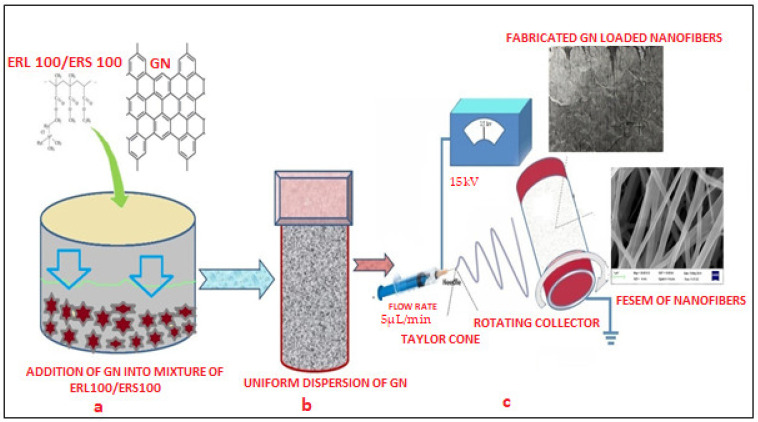
Exclusive physicochemical and biological properties of carbon allotrope graphene have attracted the peer attention of researchers for the synthesis and development of newer topical remedies including films, scaffolds, microspheres, and hydrogels. Here, graphene nanoplatelets (GN) were embedded into a different ratio of polymeric ERL100/ERS100 solution and fabricated in the form of a scaffold through the electrospinning process. FTIR spectra displayed characteristic similar peaks present both in GN and GN-loaded scaffold owing to the compatibility of GN and polymeric mixture. XRD curve revealed a distinct GN peak at nearly 26° whereas from DSC/TGA thermal stability was observed between polymers and graphene nanoplatelets. FESEM images showed ultrathin architecture of GN-loaded scaffold in a range of 280 ± 90 nm. The fabricated scaffold exhibited hydrophilicity (contact angle 48.8 ± 2.8°) and desirable swelling index (646% in skin pH media) which were desired criteria for the scaffold for topical application. In vitro, antifungal activity was conducted through the broth microdilution method against different virulent dermatophytes i.e., , , , and . For in vivo evaluation, inoculum was applied on the dorsal surface of each group of Swiss albino mice, and the degree and intensity of mycelial growth or erythema on skin surfaces was visually investigated. The study depicted complete signs of cure after 14 days of application of G3-loaded scaffold on the infected dorsal site. Hence graphene-loaded scaffold represented a possible alternative for the treatment of topical fungal infections caused by dermatophytes.
碳同素异形体石墨烯独特的物理化学和生物学特性吸引了研究人员的关注,促使他们合成和开发更新型的局部治疗药物,包括薄膜、支架、微球和水凝胶。在此,将石墨烯纳米片(GN)嵌入不同比例的聚合物ERL100/ERS100溶液中,并通过静电纺丝工艺制成支架形式。傅里叶变换红外光谱(FTIR)显示,由于GN与聚合物混合物的相容性,GN和负载GN的支架中都出现了特征相似的峰。X射线衍射(XRD)曲线显示在近26°处有一个明显的GN峰,而差示扫描量热法/热重分析法(DSC/TGA)观察到聚合物和石墨烯纳米片之间的热稳定性。场发射扫描电子显微镜(FESEM)图像显示负载GN的支架具有280±90nm范围内的超薄结构。制备的支架表现出亲水性(接触角48.8±2.8°)和理想的溶胀指数(在皮肤pH介质中为646%),这是局部应用支架的理想标准。在体外,通过肉汤微量稀释法对不同的致病性皮肤癣菌,即 、 、 和 进行抗真菌活性测试。为了进行体内评估,将接种物应用于每组瑞士白化小鼠的背部表面,并直观地研究皮肤表面菌丝生长或红斑的程度和强度。该研究表明,在感染的背部部位应用负载G3的支架14天后出现了完全治愈的迹象。因此,负载石墨烯的支架代表了一种治疗由皮肤癣菌引起的局部真菌感染的可能替代方法。