Hou Zhichao, Sun Zhu, Du Guolian, Shao Dengkui, Zhong Qiwen, Yang Shipeng
Qinghai Key Laboratory of Vegetable Genetics and Physiology, Agriculture and Forestry Sciences Institute of Qinghai University, Xining, PR China.
Laboratory for Research and Utilization of Germplasm Resources in Qinghai Tibet Plateau, Xining, PR China.
Heliyon. 2023 Aug 6;9(8):e18974. doi: 10.1016/j.heliyon.2023.e18974. eCollection 2023 Aug.
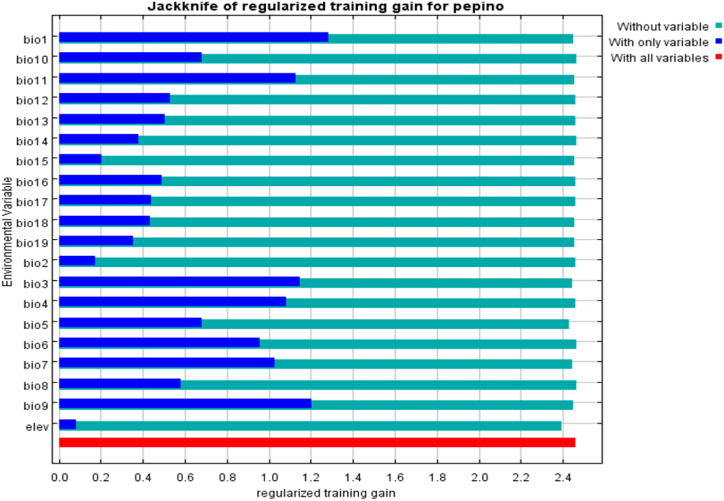
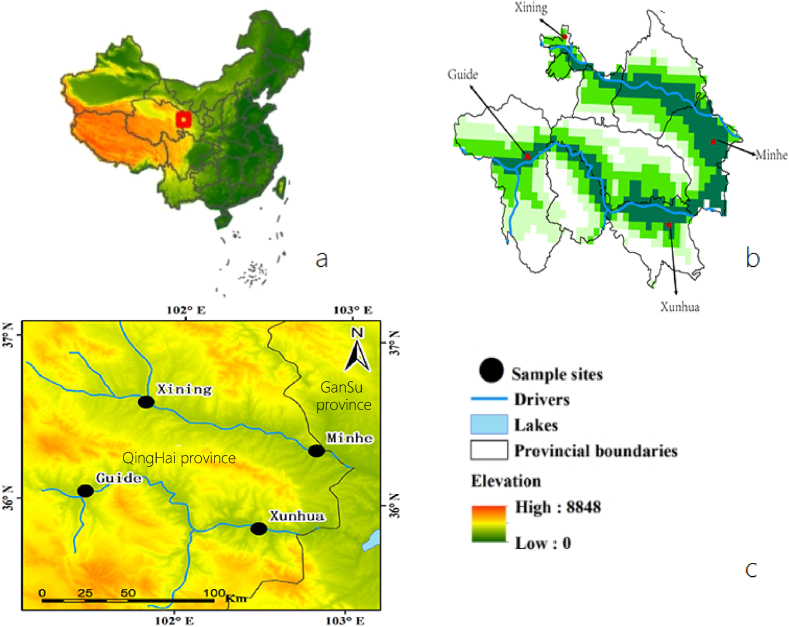
Pepino (), a member of the Solanaceae family originating from South America, is cultivated globally. However, the cultivation range and suitable habitat of Pepino have not been extensively studied, which hampers the further development of its cultivation industry. Therefore, we aimed at enrich and expand the planting scope of Pepino. Currently, the main cultivation areas of Pepino in China are the Yunnan-Guizhou Plateau and the Loess Plateau, where the altitude is above 1000 m. In this study, ArcGIS combined with the MaxEnt model was used for prediction, whose area under curve value was 0.949. The main climatic factors affecting the distribution of Pepino are temperature seasonality, annual means temperature, mean temperature of the coldest quarter, elevation, isothermality, and the climate factors, and their cumulative contribution rate of 87.6%. Pepino's main potential distribution areas are located in Yunnan-Guizhou Plateau, Yunnan Province, Hexi Corridor of Loess Plateau, and low altitude areas of Qinghai-Tibet Plateau. The main distribution ranges from 1000 to 2000 m above sea level, and the total suitable area accounts for 20.09% of China's total land area. The prediction results reveal an expanded potential area for Pepino, with no significant migration in the central region of the main potential distribution area by 2050 and 2070. No studies have been conducted on the open-area cultivation of Pepino in northern China. Our findings revealed that the yield and quality in the four experimental sites and final actual cultivation conditions were consistent with the predicted results of MaxEnt. The yiel d per plant in Xunhua and Minhe was significantly different from that in Xining, which was low, and that in Minhe was the highest. Overall, the fruit quality in the Xining region was the lowest among the three regions, which was related to the climatic differences in each region. These results align with the predicted outcomes, indicating that Xining is the least suitable area. Further, these data verify the accuracy of the prediction results. The climate data of the four regions were analyzed simultaneously to elucidate the influence of different climate conditions on the growth of Pepino. Our findings are of considerable significance for introducing characteristic horticultural crops in the Qinghai-Tibet Plateau and using the MaxEnt model to predict the cultivation range of crops.
番荔枝(Pepino)是茄科植物的一种,原产于南美洲,在全球范围内均有种植。然而,番荔枝的种植范围和适宜栖息地尚未得到广泛研究,这阻碍了其种植业的进一步发展。因此,我们旨在丰富和扩大番荔枝的种植范围。目前,中国番荔枝的主要种植区是云贵高原和黄土高原,海拔在1000米以上。在本研究中,利用ArcGIS结合MaxEnt模型进行预测,其曲线下面积值为0.949。影响番荔枝分布的主要气候因素是温度季节性、年平均温度、最冷月平均温度、海拔、等温性等气候因子,其累积贡献率为87.6%。番荔枝的主要潜在分布区位于云贵高原、云南省、黄土高原河西走廊以及青藏高原的低海拔地区。主要分布范围在海拔1000至2000米之间,适宜总面积占中国陆地总面积的20.09%。预测结果显示番荔枝的潜在种植面积有所扩大,到2050年和2070年,主要潜在分布区的中部地区没有明显迁移。目前尚未对中国北方番荔枝的露地栽培进行研究。我们的研究结果表明,四个试验点的产量和品质以及最终实际种植条件与MaxEnt的预测结果一致。循化和民和的单株产量与西宁的差异显著,西宁的产量较低,民和的产量最高。总体而言,西宁地区的果实品质在三个地区中最低,这与各地区的气候差异有关。这些结果与预测结果相符,表明西宁是最不适宜的地区。此外,这些数据验证了预测结果的准确性。同时分析了四个地区的气候数据,以阐明不同气候条件对番荔枝生长的影响。我们的研究结果对于在青藏高原引进特色园艺作物以及利用MaxEnt模型预测作物种植范围具有重要意义。