Danardono Gunawan Bondan, Handayani Nining, Louis Claudio Michael, Polim Arie Adrianus, Sirait Batara, Periastiningrum Gusti, Afadlal Szeifoul, Boediono Arief, Sini Ivan
IRSI Research and Training Centre, Jakarta, Indonesia (Mr Danardono, Ms Handayani, Mr Louis, Drs Polim and Sirait, Ms Periastiningrum, and Mr Afadlal, Drs Boediono, and Sini).
Morula IVF Jakarta Clinic, Jakarta, Indonesia (Drs Polim and Sirait, Ms Periastiningrum, and Mr Afadlal, Drs Boediono, and Sini).
AJOG Glob Rep. 2023 May 18;3(3):100209. doi: 10.1016/j.xagr.2023.100209. eCollection 2023 Aug.
Preimplantation genetic testing for aneuploidy has been proven to be effective in determining the embryo's chromosomal or ploidy status. The test requires a biopsy of embryonic cells on day 3, 5, or 6 from which complete information on the chromosomes would be obtained. The main drawbacks of preimplantation genetic testing for aneuploidy include its relatively invasive approach and the lack of research studies on the long-term effects of preimplantation genetic testing for aneuploidy.
Computer-assisted predictive modeling through machine learning and deep learning algorithms has been proposed to minimize the use of invasive preimplantation genetic testing for aneuploidy. The capability to predict morphologic characteristics of embryo ploidy status creates a meaningful support system for decision-making before further treatment.
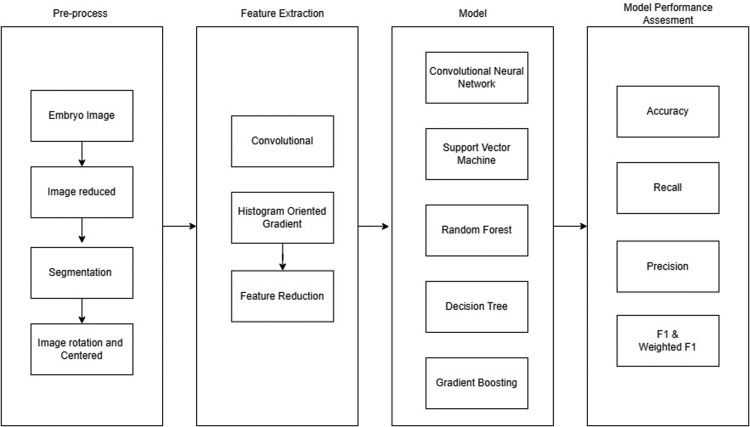
Image processing is a component in developing a predictive model specialized in image classification through which a model is able to differentiate images based on unique features. Image processing is obtained through image augmentation to capture segmented embryos and perform feature extraction. Furthermore, multiple machine learning and deep learning algorithms were used to create prediction-based modeling, and all of the prediction models undergo similar model performance assessments to determine the best model prediction algorithm.
An efficient artificial intelligence model that can predict embryo ploidy status was developed using image processing through a histogram of oriented gradient and then followed by principal component analysis. The gradient boosting algorithm showed an advantage against other algorithms and yielded an accuracy of 0.74, an aneuploid precision of 0.83, and an aneuploid predictive value (recall) of 0.84.
This research study proved that machine-assisted technology perceives the embryo differently than human observation and determined that further research on in vitro fertilization is needed. The study finding serves as a basis for developing a better computer-assisted prediction model.
非整倍体植入前基因检测已被证明在确定胚胎的染色体或倍性状态方面是有效的。该检测需要在第3、5或6天对胚胎细胞进行活检,从中获取染色体的完整信息。非整倍体植入前基因检测的主要缺点包括其相对侵入性的方法以及缺乏关于非整倍体植入前基因检测长期影响的研究。
已提出通过机器学习和深度学习算法进行计算机辅助预测建模,以尽量减少侵入性非整倍体植入前基因检测的使用。预测胚胎倍性状态形态特征的能力为进一步治疗前的决策创造了一个有意义的支持系统。
图像处理是开发专门用于图像分类的预测模型的一个组成部分,通过该模型能够根据独特特征区分图像。图像处理通过图像增强来获取分割后的胚胎并进行特征提取。此外,使用多种机器学习和深度学习算法来创建基于预测的模型,并且所有预测模型都要经过类似的模型性能评估,以确定最佳的模型预测算法。
通过使用基于定向梯度直方图然后进行主成分分析的图像处理,开发了一种能够预测胚胎倍性状态的高效人工智能模型。梯度提升算法相对于其他算法显示出优势,准确率为0.74,非整倍体精度为0.83,非整倍体预测值(召回率)为0.84。
这项研究证明,机器辅助技术对胚胎的感知与人类观察不同,并确定需要对体外受精进行进一步研究。该研究结果为开发更好的计算机辅助预测模型奠定了基础。