Department of Biomedical Informatics, The Ohio State University, Columbus, Ohio, USA; Pelotonia Institute for Immuno-Oncology, The Ohio State University Comprehensive Cancer Center, Columbus, Ohio, USA.
Mass Spectrometry Center, Stanford University, Stanford, California, USA.
Mol Cell Proteomics. 2023 Oct;22(10):100639. doi: 10.1016/j.mcpro.2023.100639. Epub 2023 Aug 30.
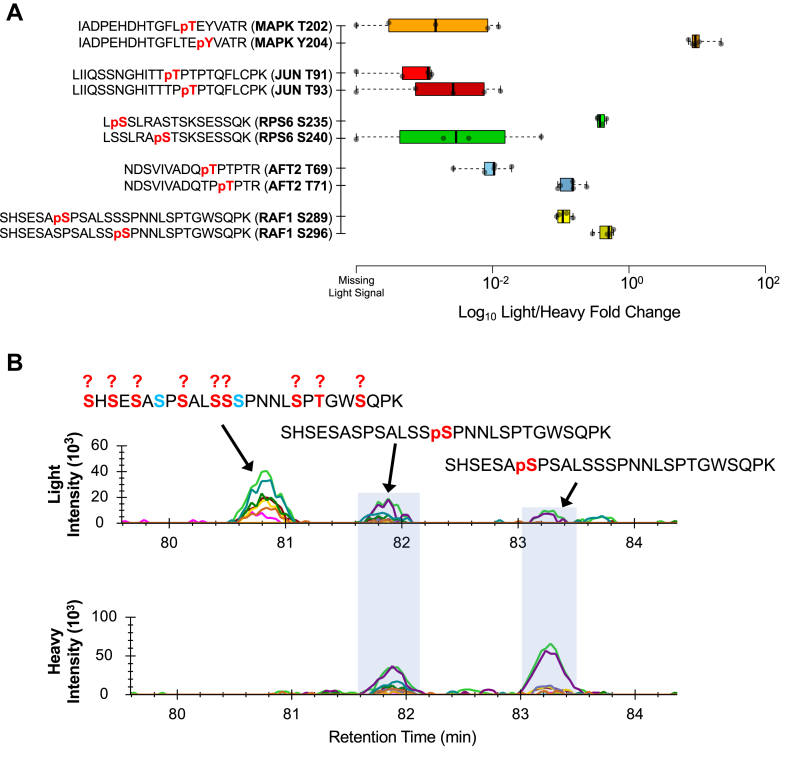
Recent advances in methodology have made phosphopeptide analysis a tractable problem for many proteomics researchers. There are now a wide variety of robust and accessible enrichment strategies to generate phosphoproteomes while free or inexpensive software tools for quantitation and site localization have simplified phosphoproteome analysis workflow tremendously. As a research group under the Association for Biomolecular Resource Facilities umbrella, the Proteomics Standards Research Group has worked to develop a multipathway phosphopeptide standard based on a mixture of heavy-labeled phosphopeptides designed to enable researchers to rapidly develop assays. This mixture contains 131 mass spectrometry vetted phosphopeptides specifically chosen to cover as many known biologically interesting phosphosites as possible from seven different signaling networks: AMPK signaling, death and apoptosis signaling, ErbB signaling, insulin/insulin-like growth factor-1 signaling, mTOR signaling, PI3K/AKT signaling, and stress (p38/SAPK/JNK) signaling. Here, we describe a characterization of this mixture spiked into a HeLa tryptic digest stimulated with both epidermal growth factor and insulin-like growth factor-1 to activate the MAPK and PI3K/AKT/mTOR pathways. We further demonstrate a comparison of phosphoproteomic profiling of HeLa performed independently in five labs using this phosphopeptide mixture with data-independent acquisition. Despite different experimental and instrumentation processes, we found that labs could produce reproducible, harmonized datasets by reporting measurements as ratios to the standard, while intensity measurements showed lower consistency between labs even after normalization. Our results suggest that widely available, biologically relevant phosphopeptide standards can act as a quantitative "yardstick" across laboratories and sample preparations enabling experimental designs larger than a single laboratory can perform. Raw data files are publicly available in the MassIVE dataset MSV000090564.
近年来,方法学的进步使得磷酸肽分析成为许多蛋白质组学研究人员可以解决的问题。现在有各种各样的强大且易于获取的富集策略可以生成磷酸肽组,而免费或廉价的定量和位点定位软件工具则极大地简化了磷酸肽组分析工作流程。作为生物分子资源设施协会下的一个研究小组,蛋白质组学标准研究小组致力于开发一种基于混合重标记磷酸肽的多通路磷酸肽标准品,旨在帮助研究人员快速开发测定方法。该混合物包含 131 种经质谱验证的磷酸肽,这些磷酸肽是专门选择的,旨在尽可能涵盖来自七个不同信号网络的已知具有生物学意义的磷酸化位点:AMPK 信号、死亡和凋亡信号、ErbB 信号、胰岛素/胰岛素样生长因子-1 信号、mTOR 信号、PI3K/AKT 信号和应激(p38/SAPK/JNK)信号。在这里,我们描述了将这种混合物掺入表皮生长因子和胰岛素样生长因子-1刺激的 HeLa 酶解物中进行特征描述,以激活 MAPK 和 PI3K/AKT/mTOR 途径。我们进一步证明了使用这种磷酸肽混合物在五个实验室中独立进行的 HeLa 磷酸蛋白质组学分析比较,采用的数据独立采集。尽管实验和仪器过程不同,但我们发现实验室可以通过将测量值报告为与标准的比值来产生可重复、协调的数据集,而强度测量值即使在归一化后,实验室之间的一致性也较低。我们的结果表明,广泛可用的、具有生物学相关性的磷酸肽标准可以作为跨实验室和样品制备的定量“标准尺”,使实验设计可以超过单个实验室的能力。原始数据文件可在 MassIVE 数据集 MSV000090564 中公开获取。