Department of Ultrasound, The First Affiliated Hospital, College of Medicine, Zhejiang University, Hangzhou, People's Republic of China.
The D-Lab, Department of Precision Medicine, GROW - School for Oncology and Reproduction, Maastricht University, Maastricht, The Netherlands.
Oncologist. 2024 Feb 2;29(2):e187-e197. doi: 10.1093/oncolo/oyad227.
Not only should resistance to neoadjuvant chemotherapy (NAC) be considered in patients with breast cancer but also the possibility of achieving a pathologic complete response (PCR) after NAC. Our study aims to develop 2 multimodal ultrasound deep learning (DL) models to noninvasively predict resistance and PCR to NAC before treatment.
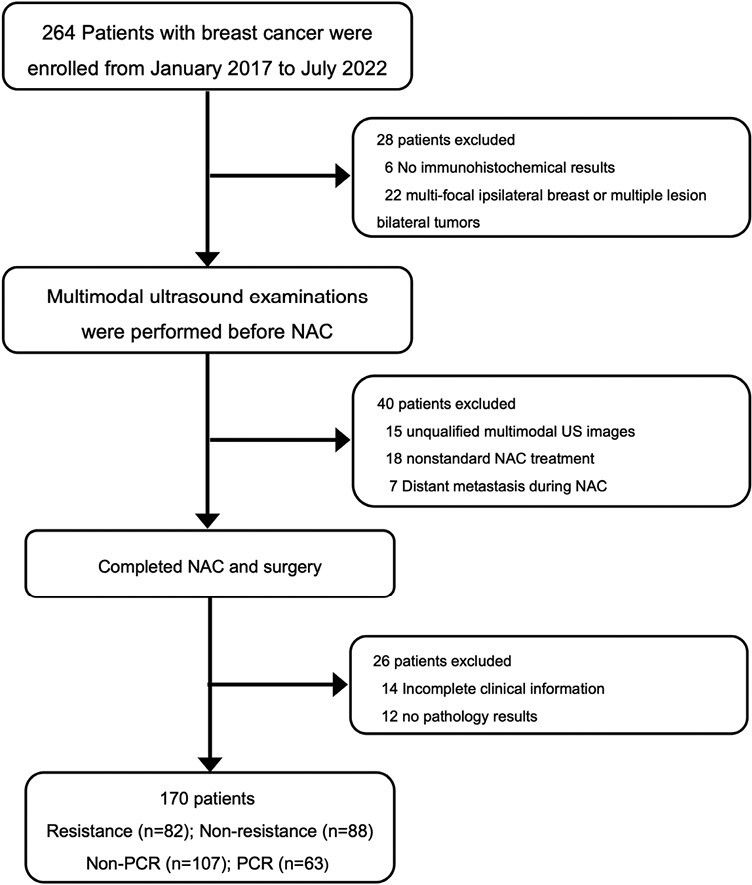
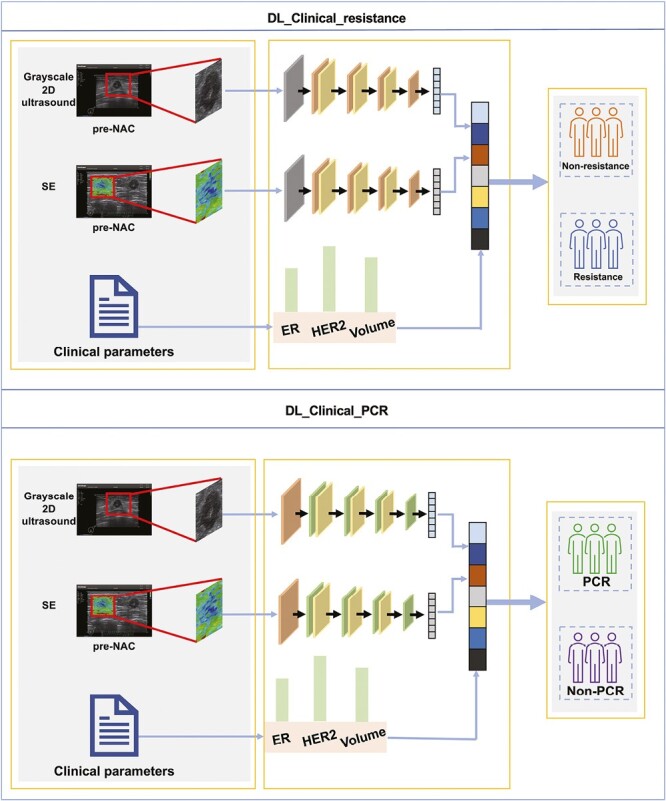
From January 2017 to July 2022, a total of 170 patients with breast cancer were prospectively enrolled. All patients underwent multimodal ultrasound examination (grayscale 2D ultrasound and ultrasound elastography) before NAC. We combined clinicopathological information to develop 2 DL models, DL_Clinical_resistance and DL_Clinical_PCR, for predicting resistance and PCR to NAC, respectively. In addition, these 2 models were combined to stratify the prediction of response to NAC.
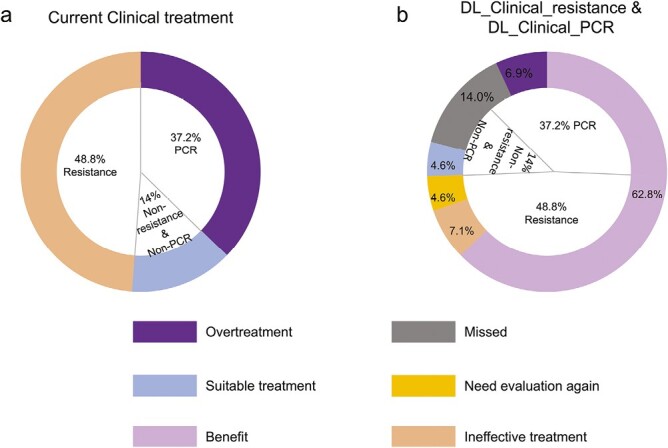
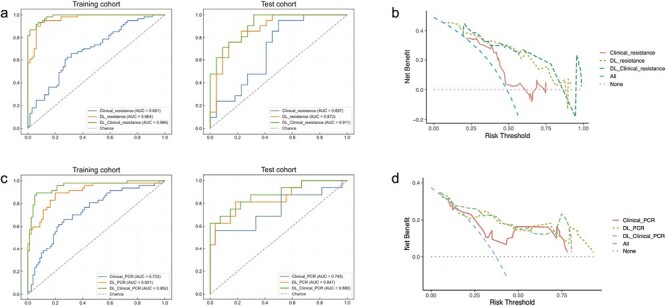
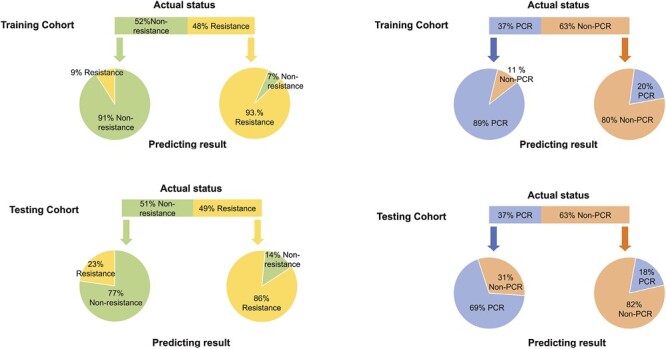
In the test cohort, DL_Clinical_resistance had an AUC of 0.911 (95%CI, 0.814-0.979) with a sensitivity of 0.905 (95%CI, 0.765-1.000) and an NPV of 0.882 (95%CI, 0.708-1.000). Meanwhile, DL_Clinical_PCR achieved an AUC of 0.880 (95%CI, 0.751-0.973) and sensitivity and NPV of 0.875 (95%CI, 0.688-1.000) and 0.895 (95%CI, 0.739-1.000), respectively. By combining DL_Clinical_resistance and DL_Clinical_PCR, 37.1% of patients with resistance and 25.7% of patients with PCR were successfully identified by the combined model, suggesting that these patients could benefit by an early change of treatment strategy or by implementing an organ preservation strategy after NAC.
The proposed DL_Clinical_resistance and DL_Clinical_PCR models and combined strategy have the potential to predict resistance and PCR to NAC before treatment and allow stratified prediction of NAC response.
不仅应考虑乳腺癌患者对新辅助化疗(NAC)的耐药性,还应考虑其在 NAC 后获得病理完全缓解(PCR)的可能性。我们的研究旨在开发 2 种多模态超声深度学习(DL)模型,以便在治疗前无创预测 NAC 的耐药性和 PCR。
本研究从 2017 年 1 月至 2022 年 7 月共前瞻性纳入 170 例乳腺癌患者。所有患者均在 NAC 前接受多模态超声检查(灰阶 2D 超声和超声弹性成像)。我们结合临床病理信息,分别开发了 2 个 DL 模型,DL_Clinical_resistance 和 DL_Clinical_PCR,用于预测 NAC 的耐药性和 PCR。此外,这 2 个模型相结合可对 NAC 反应的预测进行分层。
在测试队列中,DL_Clinical_resistance 的 AUC 为 0.911(95%CI,0.814-0.979),敏感性为 0.905(95%CI,0.765-1.000),NPV 为 0.882(95%CI,0.708-1.000)。同时,DL_Clinical_PCR 的 AUC 为 0.880(95%CI,0.751-0.973),敏感性和 NPV 分别为 0.875(95%CI,0.688-1.000)和 0.895(95%CI,0.739-1.000)。通过结合 DL_Clinical_resistance 和 DL_Clinical_PCR,联合模型成功识别出 37.1%的耐药患者和 25.7%的 PCR 患者,提示这些患者通过早期改变治疗策略或在 NAC 后实施器官保留策略可能受益。
所提出的 DL_Clinical_resistance 和 DL_Clinical_PCR 模型及联合策略有可能在治疗前预测 NAC 的耐药性和 PCR,并可对 NAC 反应进行分层预测。