Rennie Gardiner Henric, Zhao Jinlong, Camus-Ela Mukeshimana, Shi Jialu, Jiang Lan, Zhang Lili, Wang Jin, Raghavan Vijaya
Key Laboratory of Environmental Medicine and Engineering, Ministry of Education, and Department of Nutrition and Food Hygiene, School of Public Health, Southeast University, Nanjing 210009, China.
Department of Bioresource Engineering, Faculty of Agricultural and Environmental Sciences, McGill University, 21111 Lakeshore Rd, Sainte-Anne-de-Bellevue, QC H9X 3V9, Canada.
Foods. 2023 Sep 1;12(17):3290. doi: 10.3390/foods12173290.
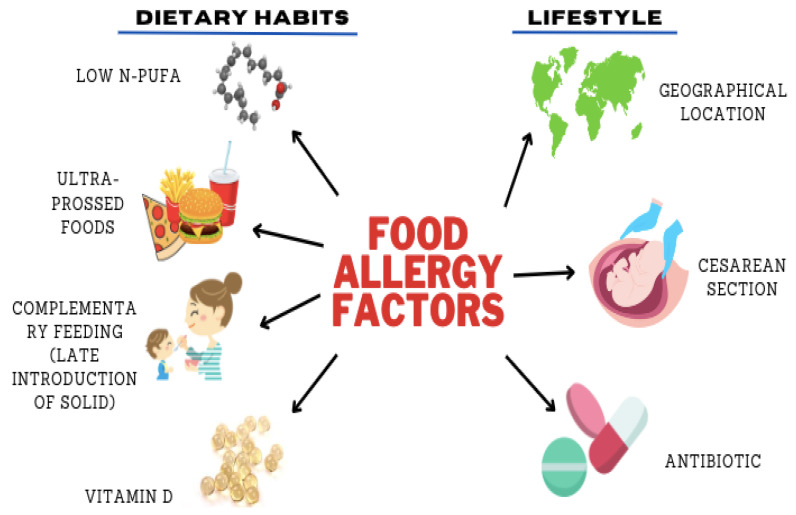
Changes in behavior, lifestyle, and nutritional patterns have influenced many potential risk variables globally. In recent decades, food allergies (FAs) have been elevated to a severe public health issue both in developed countries and developing countries (third-world countries). This study aims to evaluate the effects caused by certain factors such as lifestyle and dietary habits on food allergies, review the association of lifestyle and dietary habit status with FAs, and outline why more people are allergic to food sources as a result of lifestyle changes and dietary habits. We searched electronic international databases including Scopus, PubMed, Google Scholar, and Web of Science using combinations of keywords. Utilizing Excel, the relevant studies were included and the irrelevant studies were excluded, and Mendeley was used for referencing and also to remove duplicates. The framework proposed by Arksey and O'Malley was used for this scoping review. The papers published in the databases from 2016 to 2020 were extracted. A total of eight studies were extracted, and this scoping review was carried out according to the risk factors. In our review, we found that some lifestyle choices (Caesarean section and antibiotics) and dietary habits (n-3 PUFA, fast food, duration of dietary intervention, and vitamin D), were important contributing factors for FA.
行为、生活方式和营养模式的变化在全球范围内影响了许多潜在风险变量。近几十年来,食物过敏在发达国家和发展中国家(第三世界国家)都已成为一个严重的公共卫生问题。本研究旨在评估生活方式和饮食习惯等某些因素对食物过敏的影响,回顾生活方式和饮食习惯状况与食物过敏的关联,并概述为何由于生活方式改变和饮食习惯,越来越多的人对食物来源过敏。我们使用关键词组合在包括Scopus、PubMed、谷歌学术和科学网在内的国际电子数据库中进行搜索。利用Excel,纳入相关研究并排除无关研究,使用Mendeley进行参考文献引用并去除重复项。本综述采用了Arksey和O'Malley提出的框架。提取了2016年至2020年在数据库中发表的论文。共提取了八项研究,并根据风险因素进行了本综述。在我们的综述中,我们发现一些生活方式选择(剖腹产和抗生素)和饮食习惯(n-3多不饱和脂肪酸、快餐、饮食干预持续时间和维生素D)是食物过敏的重要促成因素。