Rota Alberto, Possenti Luca, Offeddu Giovanni S, Senesi Martina, Stucchi Adelaide, Venturelli Irene, Rancati Tiziana, Zunino Paolo, Kamm Roger D, Costantino Maria Laura
LaBS, Chemistry, Materials, and Chemical Engineering "Giulio Natta" Department Politecnico di Milano Milan Italy.
Data Science Unit, Department of Epidemiology and Data Science Fondazione IRCCS Istituto Nazionale dei Tumori Milan Italy.
Bioeng Transl Med. 2023 Jun 11;8(5):e10557. doi: 10.1002/btm2.10557. eCollection 2023 Sep.
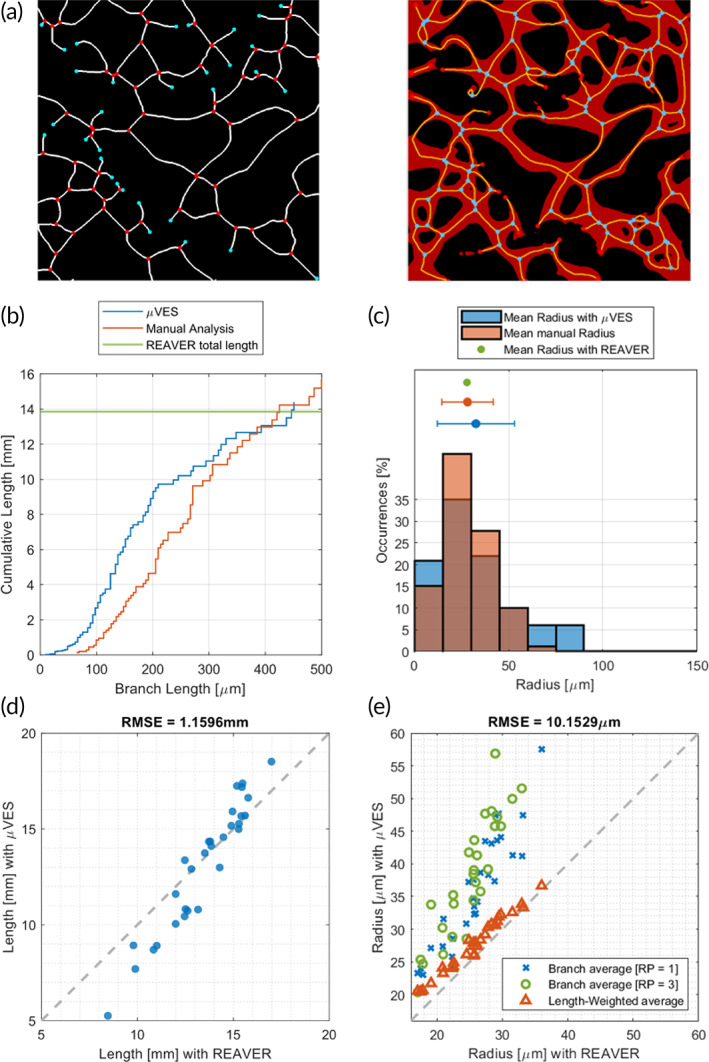
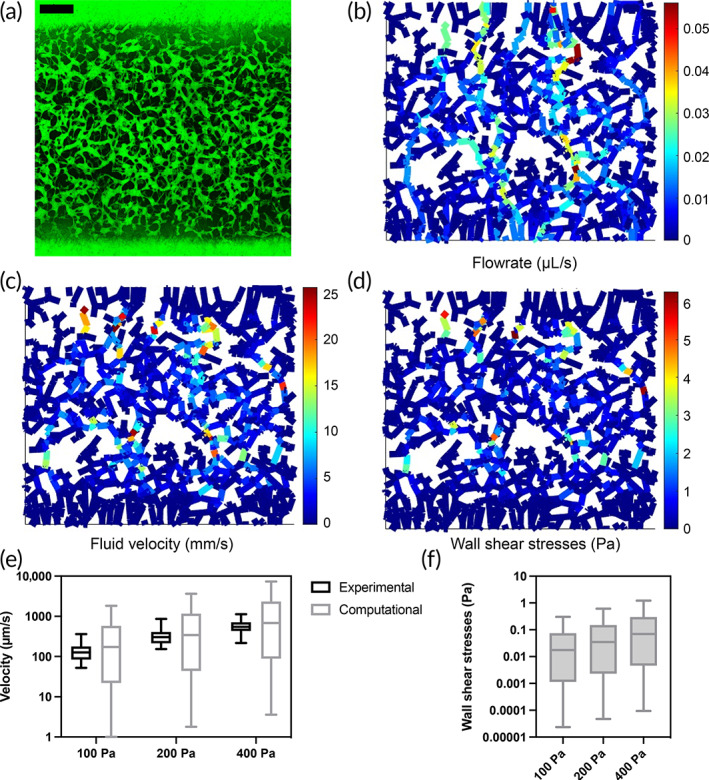
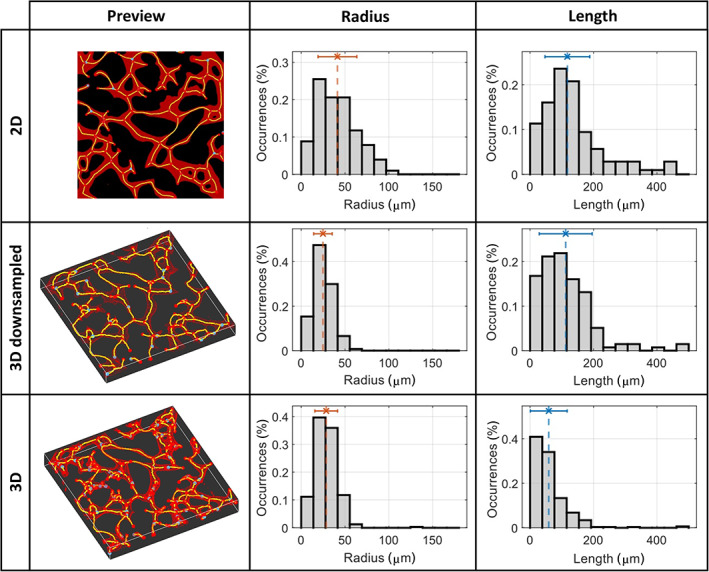
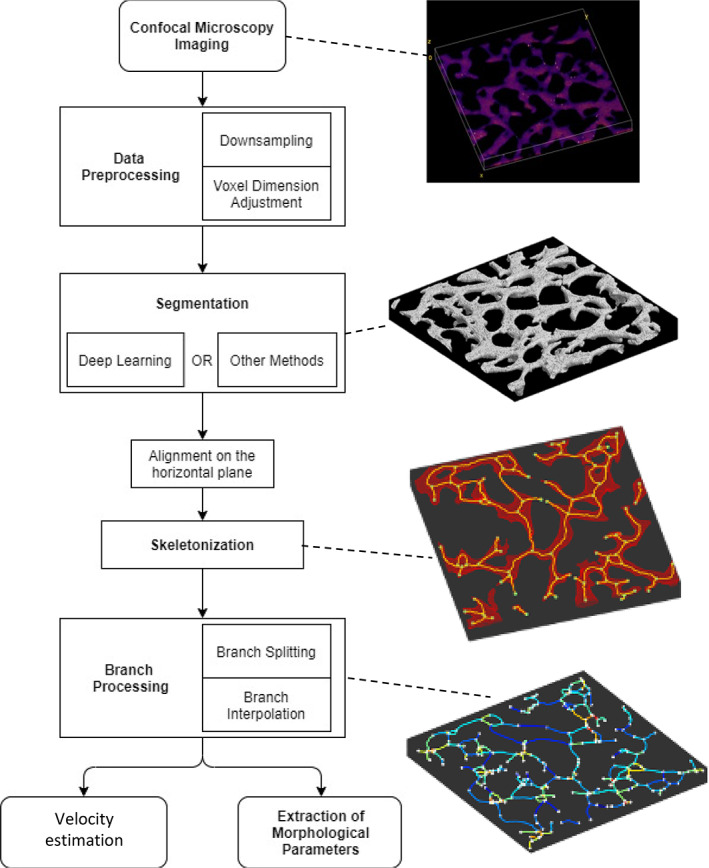
Three-dimensional (3D) imaging techniques (e.g., confocal microscopy) are commonly used to visualize in vitro models, especially microvasculature on-a-chip. Conversely, 3D analysis is not the standard method to extract quantitative information from those models. We developed the μVES algorithm to analyze vascularized in vitro models leveraging 3D data. It computes morphological parameters (geometry, diameter, length, tortuosity, eccentricity) and intravascular flow velocity. μVES application to microfluidic vascularized in vitro models shows that they successfully replicate functional features of the microvasculature in vivo in terms of intravascular fluid flow velocity. However, wall shear stress is lower compared to in vivo references. The morphological analysis also highlights the model's physiological similarities (vessel length and tortuosity) and shortcomings (vessel radius and surface-over-volume ratio). The addition of the third dimension in our analysis produced significant differences in the metrics assessed compared to 2D estimations. It enabled the computation of new indices, such as vessel eccentricity. These μVES capabilities can find application in analyses of different in vitro vascular models, as well as in vivo and ex vivo microvasculature.
三维(3D)成像技术(如共聚焦显微镜)通常用于可视化体外模型,尤其是芯片上的微血管系统。相反,3D分析并不是从这些模型中提取定量信息的标准方法。我们开发了μVES算法,利用3D数据来分析血管化体外模型。它可以计算形态学参数(几何形状、直径、长度、曲折度、偏心率)和血管内流速。将μVES应用于微流控血管化体外模型表明,就血管内流体流速而言,它们成功地复制了体内微血管系统的功能特征。然而,与体内参考值相比,壁面剪应力较低。形态学分析还突出了该模型的生理相似性(血管长度和曲折度)和不足之处(血管半径和表面积与体积比)。与二维估计相比,我们分析中增加的第三维在评估指标上产生了显著差异。它使得能够计算新的指标,如血管偏心率。这些μVES功能可应用于不同体外血管模型的分析,以及体内和离体微血管系统的分析。