Department of Earth Sciences, Palaeobiology Programme, Uppsala University, Villavägen 16 SE 75236, Sweden.
Department of Statistics, School of Mathematics, University of Leeds, Leeds LS2 9JT, UK.
Syst Biol. 2024 May 27;73(1):223-234. doi: 10.1093/sysbio/syad057.
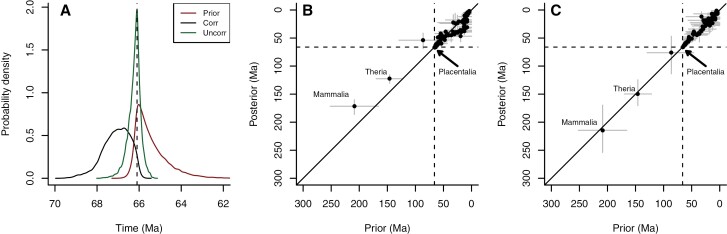
The popularity of relaxed clock Bayesian inference of clade origin timings has generated several recent publications with focal results considerably older than the fossils of the clades in question. Here, we critically examine two such clades: the animals (with a focus on the bilaterians) and the mammals (with a focus on the placentals). Each example displays a set of characteristic pathologies which, although much commented on, are rarely corrected for. We conclude that in neither case does the molecular clock analysis provide any evidence for an origin of the clade deeper than what is suggested by the fossil record. In addition, both these clades have other features (including, in the case of the placental mammals, proximity to a large mass extinction) that allow us to generate precise expectations of the timings of their origins. Thus, in these instances, the fossil record can provide a powerful test of molecular clock methodology, and why it goes astray, and we have every reason to think these problems are general. [Cambrian explosion; mammalian evolution; molecular clocks.].
支序起源时间的宽松时钟贝叶斯推断方法日益流行,由此产生了一些新的研究成果,这些研究的焦点结果都比所研究的支序的化石要古老得多。在这里,我们批判性地检查了两个这样的支序:动物(以两侧对称动物为重点)和哺乳动物(以胎盘哺乳动物为重点)。每个例子都显示出一组特征性病变,尽管这些病变经常被提及,但很少得到纠正。我们的结论是,在这两种情况下,分子钟分析都没有为支序的起源提供比化石记录所暗示的更深的证据。此外,这两个支序还有其他特征(包括,在胎盘哺乳动物的情况下,接近大灭绝事件),这些特征使我们能够对它们起源的时间产生精确的预期。因此,在这些情况下,化石记录可以为分子钟方法提供有力的检验,以及为什么它会偏离,我们有充分的理由认为这些问题是普遍存在的。[寒武纪大爆发;哺乳动物进化;分子钟。]。