Department of Radiation Oncology, University of Alabama at Birmingham, Birmingham, USA.
J Appl Clin Med Phys. 2023 Oct;24(10):e14152. doi: 10.1002/acm2.14152. Epub 2023 Sep 13.
Knowledge-based planning (KBP) offers the ability to predict dose-volume metrics based on information extracted from previous plans, reducing plan variability and improving plan quality. As clinical integration of KBP is increasing there is a growing need for quantitative evaluation of KBP models. A .NET-based application, RapidCompare, was created for automated plan creation and analysis of Varian RapidPlan models.
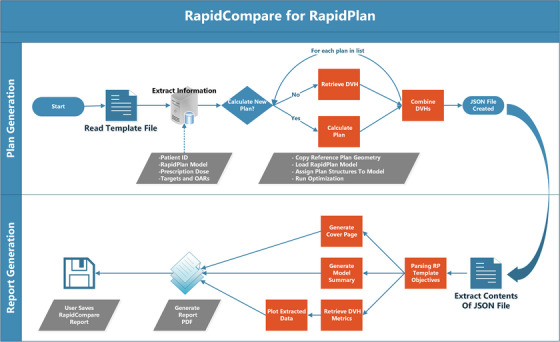
RapidCompare was designed to read calculation parameters and a list of reference plans. The tool copies the reference plan field geometry and structure set, applies the RapidPlan model, optimizes the KBP plan, and generates data for quantitative evaluation of dose-volume metrics. A cohort of 85 patients, divided into training (50), testing (10), and validation (25) groups, was used to demonstrate the utility of RapidCompare. After training and tuning, the KBP model was paired with three different optimization templates to compare various planning strategies in the validation cohort. All templates used the same set of constraints for the planning target volume (PTV). For organs-at-risk, the optimization template provided constraints using the whole dose-volume histogram (DVH), fixed-dose/volume points, or generalized equivalent uniform dose (gEUD). The resulting plans from each optimization approach were compared using DVH metrics.
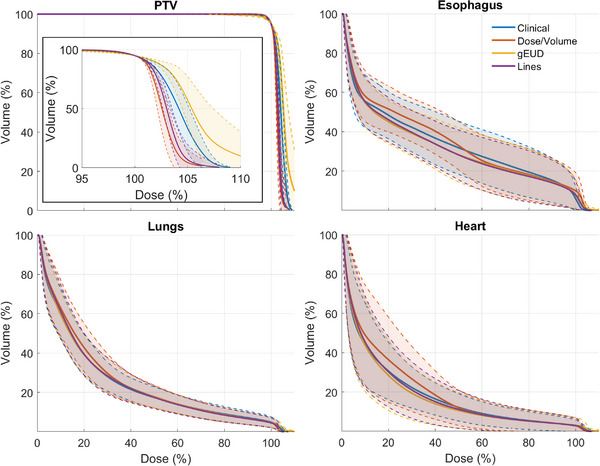
RapidCompare allowed for the automated generation of 75 total plans for comparison with limited manual intervention. In comparing optimization techniques, the Dose/Volume and Lines optimization templates generated plans with similar DVH metrics, with a slight preference for the Lines technique with reductions in heart V30Gy and spinal cord max dose. The gEUD model produced high target heterogeneity.
Automated evaluation allowed for the exploration of multiple optimization templates in a larger validation cohort than would have been feasible using a manual approach. A final KBP model using line optimization objectives produced the highest quality plans without human intervention.
基于知识的计划(KBP)能够根据从以前的计划中提取的信息预测剂量-体积指标,从而降低计划的可变性并提高计划的质量。随着 KBP 在临床中的整合,对 KBP 模型进行定量评估的需求日益增长。一个基于.NET 的应用程序 RapidCompare 被创建用于自动创建和分析瓦里安 RapidPlan 模型的计划。
RapidCompare 旨在读取计算参数和参考计划列表。该工具复制参考计划的字段几何形状和结构集,应用 RapidPlan 模型,优化 KBP 计划,并生成用于定量评估剂量-体积指标的数据。一个由 85 名患者组成的队列,分为训练(50 名)、测试(10 名)和验证(25 名)组,用于演示 RapidCompare 的实用性。在训练和调整后,KBP 模型与三个不同的优化模板配对,以在验证队列中比较各种规划策略。所有模板都为计划靶区(PTV)使用相同的约束集。对于危及器官,优化模板使用整个剂量-体积直方图(DVH)、固定剂量/体积点或广义等效均匀剂量(gEUD)来提供约束。使用 DVH 指标比较每种优化方法的结果计划。
RapidCompare 允许在有限的人工干预下自动生成 75 个总计划进行比较。在比较优化技术时,Dose/Volume 和 Lines 优化模板生成的计划具有相似的 DVH 指标,略微倾向于 Lines 技术,可降低心脏 V30Gy 和脊髓最大剂量。gEUD 模型产生了高目标异质性。
自动化评估允许在比手动方法更可行的更大验证队列中探索多种优化模板。使用线优化目标的最终 KBP 模型无需人工干预即可生成最高质量的计划。