MRC Human Immunology Unit, Medical Research Council (MRC) Weatherall Institute of Molecular Medicine (WIMM), John Radcliffe Hospital, University of Oxford, Oxford, OX3 9DS, UK.
MRC WIMM Centre for Computational Biology, MRC Weatherall Institute of Molecular Medicine, John Radcliffe Hospital, University of Oxford, Oxford, OX3 9DS, UK.
Genome Med. 2023 Sep 13;15(1):70. doi: 10.1186/s13073-023-01225-z.
T-cells play a crucial role in the adaptive immune system by triggering responses against cancer cells and pathogens, while maintaining tolerance against self-antigens, which has sparked interest in the development of various T-cell-focused immunotherapies. However, the identification of antigens recognised by T-cells is low-throughput and laborious. To overcome some of these limitations, computational methods for predicting CD8 + T-cell epitopes have emerged. Despite recent developments, most immunogenicity algorithms struggle to learn features of peptide immunogenicity from small datasets, suffer from HLA bias and are unable to reliably predict pathology-specific CD8 + T-cell epitopes.
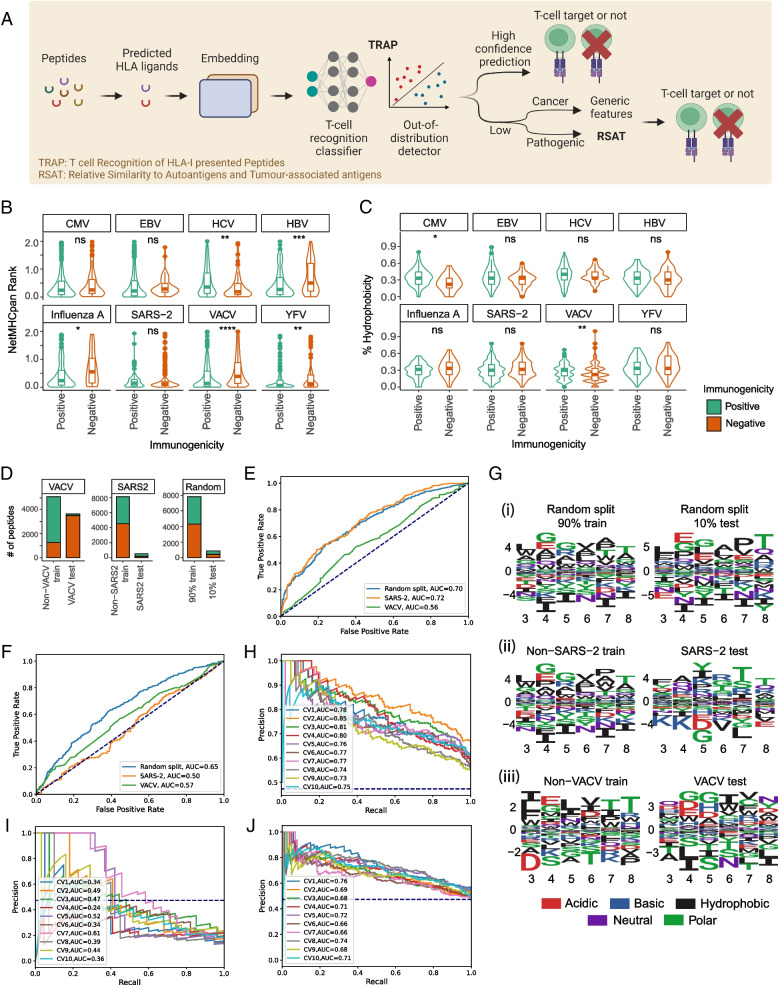
We developed TRAP (T-cell recognition potential of HLA-I presented peptides), a robust deep learning workflow for predicting CD8 + T-cell epitopes from MHC-I presented pathogenic and self-peptides. TRAP uses transfer learning, deep learning architecture and MHC binding information to make context-specific predictions of CD8 + T-cell epitopes. TRAP also detects low-confidence predictions for peptides that differ significantly from those in the training datasets to abstain from making incorrect predictions. To estimate the immunogenicity of pathogenic peptides with low-confidence predictions, we further developed a novel metric, RSAT (relative similarity to autoantigens and tumour-associated antigens), as a complementary to 'dissimilarity to self' from cancer studies.
TRAP was used to identify epitopes from glioblastoma patients as well as SARS-CoV-2 peptides, and it outperformed other algorithms in both cancer and pathogenic settings. TRAP was especially effective at extracting immunogenicity-associated properties from restricted data of emerging pathogens and translating them onto related species, as well as minimising the loss of likely epitopes in imbalanced datasets. We also demonstrated that the novel metric termed RSAT was able to estimate immunogenic of pathogenic peptides of various lengths and species. TRAP implementation is available at: https://github.com/ChloeHJ/TRAP .
This study presents a novel computational workflow for accurately predicting CD8 + T-cell epitopes to foster a better understanding of antigen-specific T-cell response and the development of effective clinical therapeutics.
T 细胞在适应性免疫系统中发挥着至关重要的作用,通过触发对癌细胞和病原体的反应,同时对自身抗原保持耐受,这激发了人们对各种 T 细胞为重点的免疫疗法的兴趣。然而,T 细胞识别的抗原的鉴定是低通量和费力的。为了克服其中的一些限制,已经出现了用于预测 CD8+T 细胞表位的计算方法。尽管最近取得了一些进展,但大多数免疫原性算法在从小数据集学习肽免疫原性特征方面都存在困难,受到 HLA 偏倚的影响,并且无法可靠地预测特定于病理学的 CD8+T 细胞表位。
我们开发了 TRAP(HLA-I 呈递肽的 T 细胞识别潜力),这是一种强大的深度学习工作流程,用于从 MHC-I 呈递的病原体和自身肽中预测 CD8+T 细胞表位。TRAP 使用迁移学习、深度学习架构和 MHC 结合信息来对 CD8+T 细胞表位进行特定于上下文的预测。TRAP 还会为与训练数据集显著不同的肽检测到低置信度预测,以避免做出错误的预测。为了估计具有低置信度预测的病原体肽的免疫原性,我们进一步开发了一种新的度量标准 RSAT(与自身抗原和肿瘤相关抗原的相对相似性),作为癌症研究中“与自身不同”的补充。
TRAP 用于鉴定胶质母细胞瘤患者和 SARS-CoV-2 肽的表位,在癌症和病原体环境中都优于其他算法。TRAP 特别有效地从新兴病原体的受限数据中提取与免疫原性相关的特性,并将其转化为相关物种,同时减少不平衡数据集中可能的表位的丢失。我们还证明了新的度量标准 RSAT 能够估计各种长度和物种的病原体肽的免疫原性。TRAP 的实现可在 https://github.com/ChloeHJ/TRAP 获得。
本研究提出了一种新的计算工作流程,用于准确预测 CD8+T 细胞表位,以促进更好地理解抗原特异性 T 细胞反应和开发有效的临床治疗方法。