
零食质量和零食时间与心血管代谢血液标志物有关:ZOE PREDICT 研究。
Snack quality and snack timing are associated with cardiometabolic blood markers: the ZOE PREDICT study.
机构信息
Department of Nutritional Sciences, King's College London, London, UK.
ZOE Ltd, London, UK.
出版信息
Eur J Nutr. 2024 Feb;63(1):121-133. doi: 10.1007/s00394-023-03241-6. Epub 2023 Sep 15.
BACKGROUND
Snacking is a common diet behaviour which accounts for a large proportion of daily energy intake, making it a key determinant of diet quality. However, the relationship between snacking frequency, quality and timing with cardiometabolic health remains unclear.
DESIGN
Demography, diet, health (fasting and postprandial cardiometabolic blood and anthropometrics markers) and stool metagenomics data were assessed in the UK PREDICT 1 cohort (N = 1002) (NCT03479866). Snacks (foods or drinks consumed between main meals) were self-reported (weighed records) across 2-4 days. Average snacking frequency and quality [snack diet index (SDI)] were determined (N = 854 after exclusions). Associations between snacking frequency, quality and timing with cardiometabolic blood and anthropometric markers were assessed using regression models (adjusted for age, sex, BMI, education, physical activity level and main meal quality).
RESULTS
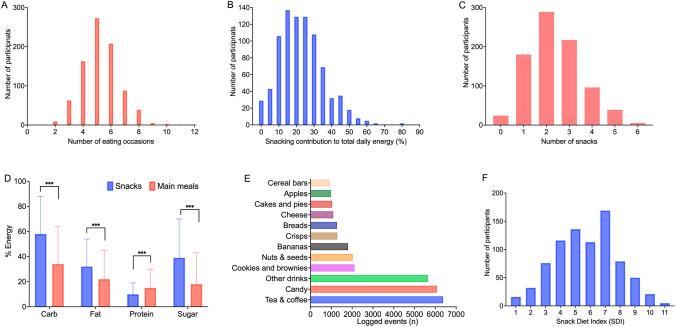
Participants were aged (mean, SD) 46.1 ± 11.9 years, had a mean BMI of 25.6 ± 4.88 kg/m and were predominantly female (73%). 95% of participants were snackers (≥ 1 snack/day; n = 813); mean daily snack intake was 2.28 snacks/day (24 ± 16% of daily calories; 203 ± 170 kcal); and 44% of participants were discordant for meal and snack quality. In snackers, overall snacking frequency and quantity of snack energy were not associated with cardiometabolic risk markers. However, lower snack quality (SDI range 1-11) was associated with higher blood markers, including elevated fasting triglycerides (TG (mmol/L) β; - 0.02, P = 0.02), postprandial TGs (6hiAUC (mmol/L.s); β; - 400, P = 0.01), fasting insulin (mIU/L) (β; - 0.15, P = 0.04), insulin resistance (HOMA-IR; β; - 0.04, P = 0.04) and hunger (scale 0-100) (β; - 0.52, P = 0.02) (P values non-significant after multiple testing adjustments). Late-evening snacking (≥ 9 pm; 31%) was associated with lower blood markers (HbA1c; 5.54 ± 0.42% vs 5.46 ± 0.28%, glucose 2hiAUC; 8212 ± 5559 vs 7321 ± 4928 mmol/L.s, P = 0.01 and TG 6hiAUC; 11,638 ± 8166 vs 9781 ± 6997 mmol/L.s, P = 0.01) compared to all other snacking times (HbA1c remained significant after multiple testing).
CONCLUSION
Snack quality and timing of consumption are simple diet features which may be targeted to improve diet quality, with potential health benefits.
CLINICAL TRIAL REGISTRY NUMBER AND WEBSITE
NCT03479866, https://clinicaltrials.gov/ct2/show/NCT03479866?term=NCT03479866&draw=2&rank=1.
背景
零食是一种常见的饮食行为,占每日能量摄入的很大比例,是饮食质量的关键决定因素。然而,零食频率、质量和时间与心脏代谢健康之间的关系仍不清楚。
设计
在英国 PREDICT 1 队列(N = 1002)(NCT03479866)中评估了人口统计学、饮食、健康(空腹和餐后心脏代谢血液和人体测量标志物)和粪便宏基因组学数据。零食(主餐之间食用的食物或饮料)通过 2-4 天的自我报告(称重记录)进行评估。确定了平均零食频率和质量[零食饮食指数(SDI)](排除后 854 名参与者)。使用回归模型评估了零食频率、质量和时间与心脏代谢血液和人体测量标记物之间的关联(调整年龄、性别、BMI、教育程度、身体活动水平和主餐质量)。
结果
参与者年龄(平均值,标准差)为 46.1 ± 11.9 岁,平均 BMI 为 25.6 ± 4.88 kg/m,主要为女性(73%)。95%的参与者是零食者(≥1 次/天;n = 813);平均每日零食摄入量为 2.28 份零食/天(24 ± 16%的每日卡路里;203 ± 170 kcal);44%的参与者在进餐和零食质量上存在差异。在零食者中,总体零食频率和零食能量摄入量与心脏代谢风险标志物无关。然而,较低的零食质量(SDI 范围 1-11)与更高的血液标志物相关,包括空腹甘油三酯(TG(mmol/L)β;-0.02,P = 0.02)、餐后 TG(6hiAUC(mmol/L.s);β;-400,P = 0.01)、空腹胰岛素(mIU/L)(β;-0.15,P = 0.04)、胰岛素抵抗(HOMA-IR;β;-0.04,P = 0.04)和饥饿感(量表 0-100)(β;-0.52,P = 0.02)(多次测试调整后 P 值不显著)。晚上晚些时候(≥9 点;31%)的零食与较低的血液标志物相关(HbA1c;5.54 ± 0.42%比 5.46 ± 0.28%,葡萄糖 2hiAUC;8212 ± 5559 比 7321 ± 4928 mmol/L.s,P = 0.01 和 TG 6hiAUC;11638 ± 8166 比 9781 ± 6997 mmol/L.s,P = 0.01)与其他所有零食时间相比(HbA1c 在多次测试后仍然显著)。
结论
零食的质量和食用时间是简单的饮食特征,可能是改善饮食质量、潜在健康益处的目标。
临床试验注册号和网站
NCT03479866,https://clinicaltrials.gov/ct2/show/NCT03479866?term=NCT03479866&draw=2&rank=1。

 Zotero 插件