Department of Biomedical Engineering, Southern University of Science and Technology, Shenzhen, 518055, Guangdong, China.
The Third People's Hospital of Shenzhen, Shenzhen, 518112, Guangdong, China.
Mil Med Res. 2023 Sep 26;10(1):44. doi: 10.1186/s40779-023-00479-3.
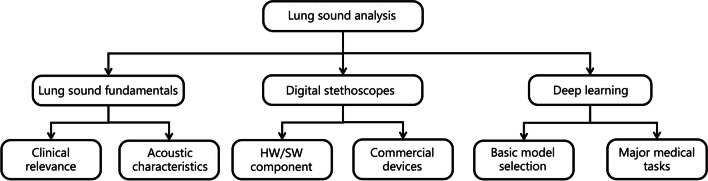
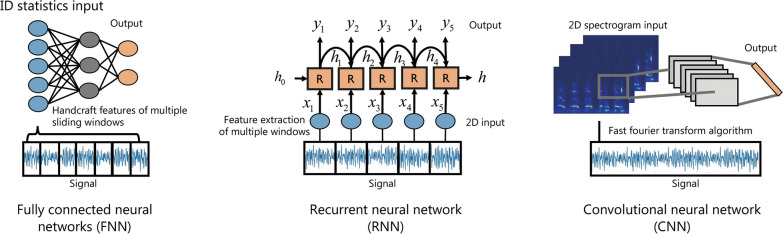
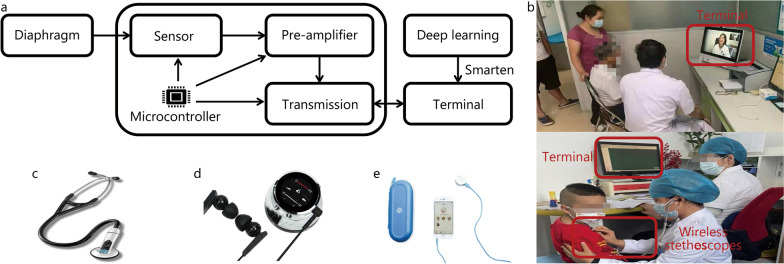
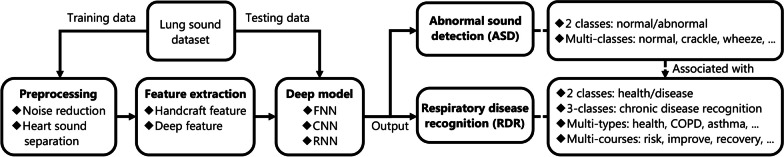
Auscultation is crucial for the diagnosis of respiratory system diseases. However, traditional stethoscopes have inherent limitations, such as inter-listener variability and subjectivity, and they cannot record respiratory sounds for offline/retrospective diagnosis or remote prescriptions in telemedicine. The emergence of digital stethoscopes has overcome these limitations by allowing physicians to store and share respiratory sounds for consultation and education. On this basis, machine learning, particularly deep learning, enables the fully-automatic analysis of lung sounds that may pave the way for intelligent stethoscopes. This review thus aims to provide a comprehensive overview of deep learning algorithms used for lung sound analysis to emphasize the significance of artificial intelligence (AI) in this field. We focus on each component of deep learning-based lung sound analysis systems, including the task categories, public datasets, denoising methods, and, most importantly, existing deep learning methods, i.e., the state-of-the-art approaches to convert lung sounds into two-dimensional (2D) spectrograms and use convolutional neural networks for the end-to-end recognition of respiratory diseases or abnormal lung sounds. Additionally, this review highlights current challenges in this field, including the variety of devices, noise sensitivity, and poor interpretability of deep models. To address the poor reproducibility and variety of deep learning in this field, this review also provides a scalable and flexible open-source framework that aims to standardize the algorithmic workflow and provide a solid basis for replication and future extension: https://github.com/contactless-healthcare/Deep-Learning-for-Lung-Sound-Analysis .
听诊对于呼吸系统疾病的诊断至关重要。然而,传统听诊器存在固有局限性,例如听众间的可变性和主观性,并且它们无法记录呼吸音以供离线/回顾性诊断或远程医疗中的远程处方。数字听诊器的出现克服了这些局限性,使医生能够存储和共享呼吸音以供咨询和教育。在此基础上,机器学习,特别是深度学习,使得对肺音的全自动分析成为可能,这可能为智能听诊器铺平道路。因此,本综述旨在全面概述用于肺音分析的深度学习算法,强调人工智能(AI)在该领域的重要性。我们专注于基于深度学习的肺音分析系统的每个组成部分,包括任务类别、公共数据集、去噪方法,以及最重要的现有深度学习方法,即将肺音转换为二维(2D)频谱图的最新方法,以及使用卷积神经网络对呼吸疾病或异常肺音进行端到端识别。此外,本综述还强调了该领域当前的挑战,包括设备种类繁多、对噪声敏感以及深度学习模型的可解释性差。为了解决该领域深度学习的可重复性和多样性差的问题,本综述还提供了一个可扩展且灵活的开源框架,旨在标准化算法工作流程,并为复制和未来扩展提供坚实的基础:https://github.com/contactless-healthcare/Deep-Learning-for-Lung-Sound-Analysis。