• 文献检索
  • 文档翻译
  • 深度研究
  • 学术资讯
  • Suppr Zotero 插件Zotero 插件
  • 邀请有礼
  • 套餐&价格
  • 历史记录
应用&插件
Suppr Zotero 插件Zotero 插件浏览器插件Mac 客户端Windows 客户端微信小程序
定价
高级版会员购买积分包购买API积分包
服务
文献检索文档翻译深度研究API 文档MCP 服务
关于我们
关于 Suppr公司介绍联系我们用户协议隐私条款
关注我们

Suppr 超能文献

核心技术专利:CN118964589B侵权必究
粤ICP备2023148730 号-1Suppr @ 2026

文献检索

告别复杂PubMed语法,用中文像聊天一样搜索,搜遍4000万医学文献。AI智能推荐,让科研检索更轻松。

立即免费搜索

文件翻译

保留排版,准确专业,支持PDF/Word/PPT等文件格式,支持 12+语言互译。

免费翻译文档

深度研究

AI帮你快速写综述,25分钟生成高质量综述,智能提取关键信息,辅助科研写作。

立即免费体验

可穿戴传感器和机器学习算法在康复训练中的应用:系统评价。

The Application of Wearable Sensors and Machine Learning Algorithms in Rehabilitation Training: A Systematic Review.

机构信息

College of Furnishings and Industrial Design, Nanjing Forestry University, Nanjing 210037, China.

Co-Innovation Center of Efficient Processing and Utilization of Forest Resources, Nanjing Forestry University, Nanjing 210037, China.

出版信息

Sensors (Basel). 2023 Sep 5;23(18):7667. doi: 10.3390/s23187667.

DOI:10.3390/s23187667
PMID:37765724
原文链接:https://pmc.ncbi.nlm.nih.gov/articles/PMC10537628/
Abstract

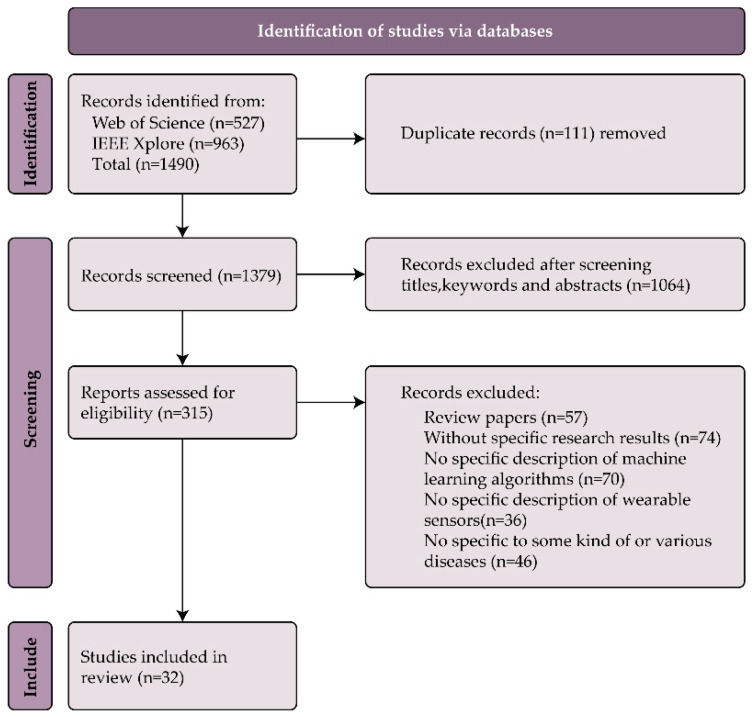
The integration of wearable sensor technology and machine learning algorithms has significantly transformed the field of intelligent medical rehabilitation. These innovative technologies enable the collection of valuable movement, muscle, or nerve data during the rehabilitation process, empowering medical professionals to evaluate patient recovery and predict disease development more efficiently. This systematic review aims to study the application of wearable sensor technology and machine learning algorithms in different disease rehabilitation training programs, obtain the best sensors and algorithms that meet different disease rehabilitation conditions, and provide ideas for future research and development. A total of 1490 studies were retrieved from two databases, the Web of Science and IEEE Xplore, and finally 32 articles were selected. In this review, the selected papers employ different wearable sensors and machine learning algorithms to address different disease rehabilitation problems. Our analysis focuses on the types of wearable sensors employed, the application of machine learning algorithms, and the approach to rehabilitation training for different medical conditions. It summarizes the usage of different sensors and compares different machine learning algorithms. It can be observed that the combination of these two technologies can optimize the disease rehabilitation process and provide more possibilities for future home rehabilitation scenarios. Finally, the present limitations and suggestions for future developments are presented in the study.

摘要

可穿戴传感器技术与机器学习算法的融合,极大地改变了智能医疗康复领域。这些创新技术使得在康复过程中能够收集有价值的运动、肌肉或神经数据,使医疗专业人员能够更有效地评估患者的康复情况和预测疾病的发展。本系统综述旨在研究可穿戴传感器技术和机器学习算法在不同疾病康复训练计划中的应用,获取满足不同疾病康复条件的最佳传感器和算法,并为未来的研究和开发提供思路。从两个数据库 Web of Science 和 IEEE Xplore 共检索到 1490 项研究,最终选择了 32 篇文章。在本综述中,所选论文采用不同的可穿戴传感器和机器学习算法来解决不同的疾病康复问题。我们的分析重点关注所使用的可穿戴传感器的类型、机器学习算法的应用以及针对不同医疗状况的康复训练方法。它总结了不同传感器的使用情况并比较了不同的机器学习算法。可以看出,这两种技术的结合可以优化疾病康复过程,并为未来的家庭康复场景提供更多的可能性。最后,在研究中提出了当前的局限性和对未来发展的建议。
https://cdn.ncbi.nlm.nih.gov/pmc/blobs/80db/10537628/70c6f25e16da/sensors-23-07667-g008.jpg
https://cdn.ncbi.nlm.nih.gov/pmc/blobs/80db/10537628/8c976fd8034d/sensors-23-07667-g001.jpg
https://cdn.ncbi.nlm.nih.gov/pmc/blobs/80db/10537628/d478925b935c/sensors-23-07667-g002.jpg
https://cdn.ncbi.nlm.nih.gov/pmc/blobs/80db/10537628/0a534c278805/sensors-23-07667-g003.jpg
https://cdn.ncbi.nlm.nih.gov/pmc/blobs/80db/10537628/c2beae51efd9/sensors-23-07667-g004.jpg
https://cdn.ncbi.nlm.nih.gov/pmc/blobs/80db/10537628/9781a878c688/sensors-23-07667-g005.jpg
https://cdn.ncbi.nlm.nih.gov/pmc/blobs/80db/10537628/2f7355ddb4a4/sensors-23-07667-g006.jpg
https://cdn.ncbi.nlm.nih.gov/pmc/blobs/80db/10537628/a0468db147e9/sensors-23-07667-g007.jpg
https://cdn.ncbi.nlm.nih.gov/pmc/blobs/80db/10537628/70c6f25e16da/sensors-23-07667-g008.jpg
https://cdn.ncbi.nlm.nih.gov/pmc/blobs/80db/10537628/8c976fd8034d/sensors-23-07667-g001.jpg
https://cdn.ncbi.nlm.nih.gov/pmc/blobs/80db/10537628/d478925b935c/sensors-23-07667-g002.jpg
https://cdn.ncbi.nlm.nih.gov/pmc/blobs/80db/10537628/0a534c278805/sensors-23-07667-g003.jpg
https://cdn.ncbi.nlm.nih.gov/pmc/blobs/80db/10537628/c2beae51efd9/sensors-23-07667-g004.jpg
https://cdn.ncbi.nlm.nih.gov/pmc/blobs/80db/10537628/9781a878c688/sensors-23-07667-g005.jpg
https://cdn.ncbi.nlm.nih.gov/pmc/blobs/80db/10537628/2f7355ddb4a4/sensors-23-07667-g006.jpg
https://cdn.ncbi.nlm.nih.gov/pmc/blobs/80db/10537628/a0468db147e9/sensors-23-07667-g007.jpg
https://cdn.ncbi.nlm.nih.gov/pmc/blobs/80db/10537628/70c6f25e16da/sensors-23-07667-g008.jpg

相似文献

1
The Application of Wearable Sensors and Machine Learning Algorithms in Rehabilitation Training: A Systematic Review.可穿戴传感器和机器学习算法在康复训练中的应用:系统评价。
Sensors (Basel). 2023 Sep 5;23(18):7667. doi: 10.3390/s23187667.
2
The Contribution of Machine Learning in the Validation of Commercial Wearable Sensors for Gait Monitoring in Patients: A Systematic Review.机器学习在验证商业可穿戴传感器用于监测患者步态中的作用:系统评价。
Sensors (Basel). 2021 Jul 14;21(14):4808. doi: 10.3390/s21144808.
3
Generalizable machine learning for stress monitoring from wearable devices: A systematic literature review.用于可穿戴设备压力监测的通用机器学习:系统文献综述
Int J Med Inform. 2023 May;173:105026. doi: 10.1016/j.ijmedinf.2023.105026. Epub 2023 Feb 28.
4
Development of prediction models for screening depression and anxiety using smartphone and wearable-based digital phenotyping: protocol for the Smartphone and Wearable Assessment for Real-Time Screening of Depression and Anxiety (SWARTS-DA) observational study in Korea.利用智能手机和可穿戴设备的数字表型开发抑郁症和焦虑症筛查预测模型:韩国抑郁症和焦虑症实时筛查智能手机与可穿戴设备评估(SWARTS-DA)观察性研究方案
BMJ Open. 2025 Jun 20;15(6):e096773. doi: 10.1136/bmjopen-2024-096773.
5
Health professionals' experience of teamwork education in acute hospital settings: a systematic review of qualitative literature.医疗专业人员在急症医院环境中团队合作教育的经验:对定性文献的系统综述
JBI Database System Rev Implement Rep. 2016 Apr;14(4):96-137. doi: 10.11124/JBISRIR-2016-1843.
6
Wearable Artificial Intelligence for Detecting Anxiety: Systematic Review and Meta-Analysis.可穿戴人工智能在焦虑检测中的应用:系统评价和荟萃分析。
J Med Internet Res. 2023 Nov 8;25:e48754. doi: 10.2196/48754.
7
Precision nutrition: A systematic literature review.精准营养:系统文献回顾。
Comput Biol Med. 2021 Jun;133:104365. doi: 10.1016/j.compbiomed.2021.104365. Epub 2021 Apr 7.
8
An insight into diagnosis of depression using machine learning techniques: a systematic review.利用机器学习技术进行抑郁症诊断的研究进展:系统综述。
Curr Med Res Opin. 2022 May;38(5):749-771. doi: 10.1080/03007995.2022.2038487. Epub 2022 Feb 17.
9
Interactive wearable systems for upper body rehabilitation: a systematic review.用于上肢康复的交互式可穿戴系统:一项系统综述。
J Neuroeng Rehabil. 2017 Mar 11;14(1):20. doi: 10.1186/s12984-017-0229-y.
10
Uses of Different Machine Learning Algorithms for Diagnosis of Dental Caries.不同机器学习算法在龋齿诊断中的应用。
J Healthc Eng. 2022 Mar 31;2022:5032435. doi: 10.1155/2022/5032435. eCollection 2022.

引用本文的文献

1
The Interplay Between Environment and Drug Effects: Decoding the Ecocebo Phenomenon with Virtual Technologies.环境与药物效应之间的相互作用:利用虚拟技术解读生态安慰剂现象。
Sensors (Basel). 2025 Aug 24;25(17):5268. doi: 10.3390/s25175268.
2
Development of an upper limb muscle strength rehabilitation assessment system using particle swarm optimisation.基于粒子群优化算法的上肢肌肉力量康复评估系统的开发。
Front Bioeng Biotechnol. 2025 Jul 9;13:1619411. doi: 10.3389/fbioe.2025.1619411. eCollection 2025.
3
Virtual reality-enhanced rehabilitation for improving musculoskeletal function and recovery after trauma.

本文引用的文献

1
The Methods of Fall Detection: A Literature Review.摔倒检测方法:文献综述。
Sensors (Basel). 2023 May 30;23(11):5212. doi: 10.3390/s23115212.
2
Inertial Sensors for Hip Arthroplasty Rehabilitation: A Scoping Review.髋关节置换康复用惯性传感器:范围综述。
Sensors (Basel). 2023 May 25;23(11):5048. doi: 10.3390/s23115048.
3
Sensor-Based Rehabilitation in Neurological Diseases: A Bibliometric Analysis of Research Trends.神经疾病中基于传感器的康复:研究趋势的文献计量分析
虚拟现实增强康复用于改善创伤后肌肉骨骼功能及恢复。
J Orthop Surg Res. 2025 Apr 23;20(1):404. doi: 10.1186/s13018-025-05705-3.
4
Systematic review of AI/ML applications in multi-domain robotic rehabilitation: trends, gaps, and future directions.多领域机器人康复中人工智能/机器学习应用的系统综述:趋势、差距与未来方向
J Neuroeng Rehabil. 2025 Apr 9;22(1):79. doi: 10.1186/s12984-025-01605-z.
5
Remote monitoring of Tai Chi balance training interventions in older adults using wearable sensors and machine learning.使用可穿戴传感器和机器学习对老年人太极拳平衡训练干预进行远程监测。
Sci Rep. 2025 Mar 26;15(1):10444. doi: 10.1038/s41598-025-93979-2.
6
Sliding-Window CNN + Channel-Time Attention Transformer Network Trained with Inertial Measurement Units and Surface Electromyography Data for the Prediction of Muscle Activation and Motion Dynamics Leveraging IMU-Only Wearables for Home-Based Shoulder Rehabilitation.基于惯性测量单元和表面肌电图数据训练的滑动窗口卷积神经网络+通道-时间注意力变压器网络,用于预测肌肉激活和运动动力学,利用仅含惯性测量单元的可穿戴设备进行居家肩部康复。
Sensors (Basel). 2025 Feb 19;25(4):1275. doi: 10.3390/s25041275.
7
Sensor-based technologies for motion analysis in sports injuries: a scoping review.用于运动损伤运动分析的基于传感器的技术:一项范围综述
BMC Sports Sci Med Rehabil. 2025 Jan 30;17(1):15. doi: 10.1186/s13102-025-01063-z.
8
Technologies and Sensors for Artificial Muscles in Rehabilitation.康复领域中用于人造肌肉的技术与传感器
Sensors (Basel). 2024 Nov 26;24(23):7532. doi: 10.3390/s24237532.
9
Remote Monitoring of Tai Chi Balance Training Interventions in Older Adults Using Wearable Sensors and Machine Learning.使用可穿戴传感器和机器学习对老年人太极拳平衡训练干预进行远程监测
Res Sq. 2024 Dec 2:rs.3.rs-5389927. doi: 10.21203/rs.3.rs-5389927/v1.
10
Evaluation of Rehabilitation Outcomes in Patients with Chronic Neurological Health Conditions Using a Machine Learning Approach.使用机器学习方法评估慢性神经健康状况患者的康复结果
J Funct Morphol Kinesiol. 2024 Sep 26;9(4):176. doi: 10.3390/jfmk9040176.
Brain Sci. 2023 Apr 26;13(5):724. doi: 10.3390/brainsci13050724.
4
A Comprehensive Review on Machine Learning in Healthcare Industry: Classification, Restrictions, Opportunities and Challenges.机器学习在医疗行业的全面综述:分类、限制、机遇和挑战。
Sensors (Basel). 2023 Apr 22;23(9):4178. doi: 10.3390/s23094178.
5
Development of a compensation-aware virtual rehabilitation system for upper extremity rehabilitation in community-dwelling older adults with stroke.开发一种具有补偿意识的虚拟康复系统,用于社区居住的脑卒中老年人上肢康复。
J Neuroeng Rehabil. 2023 May 1;20(1):56. doi: 10.1186/s12984-023-01183-y.
6
Automatic Assessments of Parkinsonian Gait with Wearable Sensors for Human Assistive Systems.基于可穿戴传感器的帕金森步态自动评估及其在人体辅助系统中的应用。
Sensors (Basel). 2023 Feb 13;23(4):2104. doi: 10.3390/s23042104.
7
A Wireless Multi-Layered EMG/MMG/NIRS Sensor for Muscular Activity Evaluation.一种用于肌肉活动评估的无线多层肌电图/肌音图/近红外光谱传感器。
Sensors (Basel). 2023 Jan 31;23(3):1539. doi: 10.3390/s23031539.
8
Retropulsion with tilted postural vertical causing backward falls in an individual with Parkinson's disease: Improvement by specific rehabilitation.帕金森病患者因姿势垂直倾斜导致向后跌倒的后冲现象:通过特定康复治疗得到改善
Ann Phys Rehabil Med. 2023 May;66(4):101728. doi: 10.1016/j.rehab.2022.101728. Epub 2023 Jan 14.
9
Sensor selection and miniaturization limits for detection of interictal epileptiform discharges with wearable EEG.可穿戴 EEG 检测癫痫发作间期放电的传感器选择和小型化限制
J Neural Eng. 2023 Feb 14;20(1). doi: 10.1088/1741-2552/acb231.
10
A Clinical Perspective on Bespoke Sensing Mechanisms for Remote Monitoring and Rehabilitation of Neurological Diseases: Scoping Review.定制化传感机制在神经疾病远程监测与康复中的临床应用视角:范围综述。
Sensors (Basel). 2023 Jan 3;23(1):536. doi: 10.3390/s23010536.