Department of Cardiology, Shanghai Institute of Cardiovascular Diseases, Zhongshan Hospital Fudan University, Shanghai 710032, China.
National Clinical Research Center for Interventional Medicine, Shanghai 200032, China.
J Mol Cell Biol. 2024 Apr 4;15(9). doi: 10.1093/jmcb/mjad056.
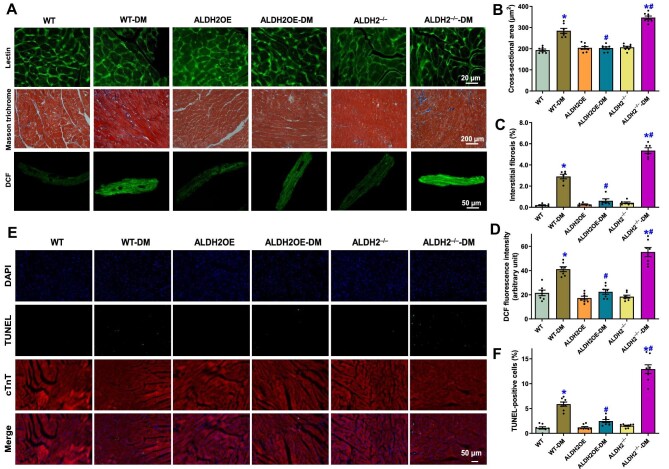
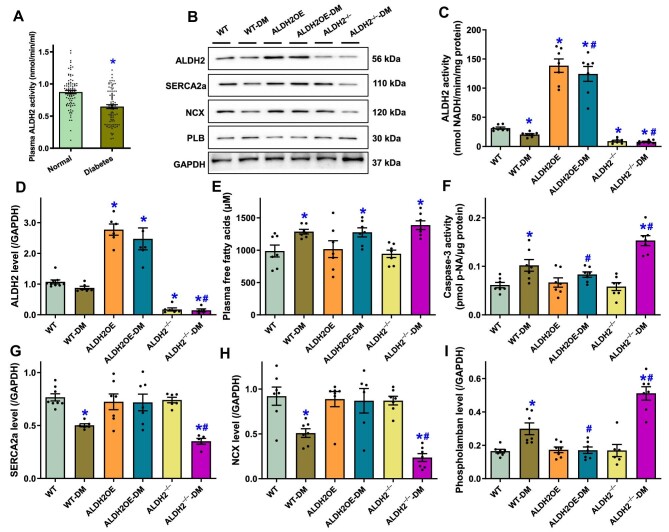
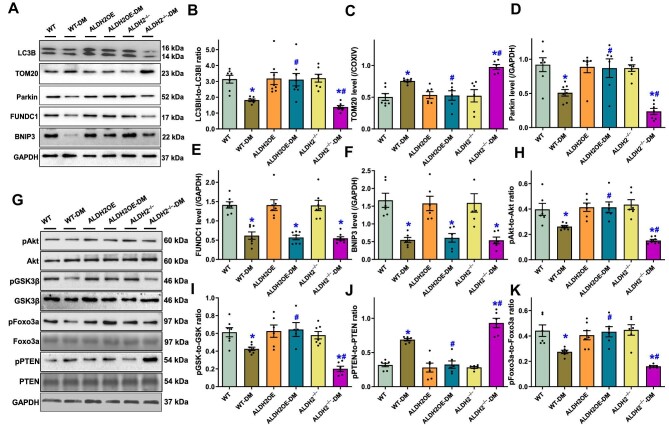
Mitochondrial aldehyde dehydrogenase (ALDH2) offers proven cardiovascular benefit, although its impact on diabetes remains elusive. This study examined the effects of ALDH2 overexpression and knockout on diabetic cardiomyopathy and the mechanism involved with a focus on mitochondrial integrity. Mice challenged with streptozotocin (STZ, 200 mg/kg, via intraperitoneal injection) exhibited pathological alterations, including reduced respiratory exchange ratio, dampened fractional shortening and ejection fraction, increased left ventricular end-systolic and diastolic diameters, cardiac remodeling, cardiomyocyte contractile anomalies, intracellular Ca2+ defects, myocardial ultrastructural injury, oxidative stress, apoptosis, and mitochondrial damage, which were overtly attenuated or accentuated by ALDH2 overexpression or knockout, respectively. Diabetic patients also exhibited reduced plasma ALDH2 activity, cardiac remodeling, and diastolic dysfunction. In addition, STZ challenge altered expression levels of mitochondrial proteins (PGC-1α and UCP2) and Ca2+ regulatory proteins (SERCA, Na+-Ca2+ exchanger, and phospholamban), dampened autophagy and mitophagy (LC3B ratio, TOM20, Parkin, FUNDC1, and BNIP3), disrupted phosphorylation of Akt, GSK3β, and Foxo3a, and elevated PTEN phosphorylation, most of which were reversed or worsened by ALDH2 overexpression or knockout, respectively. Furthermore, the novel ALDH2 activator torezolid, as well as the classical ALDH2 activator Alda-1, protected against STZ- or high glucose-induced in vivo or in vitro cardiac anomalies, which was nullified by inhibition of Akt, GSK3β, Parkin, or mitochondrial coupling. Our data discerned a vital role for ALDH2 in diabetic cardiomyopathy possibly through regulation of Akt and GSK3β activation, Parkin mitophagy, and mitochondrial function.
线粒体乙醛脱氢酶 (ALDH2) 已被证实具有心血管益处,但其对糖尿病的影响仍不清楚。本研究探讨了 ALDH2 过表达和敲除对糖尿病心肌病的影响及其作用机制,重点关注线粒体完整性。用链脲佐菌素 (STZ,200mg/kg,腹腔注射) 处理的小鼠表现出病理改变,包括呼吸交换率降低、分数缩短和射血分数减弱、左心室收缩末期和舒张末期直径增大、心脏重构、心肌收缩异常、细胞内 Ca2+ 缺陷、心肌超微结构损伤、氧化应激、细胞凋亡和线粒体损伤,这些改变分别被 ALDH2 过表达或敲除明显减轻或加重。糖尿病患者还表现出血浆 ALDH2 活性降低、心脏重构和舒张功能障碍。此外,STZ 处理改变了线粒体蛋白 (PGC-1α 和 UCP2) 和 Ca2+ 调节蛋白 (SERCA、Na+-Ca2+ 交换体和磷蛋白) 的表达水平,减弱了自噬和线粒体自噬 (LC3B 比值、TOM20、Parkin、FUNDC1 和 BNIP3),破坏了 Akt、GSK3β 和 Foxo3a 的磷酸化,并增加了 PTEN 的磷酸化,这些改变大部分被 ALDH2 过表达或敲除分别逆转或加重。此外,新型 ALDH2 激活剂托瑞佐利德以及经典的 ALDH2 激活剂 Alda-1 可预防 STZ 或高葡萄糖诱导的体内或体外心脏异常,该作用被 Akt、GSK3β、Parkin 或线粒体偶联的抑制所消除。我们的数据表明,ALDH2 在糖尿病心肌病中可能发挥重要作用,其作用机制可能涉及 Akt 和 GSK3β 激活、Parkin 线粒体自噬和线粒体功能的调节。