Chandnani Rahul, Qin Tongfei, Ye Heng, Hu Haifei, Panjvani Karim, Tokizawa Mutsutomo, Macias Javier Mora, Medina Alma Armenta, Bernardino Karine, Pradier Pierre-Luc, Banik Pankaj, Mooney Ashlyn, V Magalhaes Jurandir, T Nguyen Henry, Kochian Leon V
Global Institute for Food Security, University of Saskatchewan, Saskatoon, SK, Canada.
NRGene Canada, 110 Research Dr Suite 101, Saskatoon, SK, Canada.
Plant Phenomics. 2023 Sep 28;5:0097. doi: 10.34133/plantphenomics.0097. eCollection 2023.
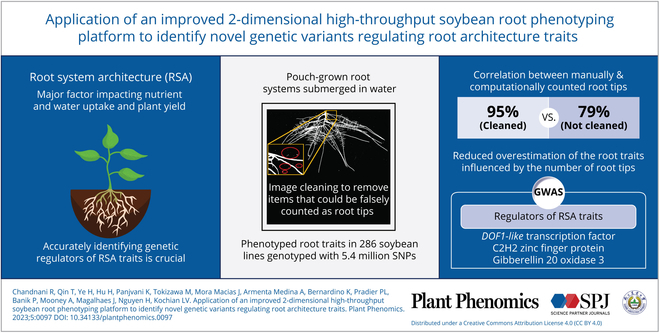
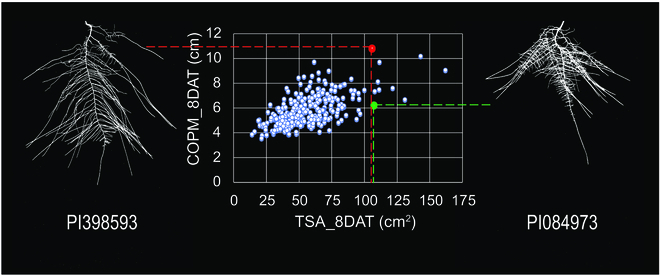
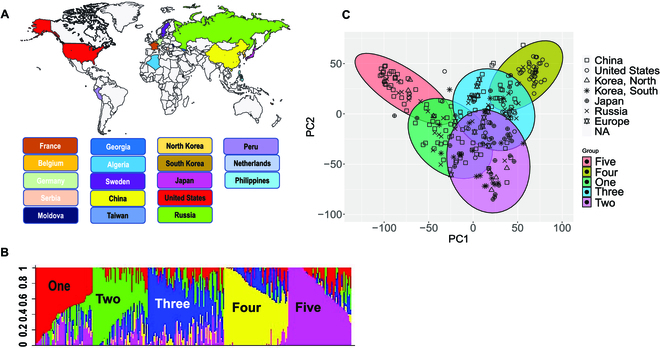
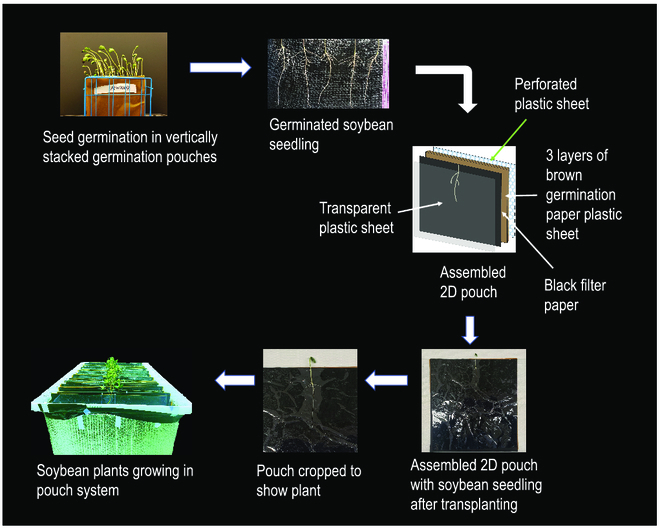
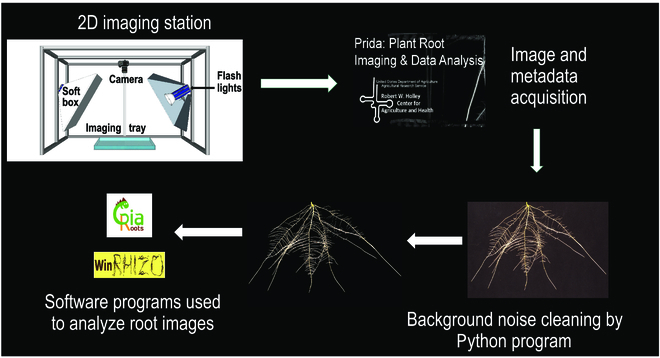
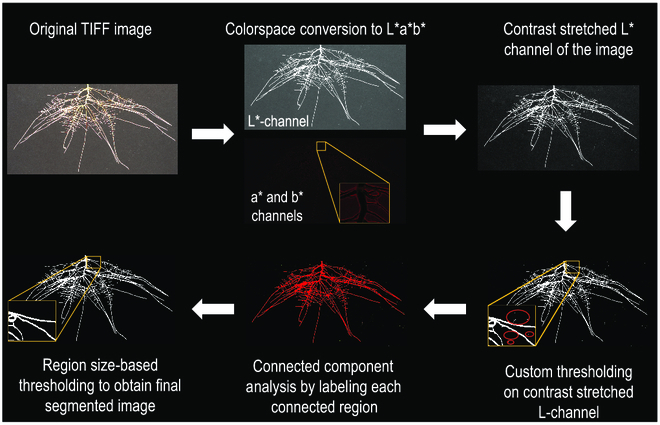
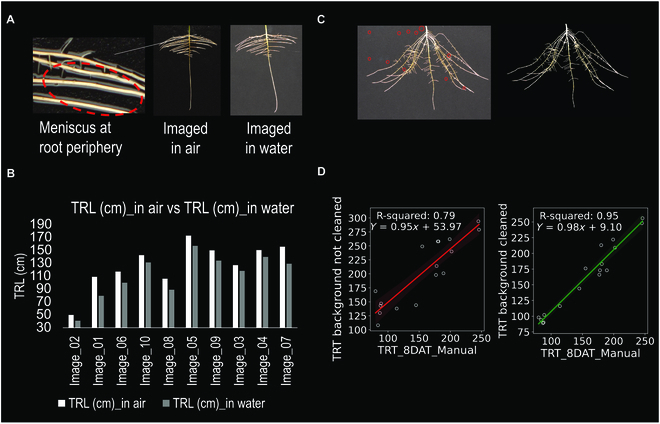
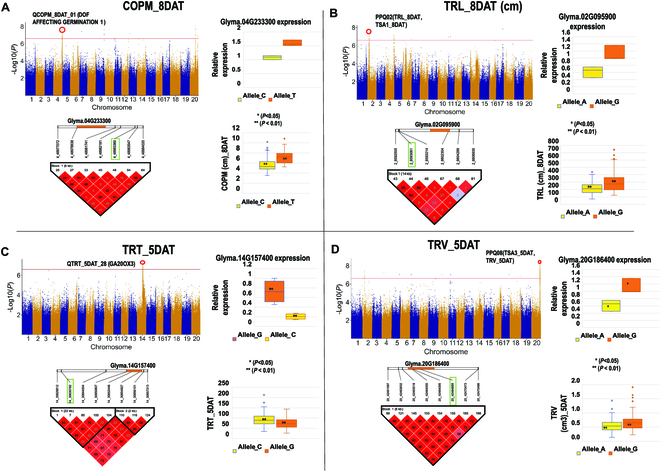
Nutrient-efficient root system architecture (RSA) is becoming an important breeding objective for generating crop varieties with improved nutrient and water acquisition efficiency. Genetic variants shaping soybean RSA is key in improving nutrient and water acquisition. Here, we report on the use of an improved 2-dimensional high-throughput root phenotyping platform that minimizes background noise by imaging pouch-grown root systems submerged in water. We also developed a background image cleaning Python pipeline that computationally removes images of small pieces of debris and filter paper fibers, which can be erroneously quantified as root tips. This platform was used to phenotype root traits in 286 soybean lines genotyped with 5.4 million single-nucleotide polymorphisms. There was a substantially higher correlation in manually counted number of root tips with computationally quantified root tips (95% correlation), when the background was cleaned of nonroot materials compared to root images without the background corrected (79%). Improvements in our RSA phenotyping pipeline significantly reduced overestimation of the root traits influenced by the number of root tips. Genome-wide association studies conducted on the root phenotypic data and quantitative gene expression analysis of candidate genes resulted in the identification of 3 putative positive regulators of root system depth, total root length and surface area, and root system volume and surface area of thicker roots ( zinc finger transcription factor, protein of unknown function, and C2H2 zinc finger protein). We also identified a putative negative regulator (gibberellin 20 oxidase 3) of the total number of lateral roots.
营养高效的根系结构(RSA)正成为培育具有更高养分和水分获取效率作物品种的重要育种目标。塑造大豆RSA的基因变异是提高养分和水分获取的关键。在此,我们报告了一种改进的二维高通量根系表型分析平台的应用,该平台通过对浸没在水中的袋培根系进行成像,将背景噪声降至最低。我们还开发了一个背景图像清理Python程序,通过计算去除小碎片和滤纸纤维的图像,这些图像可能会被错误地量化为根尖。该平台用于对286个大豆品系的根系性状进行表型分析,这些品系通过540万个单核苷酸多态性进行了基因分型。与未校正背景的根系图像相比(79%),当去除非根系物质的背景后,人工计数的根尖数量与通过计算量化的根尖数量之间的相关性显著更高(95%)。我们的RSA表型分析程序的改进显著减少了受根尖数量影响的根系性状的高估。对根系表型数据进行全基因组关联研究以及对候选基因进行定量基因表达分析,结果鉴定出3个根系深度、总根长和表面积、较粗根系的根系体积和表面积的假定正调控因子(锌指转录因子、功能未知蛋白和C2H2锌指蛋白)。我们还鉴定出一个侧根总数的假定负调控因子(赤霉素20氧化酶3)。