Centre for Palaeogenetics, Svante Arrhenius väg 20C, SE-10691 Stockholm, Sweden.
Department of Zoology, Stockholm University, SE-10691 Stockholm, Sweden.
Science. 2023 Oct 6;382(6666):48-53. doi: 10.1126/science.adh7943. Epub 2023 Oct 5.
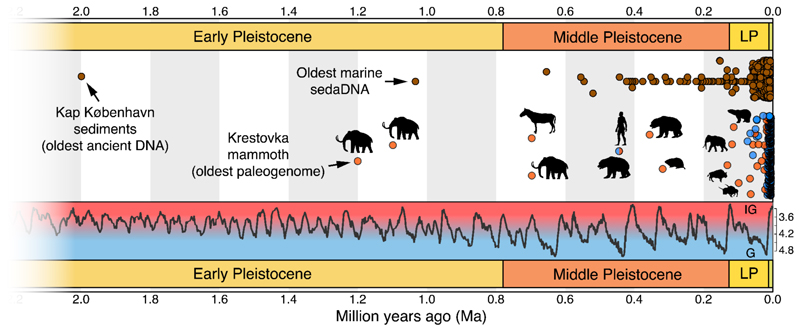
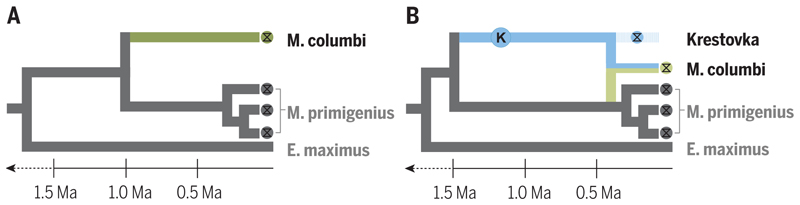
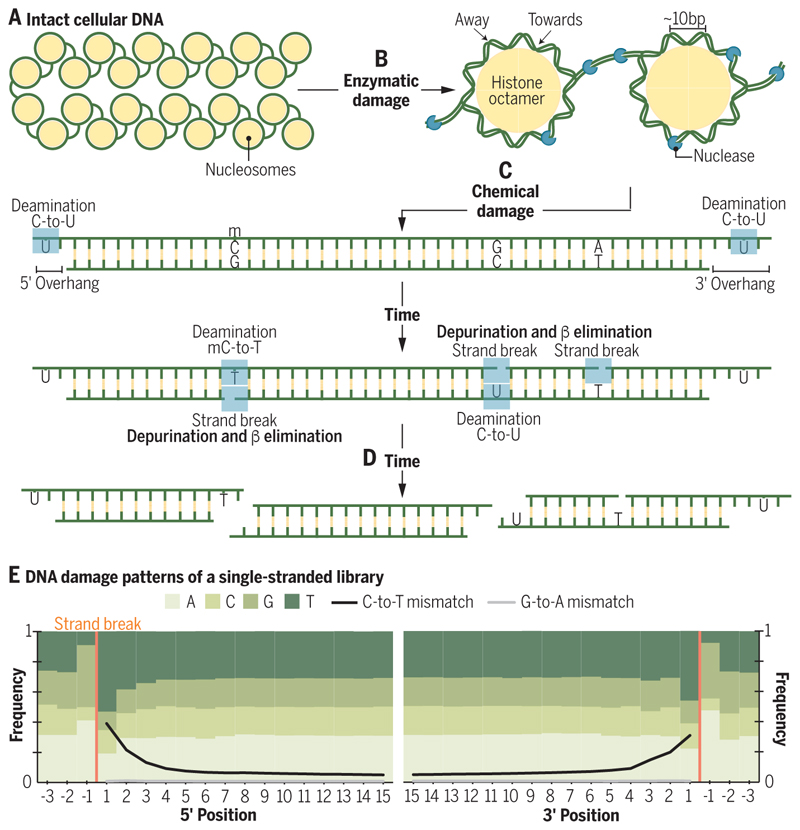
Although most ancient DNA studies have focused on the last 50,000 years, paleogenomic approaches can now reach into the early Pleistocene, an epoch of repeated environmental changes that shaped present-day biodiversity. Emerging deep-time genomic transects, including from DNA preserved in sediments, will enable inference of adaptive evolution, discovery of unrecognized species, and exploration of how glaciations, volcanism, and paleomagnetic reversals shaped demography and community composition. In this Review, we explore the state-of-the-art in paleogenomics and discuss key challenges, including technical limitations, evolutionary divergence and associated biases, and the need for more precise dating of remains and sediments. We conclude that with improvements in laboratory and computational methods, the emerging field of deep-time paleogenomics will expand the range of questions addressable using ancient DNA.
尽管大多数古 DNA 研究都集中在过去的 5 万年,但古基因组学方法现在可以追溯到更新世早期,这是一个环境变化反复的时代,塑造了当今的生物多样性。新兴的深层时间基因组横切,包括从沉积物中保存的 DNA 中获得的信息,将能够推断适应性进化,发现未被识别的物种,并探索冰川作用、火山作用和古地磁反转如何塑造人口和群落组成。在这篇综述中,我们探讨了古基因组学的最新进展,并讨论了关键挑战,包括技术限制、进化分歧和相关偏差,以及更精确地确定遗骸和沉积物年代的必要性。我们的结论是,随着实验室和计算方法的改进,新兴的深层时间古基因组学领域将扩大使用古 DNA 解决问题的范围。