Taylor Jayce E, Palur Dileep Sai Kumar, Zhang Angela, Gonzales Jake N, Arredondo Augustine, Coulther Timothy A, Lechner Amiruddin Bin Johan, Rodriguez Elys P, Fiehn Oliver, Didzbalis John, Siegel Justin B, Atsumi Shota
Department of Chemistry, University of California, Davis, Davis, CA, 95616, USA.
Plant Biology Graduate Group, University of California, Davis, Davis, CA, 95616, USA.
NPJ Sci Food. 2023 Oct 14;7(1):54. doi: 10.1038/s41538-023-00231-0.
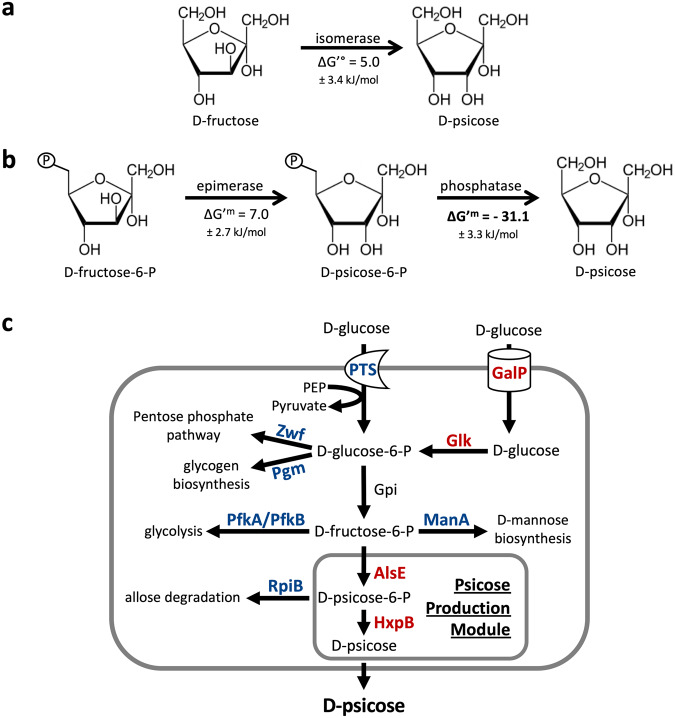
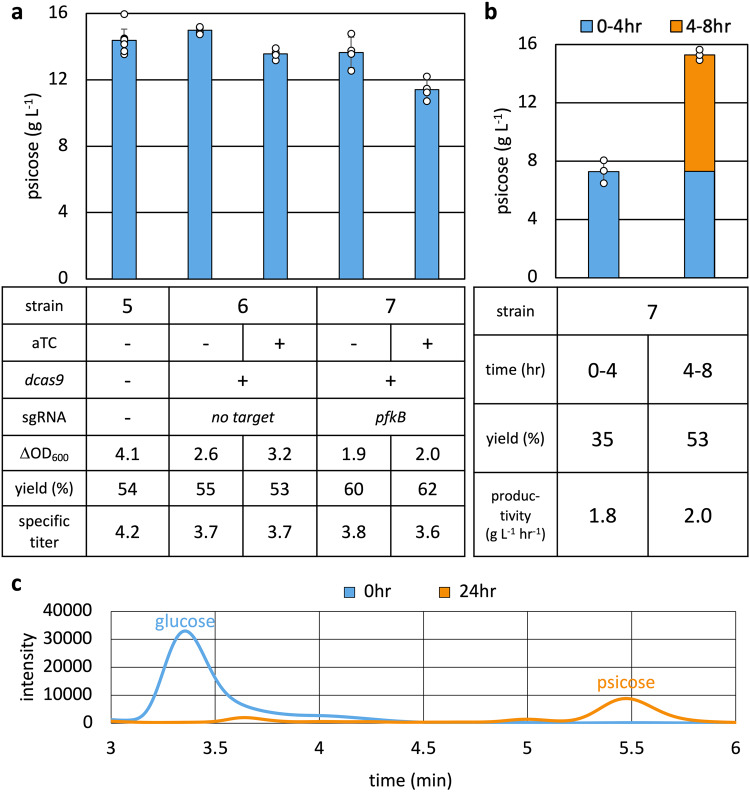
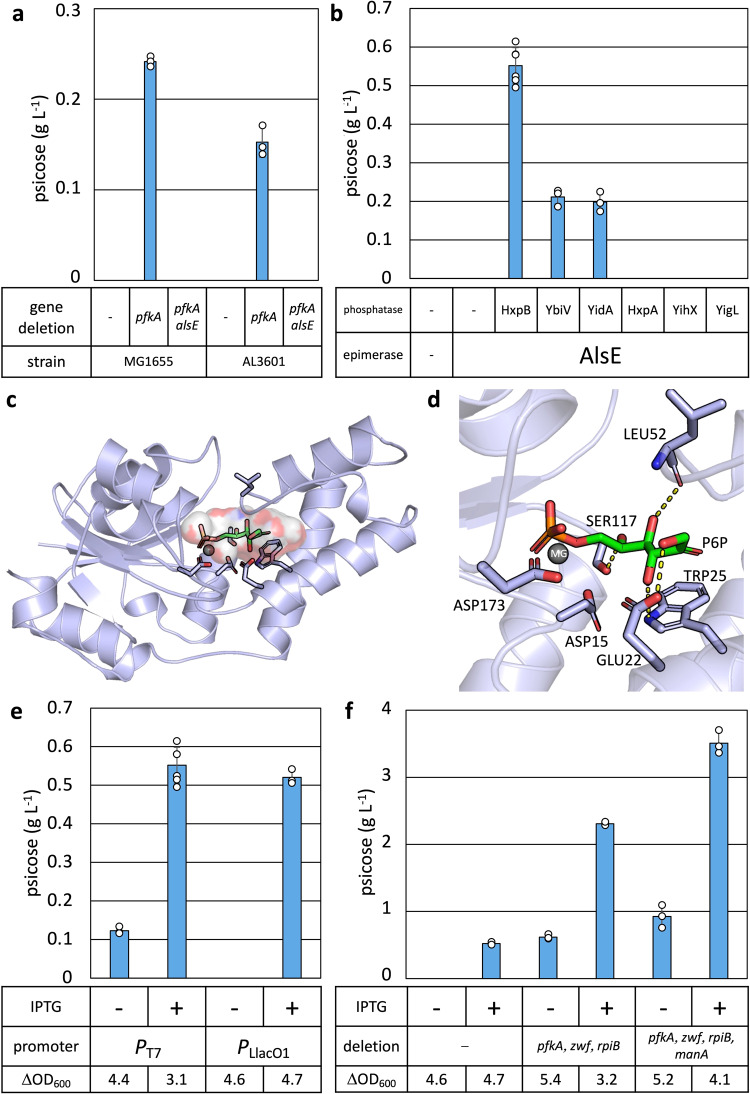
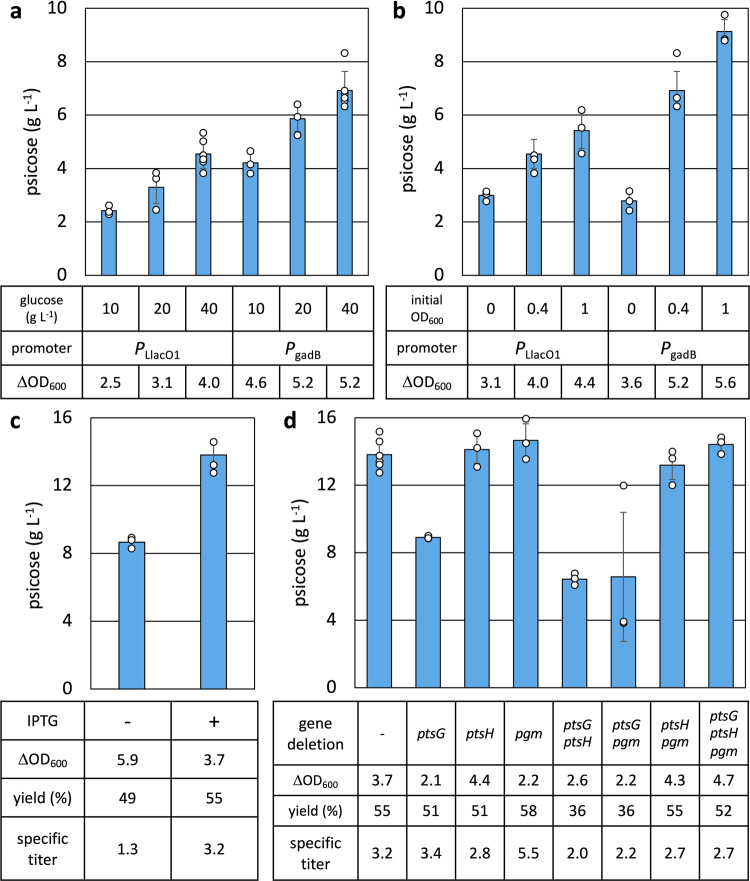
Due to the rampant rise in obesity and diabetes, consumers are desperately seeking for ways to reduce their sugar intake, but to date there are no options that are both accessible and without sacrifice of palatability. One of the most promising new ingredients in the food system as a non-nutritive sugar substitute with near perfect palatability is D-psicose. D-psicose is currently produced using an in vitro enzymatic isomerization of D-fructose, resulting in low yield and purity, and therefore requiring substantial downstream processing to obtain a high purity product. This has made adoption of D-psicose into products limited and results in significantly higher per unit costs, reducing accessibility to those most in need. Here, we found that Escherichia coli natively possesses a thermodynamically favorable pathway to produce D-psicose from D-glucose through a series of phosphorylation-epimerization-dephosphorylation steps. To increase carbon flux towards D-psicose production, we introduced a series of genetic modifications to pathway enzymes, central carbon metabolism, and competing metabolic pathways. In an attempt to maximize both cellular viability and D-psicose production, we implemented methods for the dynamic regulation of key genes including clustered regularly interspaced short palindromic repeats inhibition (CRISPRi) and stationary-phase promoters. The engineered strains achieved complete consumption of D-glucose and production of D-psicose, at a titer of 15.3 g L, productivity of 2 g L h, and yield of 62% under test tube conditions. These results demonstrate the viability of whole-cell catalysis as a sustainable alternative to in vitro enzymatic synthesis for the accessible production of D-psicose.
由于肥胖和糖尿病的急剧增加,消费者迫切寻求降低糖分摄入的方法,但迄今为止,尚无既容易获得又不牺牲口感的选择。作为一种具有近乎完美口感的非营养性糖替代品,D-阿洛酮糖是食品系统中最有前景的新成分之一。目前,D-阿洛酮糖是通过D-果糖的体外酶促异构化生产的,产量和纯度较低,因此需要大量的下游加工才能获得高纯度产品。这使得D-阿洛酮糖在产品中的应用受到限制,导致单位成本显著提高,降低了最需要者的可及性。在此,我们发现大肠杆菌天然拥有一条热力学上有利的途径,可通过一系列磷酸化-差向异构化-去磷酸化步骤从D-葡萄糖生产D-阿洛酮糖。为了增加碳通量以生产D-阿洛酮糖,我们对途径酶、中心碳代谢和竞争性代谢途径进行了一系列基因改造。为了使细胞活力和D-阿洛酮糖产量最大化,我们实施了包括成簇规律间隔短回文重复序列抑制(CRISPRi)和稳定期启动子在内的关键基因动态调控方法。在试管条件下,工程菌株实现了D-葡萄糖的完全消耗和D-阿洛酮糖的生产,滴度为15.3 g/L,生产力为2 g/L·h,产率为62%。这些结果证明了全细胞催化作为一种可持续替代体外酶促合成的方法,用于可及地生产D-阿洛酮糖的可行性。